| The Colbert Report | Mon - Thurs 11:30pm / 10:30c | |||
| Michael Reynolds | ||||
| ||||
Monday, March 30, 2009
Garbage Warrior, Mike Reynolds & Stephen Colbert
Posted by
Keith Johnson
at
12:03 AM
0
comments
Labels: Building With Garbage, Colbert Report, Garbage Homes, Green Living, Green News, Green Technology, Michael Reynolds, Stephen Colbert
Sunday, March 29, 2009
Guerrilla Gardening, Veggie Vandalism
Posted by
Keith Johnson
at
11:57 PM
0
comments
Labels: gurerilla gardening
Tuesday, March 24, 2009
Bicycle add-ons for toting and schlepping
Previously we had considered the multitude of options for different kinds of bikes especially designed to do work. Now we'll take a look at suppliers of bicycle add-ons to make any bike more useful and practical.
Rivendell Bicycle Works, Walnut Creek, California Our mission is to make things that wouldn't be made if we weren't here, to offer an alternative to racing-centric bikes and parts, and to espouse a different approach to riding. And to resurrect and keep healthy many of the better ideas, designs, and styles of bicycles, clothing, and accessories that we personally like to use or wear. If you'd like to know more, just ask. It's not a secret business we have here. -Grant
The CARGO is Tubus's all-purpose rear rack. The most popular, most versatile, the one that carries a basket best, if that matters to you, and the one to get unless you have heel clearance problems with most racks.
The Sackville Saddlesack sits level, is easy to load & it never spills, tough as rocks but looks natty, has two outside pockets you can access while riding, and a snap-offable flap pocket so you can take your wallet-keys-cell phone with you when you leave your bike for a bit.
These folks in New Orleans have a good selection of bike bags and supplies.
Peter White Cycles 24 Hall Rd. Hillsborough, NH 03244 603 478 0900 (Phone) 603 478 0902 (Phax)
While we specialize in the touring and tandem arena, we also cater to road racing and cross country off road cyclists. Much of our own cycling is off road, though my wife and I both enjoy road riding on our singles as well as on our Co-Motion tandem.
We offer products that make the practical use of the bicycle easier and safer. As gasoline prices keep rising, making the use of automobiles less viable, properly equipped bicycles offer an environmentally friendly alternative. While some people can't use a bicycle for their everyday transportation, many others can. And in time, many more will have no choice but to alter their lifestyles so as to include bicycles for transportation. But many people don't know that good lights are available to make riding at night much safer, or that studded tires and special clothing are available that make riding in the winter or rain both safer and more fun. That's why we're here.
Wald Bicycle Baskets, in Maysville, KY, were not the first product Wald invented. Rather, it was a bicycle tire repair tool. But it didn't take long for Grandpa Ewald and Uncle Herman to recognize what a difference the bicycle basket could be. No other domestic bicycle parts manufacturer comes close to our longevity. When you purchase or use our products, you too become an integral part of that legacy. Thank you for your interest in our products. We hope you find something you need, or even better, something you like.
Nashbar Bike P.0. Box 1455 Crab Orchard, WV 25827 


Arkel - Bike racks, panniers, clothing and more. Dealers in the USA, Canada, UK, France, Germany, Australia, and Africa.
Posted by
Keith Johnson
at
9:38 PM
1 comments
Labels: bicycle panniers, bicycle racks, bicycles baskets
Tuesday, March 17, 2009
A Farm for the Future
Wildlife film maker Rebecca Hosking investigates how to transform her family's farm in Devon into a low energy farm for the future, and discovers that nature holds the key. With her father close to retirement, Rebecca returns to her family's wildlife-friendly farm in Devon, to become the next generation to farm the land.
But last year's high fuel prices were a wake-up call for Rebecca. Realising that all food production in the UK is completely dependent on abundant cheap fossil fuel, particularly oil, she sets out to discover just how secure this oil supply is. Alarmed by the answers, she explores ways of farming without using fossil fuel. With the help of pioneering farmers and growers, Rebecca learns that it is actually nature that holds the key to farming in a low-energy future.
The following from Tree Hugger:
Film Maker Explores Post-Oil Farming
Last week I wrote about a BBC documentary which I hadn't seen, but the green scene in the UK was all a flutter over. A Farm for the Future explores nature film maker
Rebecca Hosking's return to her small family farm and her search for a post-fossil fuel agriculture. I've since seen the film, and would recommend it to anyone with an interest in food and farming - come to think of it, I'd recommend it to anyone who eats. But for those without the time or means to watch it, Rebecca has also written an excellent article in the Daily Mail newspaper about her quest for truly sustainable agriculture.
Rebecca's work (who incidentally is also responsible for a plastic bag ban in her home town!) is not just remarkable for the content she is covering - but the venues in which it is being aired too. To have a half-hour documentary devoted to peak oil, agriculture and alternatives like forest gardening and permaculture appear on prime time BBC is a telling sign of the times. But to also have an article in the Daily Mail - hardly the bastion of environmental radicalism - is dynamite.
There is no doubt in my mind that Rebecca is opening a lot of eyes to the unsustainability of our present food system. Take this excerpt from Rebecca's conversation with permaculture guru Patrick Whitefield [Disclaimer: Patrick is a former teacher and friend of mine]:
But it will work only if we have a lot more growers. Some reports estimate it's going to take as many as 12 million, although currently we have 11million gardeners. A food-growing system based on natural ecology appeals to my naturalist side. But the farmer's daughter in me needed a bit more convincing. Could permaculture feed Britain? I asked Patrick Whitefield, Britain's leading expert in permaculture.'Good question,' he said. 'A better question would be, "Can present methods go on feeding Britain?" In the long term, it is certain that present methods can't because they are so entirely dependent on fossil-fuel energy. So we haven't got any choice other than to find something different.'
The more permaculture people I met, the more hopeful I became that we can find a way out of this mess if we start preparing for peak oil now.
Along the way, Rebecca also meets Ben and Charlotte Hollins - the brother and sister team who now run the innovative Fordhall Farm in Shropshire - and talks about their nature-based no-till pasture system; she talks with peak oil experts Richard Heinberg and Colin Campbell; visits Martin Crawford of the Agroforestry Research Trust and explores the small holding of Chris and Lynn Dixon - who have pioneered their low input, biodiverse permaculture-based land management techniques in the hills of Wales for years.
For folks like me who have long followed permaculture and other sustainable, but often marginalized, food movements, it's really incredible to see voices like this getting a wide and receptive audience. Now we just have to see how many folks are willing to roll up their sleeves, get their hands dirty, and start planting.
Posted by
Keith Johnson
at
10:34 PM
1 comments
Labels: Food and Farming Transition, Permaculture, transition
Wednesday, March 11, 2009
MORE Work Bikes!
From Yuba Bikes the Mundo cargo bike: Yuba was launched in 2006 to build and provide affordable mobility solutions with a particular emphasis on distributing them to those most in need. The founders of Yuba came together to advance economic and social development, to promote self-reliance, and to emphasize better environmental awareness and lifestyle choices – all through the use of bicycles. Because bicycles are one of the most energy efficient, financially affordable, mechanically reliable, and environmentally friendly vehicles, we believe that a more bike-centric world makes for a better world, a more connected world.
Designed for maximum bicycle mobility, the all-terrain Mundo offers an affordable and sustainable alternative for:
environmentally friendly transportation
economic viability
unsurpassed cargo capacity
the ability to carry passengers
affordable mobility
See Worldbike for "open-source" bicycle designs: "Worldbike is an international network of bicycle designers and industry leaders, and international development professionals, working together to provide transportation solutions and create income-generating opportunities for the world’s poor. All across the developing world, people use bicycles the way we use pickup trucks and school buses. However, the bicycles sold in developing countries are those designed for recreation and are ill-suited to carrying loads. Worldbike designs higher-strength, longer-wheelbase bicycles with integrated cargo capacity. We conduct trial markets to determine the ideal price levels, work with the bike industry to get the best quality parts and frames at the lowest cost, and partner with international development organizations like Kickstart International to sell and distribute the bicycles..."
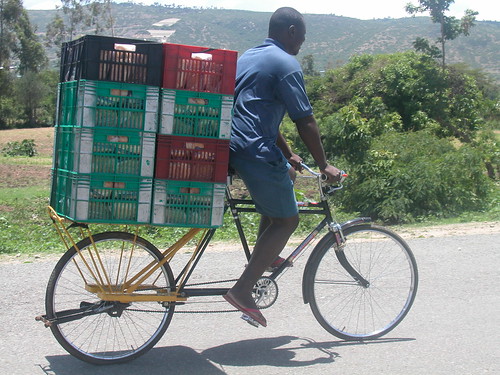
"The bicycle is the most efficient transportation device yet invented. Trouble is, modern bicycle design has been far more influenced by the needs of racers than by the needs of everyday riders like you. The result: your bike is compact, light, and strong, but it doesn’t have a good place to carry a week’s groceries, waterproof storage capacity, or a good seat for a passenger. Xtracycle solves these problems.
Imagine your favorite bike with the rear wheel stretched out behind the seat, a big, stable platform for a load or a passenger, and elegant saddlebags on either side that are expandable when you need them and are cleanly out of the way when you don’t. Best of all, your bike is still lightweight and fast, and because the load is centered between your two wheels, the whole package handles with ease. Suddenly you have much less need or desire to drive around town for your errands. Picture this: riding breezily unloaded to your favorite grocery store, coasting reliably around corners; arriving ahead of traffic; parking at the rack directly in front of the entrance; shopping and easily loading your four bags of groceries; then pedaling home, care-free on a bike that handles just as swiftly now that it’s loaded."
WorkCycles: Transport bike, cargo trike & handmade Dutch city bike specialist[These are beautiful and VERY functional bikes. Visit their site for a view of many other styles-KJ]
WorkCycles is the specialist in quality utility bicycles for commercial, family and personal use. We develop our own models and also sell bikes from Azor, Bakfiets.nl, De Redding, Monark, Nijland, Onderwater and others. WorkCycles bicycles are known for their timeless design, top quality and attention to detail. Whether you need a bike to safely carry your children, a classic Dutch city bike or tough industrial bikes we we've got it.
OMG! It carries 12 kids!
Look into The International Bicycle Fund especially their page on (work bikes): A non-governmental, nonprofit, advocacy organization, providing information and resources promoting sustainable transport and international understanding to make this planet a healthier and happier place to live. Major areas of activity are non-motorized urban planning, economic development, bike safety education, responsible travel and bicycle tourism, and cross-cultural, educational programs.Bicycle Taxis are becoming popular in NY and other cities:
BicyTaxi NYC Pedicabs – Word Spreads Fast!
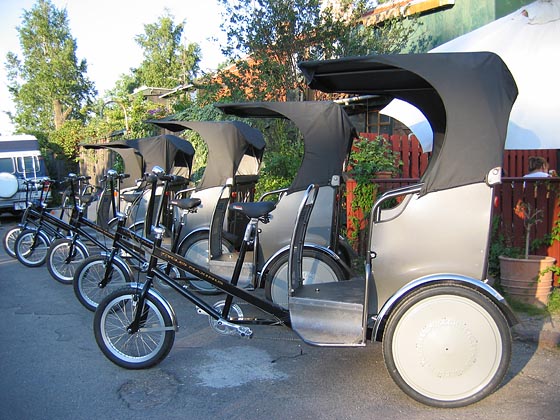
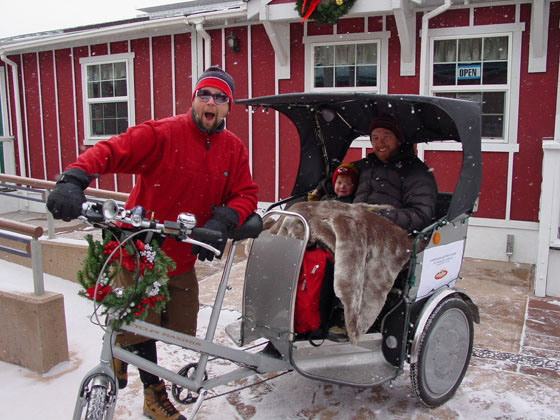
BicyTaxi has fast become a common sight in many environmentally-conscious cities worldwide. Because our cities are becoming increasingly crowded and busy, we must consider new and innovative concepts in order to maintain, or even improve, the quality of life for residents. Bicytaxi is the ideal solution to these problems as it ecologically and efficiently reduces urban emissions and therefore pollution. Urban transportation is enhanced through a flexible and reliable mobility system. BicyTaxi pedicabs which are similar to a rickshaw or riksha, however, are not only excellent means of transport for urban areas but also excel at events. They may further be used as a shuttle service and are, of course, one of the best and most effective advertising media in the outdoor sector.
In the UK look for pedi-cabs at Cycles Maximus Ltd
"We set out to build a high capacity tricycle that provides a practical, environmentally friendly solution to your local transport needs. The modular construction offers a wide choice of applications, pioneering design and craftsmanship combine to provide a viable alternative to the internal combustion engine."
(France)

In Germany:


In India:
Present activities are in sustainable transport, lighting , environment pollution abatement, handicapped rickshaw, etc. Improved pedal rickshaw (IMPRA) |


(In Florida)

(In Colorado)


And, it turns out, many more. See the complete list at
http://www.ibike.org/economics/pedicab-manufacturers.htm
Posted by
Keith Johnson
at
6:51 PM
2
comments
Labels: bikes, human-powered, work bikes
Work Bikes for a Low-Energy Future
In a previous post I featured Bikes At Work's trailers for converting your bike to a work bike. These will undoubtedly become a primary means of transport as the economy shifts to a post-petroleum future...(watch for more donkeys and horses, too.) Here's a few more sources for work bikes: 

Worksman Bikes: I first learned about these folks through CoEvolution Quarterly (Whole Earth Review): "Worksman Cycles has long been known as the world-leader in Industrial Cycles (Bicycles and Tricycles). Today
m
ore than ever, leading companies call upon our Worksman Business Cycle System to safely and efficiently move key personnel and supplies within large industrial facilities. Our customer list is incredibly diverse and impressive, featuring the world's largest and most respected companies. These companies know that for durable, emission-free transportation, Worksman Business Cycles are the only smart choice." The vegetable delivery cart (which I'd love to have) and the hand-pedaled bike are very cool.


International Surrey Co., LTD: "Offering the finest four (4) wheel Surrey bikes in the world. No other Surrey bicycle company has rented, distributed and manufactured these distinctive four wheel bicycles. Our pledge is to continue to offer innovative two person and four person four wheel Surrey bikes for your business or home and CYCLES THAT MOVE YOU™."


Check out this Wiki page featuring work bikes from around the planet, many of them homemade.
Posted by
Keith Johnson
at
5:26 PM
5
comments
Labels: bicycle powered, human-powered, work bikes
Tuesday, March 3, 2009
Collapse IS the Solution
More books are cropping up with solutions to the crumbling of Empire. Not surprisingly, many of them are suggesting that the collapse of empire IS the solution. The challenge, of course, is to survive and maybe even thrive on a low-energy solar budget. Here's one you can read online:
A Matter of Scale by Keith Farnish
A Book, A Solution, A Future
"For hundreds of millennia, humans connected tightly to the land and the life forms their survival depended upon, because that was how it had to be. Failure to connect was not an option; if you didn’t know how plants grew, how animals bred, how rivers ran, how the seasons and the weather changed, then you did not survive. In some parts of the world – the Native American tribal lands of West Coast USA, the dense forests of West Papua, the deep valleys and jagged mountains of northern India – these connections remain, and cling on despite the best efforts of those who seek to gain more from the land than 'mere' survival. This connection has ebbed away from the majority of humanity, in many cases to the extent that people feel nothing for anything humans have not created themselves. But we cannot eat concrete; we cannot breathe television; we cannot drink money."
A Matter Of Scale is a free, online book which you can read here, or download to read whenever you like. Enjoy it, but don't get too comfortable...The Author: Keith Farnish is an environmental writer, philosopher and activist. He founded The Earth Blog (www.theearthblog.org) in 2006, and writes The Unsuitablog (www.unsuitablog.com). He is also a guest author on The Sietch Blog. Keith lives in Essex with his wife and children. He is also the author of TIME'S UP!, a book about survival; about ensuring that every individual human has the means to save herself or himself from the global crisis that is unfolding.
Posted by
Keith Johnson
at
10:57 PM
0
comments
Labels: A Matter of Scale, Collapse, Keith Farnish, peak oil, Time's Up
Closing the Collapse Gap
Dmitri Orlov in great form as usual. The following excerpted from the complete slide show at Energy Bulletin.
Here's the video of the talk:
Good evening, ladies and gentlemen. I am not an expert or a scholar or an activist. I am more of an eye-witness. I watched the Soviet Union collapse, and I have tried to put my observations into a concise message. I will leave it up to you to decide just how urgent a message it is.
My talk tonight is about the lack of collapse-preparedness here in the United States. I will compare it with the situation in the Soviet Union, prior to its collapse. The rhetorical device I am going to use is the "Collapse Gap" – to go along with the Nuclear Gap, and the Space Gap, and various other superpower gaps that were fashionable during the Cold War.
One important element of collapse-preparedness is making sure that you don't need a functioning economy to keep a roof over your head. In the Soviet Union, all housing belonged to the government, which made it available directly to the people. Since all housing was also built by the government, it was only built in places that the government could service using public transportation. After the collapse, almost everyone managed to keep their place. In the United States, very few people own their place of residence free and clear, and even they need an income to pay real estate taxes. People without an income face homelessness. When the economy collapses, very few people will continue to have an income, so homelessness will become rampant. Add to that the car-dependent nature of most suburbs, and what you will get is mass migrations of homeless people toward city centers.
Soviet public transportation was more or less all there was, but there was plenty of it. There were also a few private cars, but so few that gasoline rationing and shortages were mostly inconsequential. All of this public infrastructure was designed to be almost infinitely maintainable, and continued to run even as the rest of the economy collapsed.
The population of the United States is almost entirely car-dependent, and relies on markets that control oil import, refining, and distribution. They also rely on continuous public investment in road construction and repair. The cars themselves require a steady stream of imported parts, and are not designed to last very long. When these intricately interconnected systems stop functioning, much of the population will find itself stranded.
Economic collapse affects public sector employment almost as much as private sector employment, eventually. Because government bureaucracies tend to be slow to act, they collapse more slowly. Also, because state-owned enterprises tend to be inefficient, and stockpile inventory, there is plenty of it left over, for the employees to take home, and use in barter. Most Soviet employment was in the public sector, and this gave people some time to think of what to do next.Private enterprises tend to be much more efficient at many things. Such laying off their people, shutting their doors, and liquidating their assets. Since most employment in the United States is in the private sector, we should expect the transition to permanent unemployment to be quite abrupt for most people.
The Soviet agricultural sector was notoriously inefficient. Many people grew and gathered their own food even in relatively prosperous times. There were food warehouses in every city, stocked according to a government allocation scheme. There were very few restaurants, and most families cooked and ate at home. Shopping was rather labor-intensive, and involved carrying heavy loads. Sometimes it resembled hunting – stalking that elusive piece of meat lurking behind some store counter. So the people were well-prepared for what came next.In the United States, most people get their food from a supermarket, which is supplied from far away using refrigerated diesel trucks. Many people don't even bother to shop and just eat fast food. When people do cook, they rarely cook from scratch. This is all very unhealthy, and the effect on the nation's girth, is visible, clear across the parking lot. A lot of the people, who just waddle to and from their cars, seem unprepared for what comes next. If they suddenly had to start living like the Russians, they would blow out their knees.
There are some things that I would like the government to take care of in preparation for collapse. I am particularly concerned about all the radioactive and toxic installations, stockpiles, and dumps. Future generations are unlikely to able to control them, especially if global warming puts them underwater. There is enough of this muck sitting around to kill off most of us. I am also worried about soldiers getting stranded overseas – abandoning one's soldiers is among the most shameful things a country can do. Overseas military bases should be dismantled, and the troops repatriated. I'd like to see the huge prison population whittled away in a controlled manner, ahead of time, instead of in a chaotic general amnesty. Lastly, I think that this farce with debts that will never be repaid, has gone on long enough. Wiping the slate clean will give society time to readjust. So, you see, I am not asking for any miracles. Although, if any of these things do get done, I would consider it a miracle.
Certain types of mainstream economic behavior are not prudent on a personal level, and are also counterproductive to bridging the Collapse Gap. Any behavior that might result in continued economic growth and prosperity is counterproductive: the higher you jump, the harder you land. It is traumatic to go from having a big retirement fund to having no retirement fund because of a market crash. It is also traumatic to go from a high income to little or no income. If, on top of that, you have kept yourself incredibly busy, and suddenly have nothing to do, then you will really be in rough shape. Economic collapse is about the worst possible time for someone to suffer a nervous breakdown, yet this is what often happens. The people who are most at risk psychologically are successful middle-aged men. When their career is suddenly over, their savings are gone, and their property worthless, much of their sense of self-worth is gone as well. They tend to drink themselves to death and commit suicide in disproportionate numbers. Since they tend to be the most experienced and capable people, this is a staggering loss to society.
If the economy, and your place within it, is really important to you, you will be really hurt when it goes away. You can cultivate an attitude of studied indifference, but it has to be more than just a conceit. You have to develop the lifestyle and the habits and the physical stamina to back it up. It takes a lot of creativity and effort to put together a fulfilling existence on the margins of society. After the collapse, these margins may turn out to be some of the best places to live.
Posted by
Keith Johnson
at
7:33 PM
0
comments
Labels: Collapse, collapse gap, Dmitri Orlov
"Pedal"ing solutions for peak oil...
Fresh Aire Delivery Service, began in 1991 as a grocery delivery service which used a small bicycle trailer to deliver groceries to others in the community. As the business grew and took on other types of delivery services, they soon found themselves carrying loads beyond the capacity of any bicycle trailer on the market.
To satisfy their needs, they began building their own trailers. Other people with similar needs began inquiring, so they started a second company called Fresh Aire Trailer Works to fulfill the cargo-carrying needs of others and they eventually combined the two companies into one, Bikes At Work Inc.
Today, Bikes At Work manufactures a broad line of utilitarian human-powered transportation products including heavy-duty cargo bicycle trailers and custom cargo bikes while continuing to provide a mix of human-powered services to our community. This mix of products and services allows the testing, refinement, and developing of their equipment while providing a positive example of what can be done using human power alone.
- Low equipment cost - A new cargo bike or trike usually costs substantially less than a motorized vehicle.
- Non-polluting - The only pollution produced by a human-powered cargo vehicle is the carbon dioxide exhaled by the rider.
- Usable indoors or outdoors - Because a human-powered vehicle produces no poisonous fumes, it can be used inside or outside.
- Can be operated everywhere - A human-powered bike or trike is one of the few vehicles that can legally be used both on and off the street. This makes it possible to do literal "door-to-door" deliveries to areas inaccessible to motorized vehicles (college campuses, urban businesses, parks, etc.) It also opens up a much wider range of possible routes using bike paths, narrow alleyways, etc., some of which are often much shorter than those available to motor vehicles. These "shortcuts" often make transporting cargo by bike or trike as fast or faster than using an automobile or truck.
- Easily parked - A bike or trike doesn't require the amount of parking space as a car or truck, and can generally be parked anywhere.
- Always available - A human-powered vehicle doesn't need to be refueled or recharged like gasoline or electric vehicles, so it is always ready to be used.
- Great exercise - Transporting cargo using your own power is, of course, an especially good form of aerobic exercise. People who regularly haul cargo by bike are rarely fat.
Posted by
Keith Johnson
at
12:18 AM
0
comments
Labels: bicycle powered, bikes, human-powered, trailers
Monday, March 2, 2009
Oh MRSA-ful God, help us...
January 26, 2009 Washington, D.C. – A pilot study published last week by researchers at the University of Iowa has found high prevalence of MRSA in swine (49%) and swine workers (45%) on a commercial confinement operation with farms scattered in Iowa and Illinois. The study, published in the PLoS ONE, v. 4(1); 2009, is the first to demonstrate the presence of the dangerous MRSA strain ST 398 in the U.S. The results add to the mounting body of evidence pointing to farm animals as reservoirs for antibiotic resistant strains of MRSA under circumstances in which the bacteria are passed to humans.
The strain of MRSA (ST 398) found in Iowa has been found on farms in Canada and the Netherlands, where the strain has been linked to serious human infections, including skin, wound, breast, and heart infections, as well as pneumonia. In Canada, the pigs carry not only the ST 398 pig strain but also USA 100, one of the most common strains identified with human illness and death in North America.
additives for chickens, hogs, and beef cattle. Antibiotic feed additives are used without a prescription to help animals grow slightly faster – and to compensate for crowded, often unsanitary conditions on industrial-scale farms.
Read the rest here...
[These are mostly CAFO pigs on GMO foods I'll wager." KJ]
Stories from this blog about DNA pollution and antibiotics...
"...pastured pigs win hands down when it comes to quality of life. The scientists say the pasture method could potentially boost Alabama’s rural economy enabling rural landowners to start up small swine operations, as an added source of income, with minimal acreage and little up-front cost."More about pastured pigs here...
...and here...
...and here...
Posted by
Keith Johnson
at
11:44 PM
1 comments
Labels: antibiotic resistance, antibiotic resistant bacteria, antibiotics, MRSA