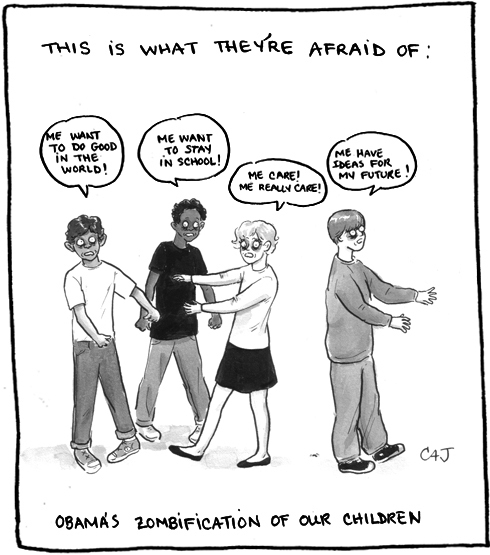
(Click image to enlarge it.)
Here's to sanity....

Read more: Comics, Tom Tomorrow, Salon Comics
Tom Tomorrow's cartoon This Modern World appears regularly in Salon.
This Modern World archive.
This Modern World animated at YouTube...

Tom Tomorrow's cartoon This Modern World appears regularly in Salon.
This Modern World archive.


By DAVID MICHAEL GREEN
I really don’t know what to say anymore, about a country in which proposing a new and better version of corporate-plunder masquerading as national healthcare gets you burned in effigy for being a socialist stooge by gun-toting angry mobs.
I really don’t know what to say anymore, about a country in which the same people who hate you for being a socialist simultaneously hate you for being a fascist.
I really don’t know what to say anymore, about a country in which angry mobs of supposed anti-socialist demonstrators scream at their congressional representatives to “keep your government hands off my Medicare”.
I really don’t know what to say anymore, about a country in which claims that the government is going to start killing off seniors are taken seriously by tens of millions of people.
I really don’t know what to say anymore, about a country in which people are all worked up about government czars, but sat silently while the Bush administration destroyed the Bill of Rights and used a thousand signing statements to write Congress out of the Constitution.
I really don’t know what to say anymore, about a country in which deficits have all of a sudden become the source of enormous anger among people who said nothing about them previously, as the tax cuts for the wealthy, off-budget wars based on lies, and unfunded prescription drug Big Pharma giveaway transmogrified the biggest surplus in American history into the biggest deficit ever.
I really don’t know what to say anymore, about a country in which politicians can rant incessantly about other peoples’ sexual morality, get caught screwing prostitutes, and then still be reelected to the highest ranks of government by trashing the president.
I could go on and on, but what would be the point? The positions of so many Americans on so many policy questions are truly inane – yes, for sure. I wish that was all that concerned me. But it all goes so much deeper than that.
I doubt anyone has ever reminded us of this ongoing danger more eloquently than did the famous American diplomat, George Kennan, when he wrote: “The counsels of impatience and hatred can always be supported by the crudest and cheapest symbols; for the counsels of moderation, the reasons are often intricate, rather than emotional, and difficult to explain. And so the chauvinists of all times and places go their appointed way: plucking the easy fruits, reaping the little triumphs of the day at the expense of someone else tomorrow, deluging in noise and filth anyone who gets in their way, dancing their reckless dance on the prospects for human progress, drawing the shadow of a great doubt over the validity of democratic institutions. And until peoples learn to spot the fanning of mass emotions and the sowing of bitterness, suspicion, and intolerance as crimes in themselves – as perhaps the greatest disservice that can be done to the cause of popular government – this sort of thing will continue to occur.”Editor’s Note: Point one – this article is circa 1998, from the now ceased-publication Permaculture International Journal. Point two – it is now more relevant than ever, so please read and ponder.
Ted Trainer argues that although the planet cannot be saved without Permaculture, not enough people in the movement realise where Permaculture fits into the solution.

Permaculture is a crucial component of the solution to the global predicament. However I want to argue that Permaculture is far from sufficient, and indeed that it can be counter-productive if it is not put in the right context. That is unless we are careful, promoting Permaculture can actually help to reinforce our existing unsustainable society. We must do much more than just contribute to the spread of Permaculture. We must locate Permaculture within a wider campaign of radical social change. Before I try to explain this, I need to outline how I see the global predicament we are in. Whether or not you will agree with my conclusions about what needs to be done and where Permaculture fits in will depend greatly on whether you share my view of the situation we are in.
Beyond the Limits to Growth
There is an overwhelmingly strong case that industrial-affluent-consumer society is grossly unsustainable. Australian per capita rates of resource use and environmental impact are far higher than can be kept up for long, or that could be had by all the world’s people. We are in other words well beyond the limits to growth. Following are a few of the points that support this conclusion. For detailed explanation The Conserver Society (Zed, 1995) or Towards a Sustainable Society (Envirobooks, 1995).
World Resource Grab
These sorts of figures leave little doubt that the way of life taken for granted in industrial-affluent-consumer society cannot possibly be kept up for long or extended to all people. We can have it only because the one fifth who live in rich countries like Australia are grabbing four fifths of world resource production to provide per capita use rates that are fifteen to twenty times those averaged by the poorest half of the world’s people.
The outlook becomes far worse when we add the implications of our manic obsession with economic growth. If Australia averaged four percent growth from now to 2050, and by then the expected 11 billion people had risen to the living standards we would then have, the total world economic output would be 220 times what it is today. The present levels of production and consumption are unsustainable, yet we are committed to an economy and a culture which is determined to increase living standards and the GNP, constantly and without limit. It should be obvious that no plausible assumption about what miraculous breakthroughs technology will achieve will enable continuation of the living standards and the systems taken for granted today; the foregoing multiples are far too big for that.
This blind obsession with raising living standards and the GNP is the underlying cause of all our major global problems, including resource depletion, environmental destruction and the depravation of the third world. For example the third world has been developed into a form which enables its land, labour and capital to produce mostly for the benefit of the rich countries and their corporations. Most people in the third world not only get little or nothing from the development, their productive capacity is put into producing for export. Hence an increasingly critical literature argues that development is plunder and that growth results in depravation.
Globalisation is making all these problems worse. We are seeing a rapid restructuring of the world to give transnational corporations and banks even greater freedom and excess to resources, markets and cheaper labour.
This basic limits to growth analysis shows our predicament to be extremely serious. We are far beyond sustainability. The problems cannot be solved without radical change.
The Solution
If the limits analysis is valid then a sustainable society will have to involve much less affluent lifestyles, highly self-sufficient local economies, little trade, little heavy industry, cooperative and participatory systems and a steady-state economy. This means much more than merely getting rid of a capitalist economy. It means developing an economy in which there is no economic growth, the GNP per capita is a small fraction of what it is in Australia today, no interest is earned on savings (because if it is you have a growth economy), most economic activity takes place outside the cash economy and there are many free goods from the local commons. The "unemployment" rate might be eighty percent (because most work and production would not be for money), and in which much "tax" would be paid via contributions of time to local working bees and committees. In addition a sustainable society requires fundamental changes in world view and values. Cooperation must become the dominant concern, not competition. A strong collective orientation must replace today’s rampant individualism. Affluence and consumption must become distasteful; frugality and self-sufficiency must become major sources of life satisfaction. Giving must become a more important source of satisfaction than getting.
If the limits to growth analysis is valid then we have no choice about these changes. Whether we like it or not we must make these sort of changes if we are to develop a sustainable society.
Many of us with some direct experience of alternative lifestyles and the ecovillage movement know how easy it would be to build a sustainable and just and admirable society. Many who have lived simply and in cooperative communities know it is possible to design and run settlements in which people have a very high quality of life at a relaxed pace, in supportive communities, secure from unemployment, poverty and violence, on very low levels of per capita resource consumption. (This is not to assume that our society will make the transition. I’m increasingly pessimistic about this.)
Indications for Permaculture
Permaculture design principles are obviously crucial for sustainability. Viable settlements must be designed to provide most of their needs from the local landscape without external inputs of resources, and in ways that are ecologically sustainable. But given the nature and the magnitude of our limits to growth problem much more than permaculture is required. Fundamental economic, political and cultural change is essential and without these Permaculture will be of no significance even if it flourishes. Unfortunately much Permaculture literature and many courses tend to leave the impression that spreading knowledge about Permaculture techniques is sufficient to achieve a sustainable world and that there is no need to question affluent living standards or the present economy. In general far too little emphasis is put on the fact that a sustainable society cannot be achieved without a radical change in lifestyles, in the economy, in the geography of settlements and in world views and values.
The important point here is that Permaculture can very easily be part of the problem. It is part of the problem if it does not increase the realisation that affluent living standards and this economy are totally incompatible with sustainability and global economic justice. Much Permaculture literature not only fails to increase people’s understanding of these crucial themes, but much of it reinforces the impression that fundamental change is not necessary because all we have to do is adopt things like organic food, composting, recycling and community supported agriculture. Permaculture is part of the problem if it is essentially enabling people to do some ecologically correct things in their gardens such as growing some organic vegies, and then feel that they are making a significant contribution to saving the planet.
Many people do such "light green" things without questioning affluent lifestyles within a growth economy and without seeing these as the basic causes of the global crisis. For too many, Permaculture is little more than another toy to play with on their hobby farms.
Similar criticisms can be made of the ecovillage movement. This is an extremely important development; we can now point to functioning examples of more sustainable settlements. But the movement is not putting anywhere near enough emphasis on the development of self-sufficient economies, living simply and cooperatively and on the need to get rid of an economic system based on market forces, growth and the profit motive. It tends to give the impression that it will be sufficient to build ecovillages that will function within the present economy.
In other words Permaculture can easily be seen as another technical fix that can save industrial-affluent-consumer society. I think most people see things like solar energy, community supported agriculture, LETS [Local Exchange Trade Systems], earth building, reed bed sewage and Permaculture as new ecologically friendly techniques that will enable us to solve resource and environment problems and therefore to go on living with high living standards, growth and free market economies, jet-away holidays and so on. They see technical advance as capable of eliminating any need for fundamental change in lifestyles or in the economy. I think that we are giving the impression that Permaculture is another of the technologies that will help to save industrial-affluent-consumer society, when the most important message to be given now is that we have to largely scrap that society. There is a seriously mistaken theory of change underlying much of the Permaculture movement. Many seem to assume that the more people we get to take an interest in Permaculture and to practice it the closer we move to the establishment of a just and sustainable society. This is not so. If all we do is work at increasing the numbers who understand and like and practice Permaculture this will probably have no more revolutionary significance than if we increased the number of people who are interested in the RSPCA or golf. This will just reach the point where all those potentially interested in Permaculture will have become interested, and will be out there reading the books and growing things, while still living in and benefitting from (and not challenging) affluent-consumer society and the growth economy.
Building Sustainable Society
Again, replacing that society is the crucial task, not getting more people to like and practice Permaculture. Merely teaching Permaculture techniques will not get them to see that affluent-industrial-consumer society is a terrible mistake, that capitalism must be scrapped, that a growth economy must be scrapped, that we must build small and highly self-sufficient economies based on cooperation and participation, and that very different lifestyles and values must be embraced. People can become very knowledgeable and keen about Permaculture without understanding any of this.
Why do you want people to take up Permaculture? Just to enjoy the idea and the practice? Or to help us build a sustainable society? If your answer is the latter, then we will not get this outcome just by increasing people’s understanding of Permaculture techniques. We make sure that wherever possible we connect Permaculture with the global scene and the need for radical social change, so that people understand that Permaculture is necessary but only as part of the bigger picture. We can’t claim to be centrally concerned with achieving sustainability is all we talk about is Permaculture. It is in fact only one element in the list of conditions and factors required for a sustainable world order. But there can be no doubt that it is a crucially important element.