The authors of the MACA letter are not conscientious farmers facing the reality of uncertain weather, evolving pests, rampant disease, and fluctuating markets. The authors make and distribute agricultural chemicals (it's a requirement for MACA membership) and they include representatives from companies with names like Monsanto, Dow AgroSciences, Syngenta, BASF Corporation, and Bayer CropScience, some of the giants of modern pesticides, herbicides, and genetically modified crops.
You can counter the lies and propaganda of these megacorps by adding your voice. Read on...
Subject: Tell Pesticide Peddlers: We support Michelle Obama's organic garden.
Dear Friend,
The Mid America CropLife Association (MACA) has a bone to pick with Michelle Obama. MACA represents chemical companies that produce pesticides, and they are angry that - wait for it - Michelle Obama isn't using chemicals in her organic garden at the White House.
I am not making this up.
In an email they forwarded to their supporters, a MACA spokesman wrote, "While a garden is a great idea, the thought of it being organic made [us] shudder." MACA went on to publish a letter it had sent to the First Lady asking her to consider using chemicals -- or what they call "crop protection products" -- in her garden.
Michelle Obama and has done America a great service by publicizing the importance of nutritious food for kids (she's growing the garden in partnership with a local elementary school class) as well as locally grown produce as an important, environmentally sustainable food source.
I just signed a petition telling MACA's board members to stop using Michelle Obama's garden to spread propaganda about produce needing to be sprayed with chemicals. I hope you will, too.
How much do we really know about the food we buy at our local supermarkets and serve to our families?
In Food, Inc., filmmaker Robert Kenner lifts the veil on our nation's food industry, exposing the highly mechanized underbelly that's been hidden from the American consumer with the consent of our government's regulatory agencies, USDA and FDA. Our nation's food supply is now controlled by a handful of corporations that often put profit ahead of consumer health, the livelihood of the American farmer, the safety of workers and our own environment. We have bigger-breasted chickens, the perfect pork chop, insecticide-resistant soybean seeds, even tomatoes that won't go bad, but we also have new strains of e coli--the harmful bacteria that causes illness for an estimated 73,000 Americans annually. We are riddled with widespread obesity, particularly among children, and an epidemic level of diabetes among adults.
Featuring interviews with such experts as Eric Schlosser (Fast Food Nation), Michael Pollan (The Omnivore's Dilemma) along with forward thinking social entrepreneurs like Stonyfield Farm's Gary Hirshberg and Polyface Farms' Joel Salatin, Food, Inc. reveals surprising -- and often shocking truths -- about what we eat, how it's produced, who we have become as a nation and where we are going from here.
With a constituency limited to anyone who eats, "Food, Inc." is a civilized horror movie for the socially conscious, the nutritionally curious and the hungry. Yes, it has a deceptively cheery palette, but helmer Robert Kenner's doc -- which does for the supermarket what "Jaws" did for the beach -- marches straight into the dark side of cutthroat agri-business, corporatized meat and the greedy manipulation of both genetics and the law. Doc biz may be in the doldrums, but "Food, Inc." is so aesthetically polished and politically urgent, theatrical play seems a no-brainer, though it won't do much for popcorn sales.
Corn is the vegetable-as-villain in "Food, Inc.," which builds on the work of nutritionists, journalists and activists Eric Schlosser ("Fast Food Nation") and Michael Pollan ("The Omnivore's Dilemma") to show how multinationals have taken over the production of food. As the movie tells us, corn -- which today assumes dozens of ubiquitous identities, notably high-fructose corn syrup -- is kept at unrealistically low prices by the government, is fed to animals that haven't evolved to eat it (such as the cow), causes those animals to develop maladies that must be treated with antibiotics (which are passed on to consumers), and has led to the mutation of new strains of the E.coli virus, which sickens tens of thousands each year.
The whole mess is exacerbated by opportunistic politics -- tools of Big Agriculture running the very regulatory agencies that are supposed to protect us -- and consumers who have become accustomed to eating whatever they want whenever they want, in quantities they don't need.
Fast food is presented as having turned meat production into a sadistic exercise in animal torture, something that's been seen in documentaries before, and it isn't pretty. But "Food, Inc." delves deeply into the case of Monsanto, which has monopolized the growing of corn by patenting the biology inside it -- and has been allowed to litigate against insurgent farmers through court decisions rendered by the likes of Supreme Court Justice Clarence Thomas, a onetime Monsanto lawyer. The whole system, "Food, Inc." tells us, is fixed.
That the filmmakers dress up all this information in glossy graphics, splashes of color and Mark Adler's often buoyant (and ironic) score is ingenious, because the artifice of the film's aesthetic is always subtly emphasizing the artificiality of the food. Schlosser and Pollan are eloquent Virgils guiding the viewer into the third circle of food hell. But then Joel Salatin -- a major figure in "Omnivore's Dilemma" who owns and operates a self- sustaining poultry-and-pig farm in Virginia's Shenandoah Valley -- arrives to throw some natural light onto the proceedings and illuminate just what can be done to salvage agriculture and our digestive systems.
Salatin is an infectiously enthusiastic champion of his own system, and the film needs him, because others in the movie -- such as a working-class Los Angeles family that can't afford fruit but can afford Burger King -- keep showing the insanity of the system.
Disturbing as it is, "Food, Inc." doesn't present some doomsday scenario. People can make a difference, it says: After all, look what happened to Big Tobacco.
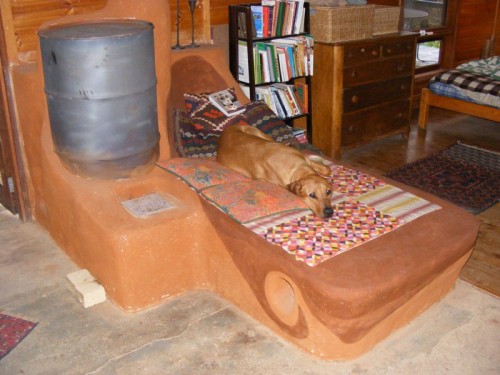
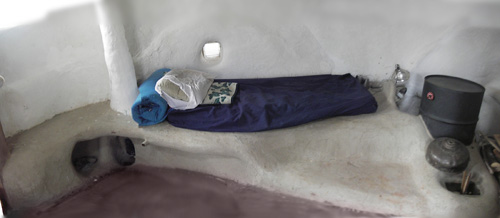
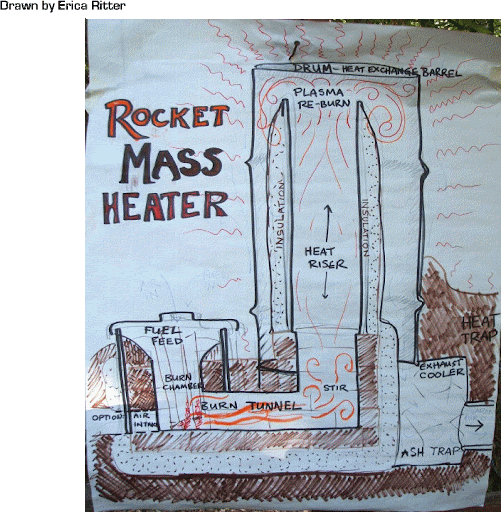
PermaculturistPaul Wheaton just sent me a link to this new video featuring the extremely fuel-efficient build-it-yourself rocket stove / mass heater. It offers, in Paul's words, "A compilation of 12 rocket heaters, 8 video clips of rocket mass heaters, 2 video clips of pocket rockets, 1 picture from the cover of the book on rocket mass heaters and one drawing from me making a feeble attempt to explain what these look like. And look! A peek at the author Ianto Evans!"
You can watch several other rocket stove videos on YouTube here.
Enjoy this series of rocket stove construction photos by Erica Ritter at her Picasa webpix album.
Previously we had considered the multitude of options for different kinds of bikes especially designed to do work. Now we'll take a look at suppliers of bicycle add-ons to make any bike more useful and practical.
Rivendell Bicycle Works, Walnut Creek, CaliforniaOur mission is to make things that wouldn't be made if we weren't here, to offer an alternative to racing-centric bikes and parts, and to espouse a different approach to riding. And to resurrect and keep healthy many of the better ideas, designs, and styles of bicycles, clothing, and accessories that we personally like to use or wear. If you'd like to know more, just ask. It's not a secret business we have here. -Grant
The CARGO is Tubus's all-purpose rear rack. The most popular, most versatile, the one that carries a basket best, if that matters to you, and the one to get unless you have heel clearance problems with most racks.The Sackville Saddlesack sits level, is easy to load & it never spills, tough as rocks but looks natty, has two outside pockets you can access while riding, and a snap-offable flap pocket so you can take your wallet-keys-cell phone with you when you leave your bike for a bit.
These folks in New Orleans have a good selection of bike bags and supplies.
Peter White Cycles 24 Hall Rd. Hillsborough, NH 03244 603 478 0900 (Phone) 603 478 0902 (Phax)
While we specialize in the touring and tandem arena, we also cater to road racing and cross country off road cyclists. Much of our own cycling is off road, though my wife and I both enjoy road riding on our singles as well as on our Co-Motion tandem.
We offer products that make the practical use of the bicycle easier and safer. As gasoline prices keep rising, making the use of automobiles less viable, properly equipped bicycles offer an environmentally friendly alternative. While some people can't use a bicycle for their everyday transportation, many others can. And in time, many more will have no choice but to alter their lifestyles so as to include bicycles for transportation. But many people don't know that good lights are available to make riding at night much safer, or that studded tires and special clothing are available that make riding in the winter or rain both safer and more fun. That's why we're here.
Wald Bicycle Baskets, in Maysville, KY, were not the first product Wald invented. Rather, it was a bicycle tire repair tool. But it didn't take long for Grandpa Ewald and Uncle Herman to recognize what a difference the bicycle basket could be.No other domestic bicycle parts manufacturer comes close to our longevity. When you purchase or use our products, you too become an integral part of that legacy. Thank you for your interest in our products. We hope you find something you need, or even better, something you like.
Wildlife film maker Rebecca Hosking investigates how to transform her family's farm in Devon into a low energy farm for the future, and discovers that nature holds the key. With her father close to retirement, Rebecca returns to her family's wildlife-friendly farm in Devon, to become the next generation to farm the land.
But last year's high fuel prices were a wake-up call for Rebecca. Realising that all food production in the UK is completely dependent on abundant cheap fossil fuel, particularly oil, she sets out to discover just how secure this oil supply is. Alarmed by the answers, she explores ways of farming without using fossil fuel. With the help of pioneering farmers and growers, Rebecca learns that it is actually nature that holds the key to farming in a low-energy future.
Film Maker Explores Post-Oil Farming Last week I wrote about a BBC documentary which I hadn't seen, but the green scene in the UK was all a flutter over. A Farm for the Future explores nature film maker Rebecca Hosking's return to her small family farm and her search for a post-fossil fuel agriculture. I've since seen the film, and would recommend it to anyone with an interest in food and farming - come to think of it, I'd recommend it to anyone who eats. But for those without the time or means to watch it, Rebecca has also written an excellent article in the Daily Mail newspaper about her quest for truly sustainable agriculture.
Rebecca's work (who incidentally is also responsible for a plastic bag ban in her home town!) is not just remarkable for the content she is covering - but the venues in which it is being aired too. To have a half-hour documentary devoted to peak oil, agriculture and alternatives like forest gardening and permaculture appear on prime time BBC is a telling sign of the times. But to also have an article in the Daily Mail - hardly the bastion of environmental radicalism - is dynamite.
There is no doubt in my mind that Rebecca is opening a lot of eyes to the unsustainability of our present food system. Take this excerpt from Rebecca's conversation with permaculture guru Patrick Whitefield [Disclaimer: Patrick is a former teacher and friend of mine]:
But it will work only if we have a lot more growers. Some reports estimate it's going to take as many as 12 million, although currently we have 11million gardeners. A food-growing system based on natural ecology appeals to my naturalist side. But the farmer's daughter in me needed a bit more convincing. Could permaculture feed Britain? I asked Patrick Whitefield, Britain's leading expert in permaculture.
'Good question,' he said. 'A better question would be, "Can present methods go on feeding Britain?" In the long term, it is certain that present methods can't because they are so entirely dependent on fossil-fuel energy. So we haven't got any choice other than to find something different.'
The more permaculture people I met, the more hopeful I became that we can find a way out of this mess if we start preparing for peak oil now.
Along the way, Rebecca also meets Ben and Charlotte Hollins - the brother and sister team who now run the innovative Fordhall Farm in Shropshire - and talks about their nature-based no-till pasture system; she talks with peak oil experts Richard Heinberg and Colin Campbell; visits Martin Crawford of the Agroforestry Research Trust and explores the small holding of Chris and Lynn Dixon - who have pioneered their low input, biodiverse permaculture-based land management techniques in the hills of Wales for years.
For folks like me who have long followed permaculture and other sustainable, but often marginalized, food movements, it's really incredible to see voices like this getting a wide and receptive audience. Now we just have to see how many folks are willing to roll up their sleeves, get their hands dirty, and start planting.
From Yuba Bikes the Mundo cargo bike:Yuba was launched in 2006 to build and provide affordable mobility solutions with a particular emphasis on distributing them to those most in need. The founders of Yuba came together to advance economic and social development, to promote self-reliance, and to emphasize better environmental awareness and lifestyle choices – all through the use of bicycles. Because bicycles are one of the most energy efficient, financially affordable, mechanically reliable, and environmentally friendly vehicles, we believe that a more bike-centric world makes for a better world, a more connected world.
Designed for maximum bicycle mobility, the all-terrain Mundo offers an affordable and sustainable alternative for:
environmentally friendly transportation economic viability unsurpassed cargo capacity the ability to carry passengers affordable mobility
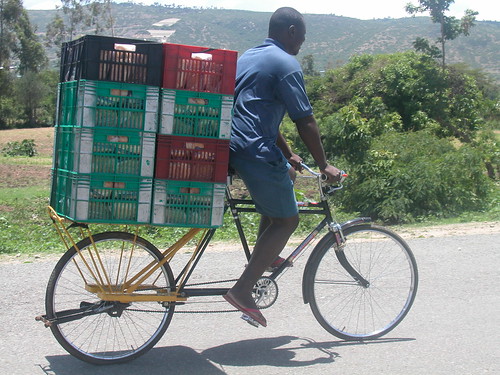
See Worldbike for "open-source" bicycle designs:"Worldbike is an international network of bicycle designers and industry leaders, and international development professionals, working together to provide transportation solutions and create income-generating opportunities for the world’s poor. All across the developing world, people use bicycles the way we use pickup trucks and school buses. However, the bicycles sold in developing countries are those designed for recreation and are ill-suited to carrying loads. Worldbike designs higher-strength, longer-wheelbase bicycles with integrated cargo capacity. We conduct trial markets to determine the ideal price levels, work with the bike industry to get the best quality parts and frames at the lowest cost, and partner with international development organizations like Kickstart International to sell and distribute the bicycles..."
"The bicycle is the most efficient transportation device yet invented. Trouble is, modern bicycle design has been far more influenced by the needs of racers than by the needs of everyday riders like you. The result: your bike is compact, light, and strong, but it doesn’t have a good place to carry a week’s groceries, waterproof storage capacity, or a good seat for a passenger. Xtracycle solves these problems.Imagine your favorite bike with the rear wheel stretched out behind the seat, a big, stable platform for a load or a passenger, and elegant saddlebags on either side that are expandable when you need them and are cleanly out of the way when you don’t. Best of all, your bike is still lightweight and fast, and because the load is centered between your two wheels, the whole package handles with ease. Suddenly you have much less need or desire to drive around town for your errands. Picture this: riding breezily unloaded to your favorite grocery store, coasting reliably around corners; arriving ahead of traffic; parking at the rack directly in front of the entrance; shopping and easily loading your four bags of groceries; then pedaling home, care-free on a bike that handles just as swiftly now that it’s loaded." WorkCycles: Transport bike, cargo trike & handmade Dutch city bike specialist [These are beautiful and VERY functional bikes. Visit their site for a view of many other styles-KJ]
WorkCycles is the specialist in quality utility bicycles for commercial, family and personal use. We develop our own models and also sell bikes from Azor, Bakfiets.nl, De Redding, Monark, Nijland, Onderwater and others. WorkCycles bicycles are known for their timeless design, top quality and attention to detail. Whether you need a bike to safely carry your children, a classic Dutch city bike or tough industrial bikes we we've got it.
OMG! It carries 12 kids! Look into The International Bicycle Fund especially their page on (work bikes): A non-governmental, nonprofit, advocacy organization, providing information and resources promoting sustainable transport and international understanding to make this planet a healthier and happier place to live. Major areas of activity are non-motorized urban planning, economic development, bike safety education, responsible travel and bicycle tourism, and cross-cultural, educational programs.
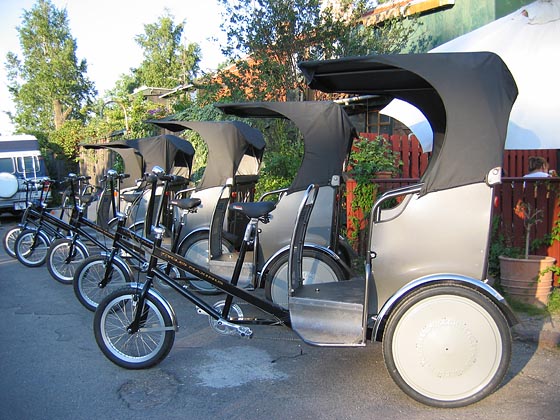
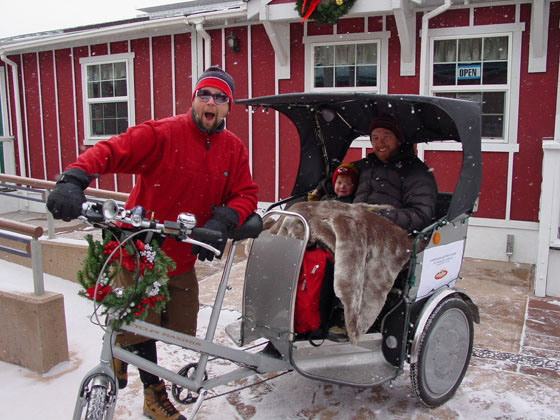
Bicycle Taxis are becoming popular in NY and other cities:
BicyTaxi has fast become a common sight in many environmentally-conscious cities worldwide. Because our cities are becoming increasingly crowded and busy, we must consider new and innovative concepts in order to maintain, or even improve, the quality of life for residents. Bicytaxi is the ideal solution to these problems as it ecologically and efficiently reduces urban emissions and therefore pollution. Urban transportation is enhanced through a flexible and reliable mobility system. BicyTaxi pedicabs which are similar to a rickshaw or riksha, however, are not only excellent means of transport for urban areas but also excel at events. They may further be used as a shuttle service and are, of course, one of the best and most effective advertising media in the outdoor sector.
"We set out to build a high capacity tricycle that provides a practical, environmentally friendly solution to your local transport needs. The modular construction offers a wide choice of applications, pioneering design and craftsmanship combine to provide a viable alternative to the internal combustion engine."
Cyclestone Pedicabs, Inc. has been doing business with pedicab since 2004. Our main partners company(Starbike Ltd.) doing business with cycles since 1988. We can offer all kind of pedicab, three cycles and bike configurations to the local and worldwide wholesaler and retail customers. Cyclestone Pedicabs goals; well quality, fast service, enjoyable pedicab & bike and lower price for all kind of our products.
(France)
In Germany:
In India: Present activities are in sustainable transport, lighting , environment pollution abatement, handicapped rickshaw, etc.

 Dear Friend,