Genetic engineering is a threat to food security, especially in a changing climate. The introduction of genetically manipulated organisms by choice or by accident grossly undermines sustainable agriculture and in so doing, severely limits the choice of food we can eat.
Once GE plants are released into the environment, they are out of control. If anything goes wrong - they are impossible to recall.
GE contamination threatens biodiversity respected as the global heritage of humankind, and one of our world's fundamental keys to survival.

Wednesday, March 30, 2011


Monday, March 28, 2011
Defining Characteristics
From the ever useful and information-rich Energy Bulletin
Published Mar 15 2011 by Resilient Homes blog,
Permaculture: Deconstructing a Definition
by Lisa Fernandes
The question “What is permaculture?” is notoriously difficult to answer in one sentence. It defies the “sound bite” culture we live in.
Let’s start with what permaculture is NOT. Seriously, it has nothing to do with permafrost. It is not sheet-mulching, though some may use that as a particular strategy. It is not a variant (or deviant:) of “organic,” though it may use many organic growing strategies. It is not getting a bunch of people together to stomp some mud in a kiddie pool and build a cob oven, though that’s a pretty darn good time in most permaculture circles. Finally, it is not some rarefied ivory tower of secret knowledge that only those who have worshipped at the church of the holy sacred PDC (permaculture design certificate) get to experience.
Permaculture, at its core, is a design process (1) and set of techniques (2) for creating resilient (3) and [truly] sustainable (4) human habitats and healthy ecosystems. (5) Now, I will footnote the daylights out of this definition, which is one of many definitions currently in use, all of which have virtues and drawbacks.

(1) Yes, you have to do design, even if it’s only in your own head, that helps chart a course from where you are today to where you want to be going. Permaculture design, unlike many other design disciplines, is informed by a set of design ethics and principles which are flexible and powerful. Think of the permaculture design as a really, really well-thought out “map” for creating the best possible chance of manifesting a particular vision or set of goals. As with most maps, a printed,visual version of that is often far more helpful (especially in group settings) than that map you keep in your head. And, as with most maps, they only work if you know where you are and can formulate an idea on where you want to go.
(2) The techniques are not the discipline. Sheet mulching, swaling, herb spirals, flowforms, de-paving, renewable energy, cordwood saunas (OK, this list could run into next week, but you get the idea) are NOT permaculture, they are techniques and strategies that we may employ in the service of good design based in real, articulated goals and visions. Those techniques and strategies may be invoked when needed, just like you choose the best tool for the job out of your tool box. Permaculture design is one of the most powerful ways to expand, organize and then intelligently use the toolkit available to you.
(3) Resilient: the ability to withstand shocks or disruptions and the ability to bounce back and/or rebuild with the least possible amount of distress or dysfunction. I would posit that resilience comes in a bunch of flavors: personal, household, neighborhood/community. There are more, but for the purposes of permaculture design, these are the most common types of resilience that need attention and can be enhanced with good design. Creating integrated, healthy, whole ecosystems (within which human habitats are embedded) calls for organizing ourselves in a way that is not beholden to unlimited cheap fossil fuels and not reliant on stable, unchanging climate patterns.
 (4) Sustainable as a word gets put in the same bucket as “green” and “eco” for me. It’s like the hackneyed photo of the human hands holding soil and teensy weensy seedling. They are overused, examples of greenwashing and mean many different things to many different people. Technically, it means something that can be continued…what?…. indefinitely? As one of my students said recently, even “dysfunction can be continued indefinitely.” So, is that sustainable? I don’t have the new definition, so I use the word very sparingly and ask others what they mean when they use it.
(5) A sort of core, or common, view among permaculture folks is that humans are a part of, and not separate from, the non-human ecosystems around us. Therefore, our fate is embedded in the fate of the interconnected set of relationships and elements in the broader world. As such, many of us use the term “landscape” to include people, buildings, villages, etc. along with forests, fields and streams. It is one integrated whole and the designs we create do focus on the “landscape” which includes food production, ecosystem health, soil fertility, buildings, energy, waste, economic systems and much more. Permaculture also seeks to learn from and work far more closely with the patterns of organization found in parts of our ecosystems that have evolved over several billion years. So we often model our design work and strategies on “patterns in nature” and encourage something called “pattern literacy.“
Every single one of these footnotes is worthy of complete exploration in its own right, and I may get around to that via this blog and encourage others to do so as well.
 And, while this is all very conceptual, one of the powerful things about permaculture is that it tends to attract real roll-up-your-sleeves and let’s-get-this-done kind of people. We do spend time thinking through design and learning new ways of working with and in the world, but almost to a one, permaculturists are actively changing the way we live, right now, starting at our own doorsteps and working out from there.
Published Mar 15 2011 by Resilient Homes blog,
Permaculture: Deconstructing a Definition
by Lisa Fernandes
The question “What is permaculture?” is notoriously difficult to answer in one sentence. It defies the “sound bite” culture we live in.
Let’s start with what permaculture is NOT. Seriously, it has nothing to do with permafrost. It is not sheet-mulching, though some may use that as a particular strategy. It is not a variant (or deviant:) of “organic,” though it may use many organic growing strategies. It is not getting a bunch of people together to stomp some mud in a kiddie pool and build a cob oven, though that’s a pretty darn good time in most permaculture circles. Finally, it is not some rarefied ivory tower of secret knowledge that only those who have worshipped at the church of the holy sacred PDC (permaculture design certificate) get to experience.
Permaculture, at its core, is a design process (1) and set of techniques (2) for creating resilient (3) and [truly] sustainable (4) human habitats and healthy ecosystems. (5) Now, I will footnote the daylights out of this definition, which is one of many definitions currently in use, all of which have virtues and drawbacks.
(1) Yes, you have to do design, even if it’s only in your own head, that helps chart a course from where you are today to where you want to be going. Permaculture design, unlike many other design disciplines, is informed by a set of design ethics and principles which are flexible and powerful. Think of the permaculture design as a really, really well-thought out “map” for creating the best possible chance of manifesting a particular vision or set of goals. As with most maps, a printed,visual version of that is often far more helpful (especially in group settings) than that map you keep in your head. And, as with most maps, they only work if you know where you are and can formulate an idea on where you want to go.
(2) The techniques are not the discipline. Sheet mulching, swaling, herb spirals, flowforms, de-paving, renewable energy, cordwood saunas (OK, this list could run into next week, but you get the idea) are NOT permaculture, they are techniques and strategies that we may employ in the service of good design based in real, articulated goals and visions. Those techniques and strategies may be invoked when needed, just like you choose the best tool for the job out of your tool box. Permaculture design is one of the most powerful ways to expand, organize and then intelligently use the toolkit available to you.
(3) Resilient: the ability to withstand shocks or disruptions and the ability to bounce back and/or rebuild with the least possible amount of distress or dysfunction. I would posit that resilience comes in a bunch of flavors: personal, household, neighborhood/community. There are more, but for the purposes of permaculture design, these are the most common types of resilience that need attention and can be enhanced with good design. Creating integrated, healthy, whole ecosystems (within which human habitats are embedded) calls for organizing ourselves in a way that is not beholden to unlimited cheap fossil fuels and not reliant on stable, unchanging climate patterns.
(4) Sustainable as a word gets put in the same bucket as “green” and “eco” for me. It’s like the hackneyed photo of the human hands holding soil and teensy weensy seedling. They are overused, examples of greenwashing and mean many different things to many different people. Technically, it means something that can be continued…what?…. indefinitely? As one of my students said recently, even “dysfunction can be continued indefinitely.” So, is that sustainable? I don’t have the new definition, so I use the word very sparingly and ask others what they mean when they use it.(5) A sort of core, or common, view among permaculture folks is that humans are a part of, and not separate from, the non-human ecosystems around us. Therefore, our fate is embedded in the fate of the interconnected set of relationships and elements in the broader world. As such, many of us use the term “landscape” to include people, buildings, villages, etc. along with forests, fields and streams. It is one integrated whole and the designs we create do focus on the “landscape” which includes food production, ecosystem health, soil fertility, buildings, energy, waste, economic systems and much more. Permaculture also seeks to learn from and work far more closely with the patterns of organization found in parts of our ecosystems that have evolved over several billion years. So we often model our design work and strategies on “patterns in nature” and encourage something called “pattern literacy.“
Every single one of these footnotes is worthy of complete exploration in its own right, and I may get around to that via this blog and encourage others to do so as well.
And, while this is all very conceptual, one of the powerful things about permaculture is that it tends to attract real roll-up-your-sleeves and let’s-get-this-done kind of people. We do spend time thinking through design and learning new ways of working with and in the world, but almost to a one, permaculturists are actively changing the way we live, right now, starting at our own doorsteps and working out from there.Editorial Notes
About the author:
Lisa Fernandes is the organizer and founding member of Portland Maine Permaculture and has been a student of permaculture and green design since 1992. She is a certified permaculture designer, team trainer and group facilitator and owned a training & consulting business for several years. She studied political science at Boston College and then environmental studies at The Evergreen State College while designing & implementing municipal waste reduction & recycling programs with a focus on organic waste recycling. Lisa is a gardener, certified Master Composter and has studied medicinal plants for nearly twenty years. She has worked in the public, private and non-profit sectors and currently brings her varied experience to developing & delivering sustainability and resilience-building events and permaculture designs for the local community. She currently serves on the Cape Farm Alliance and provides staff support to the Eat Local Foods Coalition of Maine (ELFC) and sits on the Southern Maine Partnership for Sustainable Communities. She is a proud member of the Portland Food Coop (Member-Owner #11) and the Slow Food Portland Convivium. Lisa serves on the board of the Permaculture Institute of the Northeast (PINE), helped launch The Pattern Factory design studio at Newforest Institute and is the principle permaculture designer in Resilient Homes, a solar hot water and permaculture design company. Lisa and her family are actively working to convert their 1/3 acre property into a demonstration site for resilient and sustainable “post-carbon” living.
Lisa Fernandes is the organizer and founding member of Portland Maine Permaculture and has been a student of permaculture and green design since 1992. She is a certified permaculture designer, team trainer and group facilitator and owned a training & consulting business for several years. She studied political science at Boston College and then environmental studies at The Evergreen State College while designing & implementing municipal waste reduction & recycling programs with a focus on organic waste recycling. Lisa is a gardener, certified Master Composter and has studied medicinal plants for nearly twenty years. She has worked in the public, private and non-profit sectors and currently brings her varied experience to developing & delivering sustainability and resilience-building events and permaculture designs for the local community. She currently serves on the Cape Farm Alliance and provides staff support to the Eat Local Foods Coalition of Maine (ELFC) and sits on the Southern Maine Partnership for Sustainable Communities. She is a proud member of the Portland Food Coop (Member-Owner #11) and the Slow Food Portland Convivium. Lisa serves on the board of the Permaculture Institute of the Northeast (PINE), helped launch The Pattern Factory design studio at Newforest Institute and is the principle permaculture designer in Resilient Homes, a solar hot water and permaculture design company. Lisa and her family are actively working to convert their 1/3 acre property into a demonstration site for resilient and sustainable “post-carbon” living.
Thursday, March 17, 2011
The Second American Revolution Looks Like This
Democracy School online
Democracy School - Part I from Mari Margil on Vimeo.
The Daniel Pennock Democracy School is a stimulating and illuminating course that teaches citizens and activists how to reframe exhausting and often discouraging single issue work (such as opposing toxic dumps, quarries, factory farms, etc.) in a way that we can confront corporate control on a powerful single front: people’s constitutional rights.
Democracy School explores the limits of conventional regulatory organizing and offers a new organizing model that helps citizens confront the usurpation by corporations of the rights of communities, people, and the earth. Lectures cover the history of people's movements and corporate power, and the dramatic recent organizing in Pennsylvania by communities confronting agribusiness, sewage sludge, and quarry corporations. Included with enrollment in the Democracy School is a 300 plus-page notebook of background reading material. For a historical review of the Pennsylvania work through the end of 2003, see a feature article that appeared in Orion Magazine.
Created by the Community Environmental Legal Defense Fund (CELDF) and Richard Grossman, co-founder of the Program on Corporations, Law, and Democracy (POCLAD), Democracy Schools were launched with five weekend sessions at Wilson College in Chambersburg, Pennsylvania in 2003. Since then, the number of schools has grown rapidly. In 2006, there are over a dozen locations across the country offering Democracy Schools, so peruse our list and find a school near you!
The Schools are built around carefully designed readings, clear presentations and group discussions.
* Each School reveals how it came to be that the law enables corporate managers to dictate their values, and impose their projects on communities.
* Includes an intense, comprehensive history of the judicial bestowal of constitutional rights of persons on corporations.
* Learn the secret of how People’s Movements have cut to the essence and won their struggles to be “found” in the constitution.
* The Anti-Federalists
* The Abolitionists
* The Suffragists
* The Populists
* The Labor Movement
* And learn about earlier Movements, including the Levelers and the Diggers.
* Experience the story of Pennsylvania communities, and New England Town Meetings, as well as North Western city battles – in the ongoing struggle to take the power to govern out of the Corporate Boardrooms and put it back in our communities where it belongs.
* For people of all ages, interests and occupations
* Classes consist of small groups of 10-15 people like you.
"If you take no other training this year, do the Democracy School. It is a superlative unfolding revelation of how corporations have hijacked democracy. It meticulously deconstructs the historical arc that brought us to this precipice. But most importantly, it then departs into the highly pragmatic and inspiring work now underway that is slowly turning the tide . . . This Second American Revolution may be the most important political work going on anywhere in the country or the world."
-Kenny Ausubel ‘05, Founder and Co-Executive Director, Bioneers
"Democracy School was a mind-blowing experience. During the School, I was forced to come to grips with the understanding that I really knew very little about the true structure of law that controls our activism. Democracy School is a must for everyone who seeks to be liberated from our defensive, after-the-fact reactive organizing strategies."
Featuring Thomas Linzey Esq. and Mari Margil -- WATCH PARTS II - VI HERE
Democracy School - Part I from Mari Margil on Vimeo.
The Daniel Pennock Democracy School is a stimulating and illuminating course that teaches citizens and activists how to reframe exhausting and often discouraging single issue work (such as opposing toxic dumps, quarries, factory farms, etc.) in a way that we can confront corporate control on a powerful single front: people’s constitutional rights.
Democracy School explores the limits of conventional regulatory organizing and offers a new organizing model that helps citizens confront the usurpation by corporations of the rights of communities, people, and the earth. Lectures cover the history of people's movements and corporate power, and the dramatic recent organizing in Pennsylvania by communities confronting agribusiness, sewage sludge, and quarry corporations. Included with enrollment in the Democracy School is a 300 plus-page notebook of background reading material. For a historical review of the Pennsylvania work through the end of 2003, see a feature article that appeared in Orion Magazine.
Created by the Community Environmental Legal Defense Fund (CELDF) and Richard Grossman, co-founder of the Program on Corporations, Law, and Democracy (POCLAD), Democracy Schools were launched with five weekend sessions at Wilson College in Chambersburg, Pennsylvania in 2003. Since then, the number of schools has grown rapidly. In 2006, there are over a dozen locations across the country offering Democracy Schools, so peruse our list and find a school near you!
The Schools are built around carefully designed readings, clear presentations and group discussions.
* Each School reveals how it came to be that the law enables corporate managers to dictate their values, and impose their projects on communities.
* Includes an intense, comprehensive history of the judicial bestowal of constitutional rights of persons on corporations.
* Learn the secret of how People’s Movements have cut to the essence and won their struggles to be “found” in the constitution.
* The Anti-Federalists
* The Abolitionists
* The Suffragists
* The Populists
* The Labor Movement
* And learn about earlier Movements, including the Levelers and the Diggers.
* Experience the story of Pennsylvania communities, and New England Town Meetings, as well as North Western city battles – in the ongoing struggle to take the power to govern out of the Corporate Boardrooms and put it back in our communities where it belongs.
* For people of all ages, interests and occupations
* Classes consist of small groups of 10-15 people like you.
"If you take no other training this year, do the Democracy School. It is a superlative unfolding revelation of how corporations have hijacked democracy. It meticulously deconstructs the historical arc that brought us to this precipice. But most importantly, it then departs into the highly pragmatic and inspiring work now underway that is slowly turning the tide . . . This Second American Revolution may be the most important political work going on anywhere in the country or the world."
-Kenny Ausubel ‘05, Founder and Co-Executive Director, Bioneers
"Democracy School was a mind-blowing experience. During the School, I was forced to come to grips with the understanding that I really knew very little about the true structure of law that controls our activism. Democracy School is a must for everyone who seeks to be liberated from our defensive, after-the-fact reactive organizing strategies."
Featuring Thomas Linzey Esq. and Mari Margil -- WATCH PARTS II - VI HERE
Monday, March 14, 2011
Nuke the Males (Who Design Solutions Like This)
TOKYO ELECTRIC TO BUILD US NUCLEAR PLANTS

I don't know the law in Japan, so I can't tell you if Tokyo Electric Power Co (TEPCO) can plead insanity to the homicides about to happen.
But what will Obama plead? The Administration, just months ago, asked Congress to provide a $4 billion loan guarantee for two new nuclear reactors to be built and operated on the Gulf Coast of Texas — by Tokyo Electric Power and local partners. As if the Gulf hasn't suffered enough.
Here are the facts about Tokyo Electric and the industry you haven't heard on CNN:
The failure of emergency systems at Japan's nuclear plants comes as no surprise to those of us who have worked in the field.
Nuclear plants the world over must be certified for what is called "SQ" or "Seismic Qualification." That is, the owners swear that all components are designed for the maximum conceivable shaking event, be it from an earthquake or an exploding Christmas card from Al Qaeda.
 The most inexpensive way to meet your SQ is to lie. The industry does it all the time. The government team I worked with caught them once, in 1988, at the Shoreham plant in New York. Correcting the SQ problem at Shoreham would have cost a cool billion, so engineers were told to change the tests from 'failed' to 'passed.'
The company that put in the false safety report? Stone & Webster, now the nuclear unit of Shaw Construction which will work with Tokyo Electric to build the Texas plant, Lord help us.
There's more.
Last night I heard CNN reporters repeat the official line that the tsunami disabled the pumps needed to cool the reactors, implying that water unexpectedly got into the diesel generators that run the pumps.
These safety back-up systems are the 'EDGs' in nuke-speak: Emergency Diesel Generators. That they didn't work in an emergency is like a fire department telling us they couldn't save a building because "it was on fire."
What dim bulbs designed this system? One of the reactors dancing with death at Fukushima Station 1 was built by Toshiba. Toshiba was also an architect of the emergency diesel system.
Now be afraid. Obama's $4 billion bail-out-in-the-making is called the South Texas Project. It's been sold as a red-white-and-blue way to make power domestically with a reactor from Westinghouse, a great American brand. However, the reactor will be made substantially in Japan by the company that bought the US brand name, Westinghouse — Toshiba.
 I once had a Toshiba computer. I only had to send it in once for warranty work. However, it's kind of hard to mail back a reactor with the warranty slip inside the box if the fuel rods are melted and sinking halfway to the earth's core.
TEPCO and Toshiba don't know what my son learned in 8th grade science class: tsunamis follow Pacific Rim earthquakes. So these companies are real stupid, eh? Maybe. More likely is that the diesels and related systems wouldn't have worked on a fine, dry afternoon.
Back in the day, when we checked the emergency back-up diesels in America, a mind-blowing number flunked. At the New York nuke, for example, the builders swore under oath that their three diesel engines were ready for an emergency. They'd been tested. The tests were faked, the diesels run for just a short time at low speed. When the diesels were put through a real test under emergency-like conditions, the crankshaft on the first one snapped in about an hour, then the second and third. We nicknamed the diesels, "Snap, Crackle and Pop."
(Note: Moments after I wrote that sentence, word came that two of three diesels failed at the Tokai Station as well.)
In the US, we supposedly fixed our diesels after much complaining by the industry. But in Japan, no one tells Tokyo Electric to do anything the Emperor of Electricity doesn't want to do.
I get lots of confidential notes from nuclear industry insiders. One engineer, a big name in the field, is especially concerned that Obama waved the come-hither check to Toshiba and Tokyo Electric to lure them to America. The US has a long history of whistleblowers willing to put themselves on the line to save the public. In our racketeering case in New York, the government only found out about the seismic test fraud because two courageous engineers, Gordon Dick and John Daly, gave our team the documentary evidence.
In Japan, it's simply not done. The culture does not allow the salary-men, who work all their their lives for one company, to drop the dime.
Not that US law is a wondrous shield: both engineers in the New York case were fired and blacklisted by the industry. Nevertheless, the government (local, state, federal) brought civil racketeering charges against the builders. The jury didn't buy the corporation's excuses and, in the end, the plant was, thankfully, dismantled.
Am I on some kind of xenophobic anti-Nippon crusade? No. In fact, I'm far more frightened by the American operators in the South Texas nuclear project, especially Shaw. Stone & Webster, now the Shaw nuclear division, was also the firm that conspired to fake the EDG tests in New York. (The company's other exploits have been exposed by their former consultant, John Perkins, in his book, Confessions of an Economic Hit Man .)
.)
If the planet wants to shiver, consider this: Toshiba and Shaw have recently signed a deal to become world-wide partners in the construction of nuclear stations.
The other characters involved at the South Texas Plant that Obama is backing should also give you the willies. But as I'm in the middle of investigating the American partners, I'll save that for another day.
So, if we turned to America's own nuclear contractors, would we be safe? Well, two of the melting Japanese reactors, including the one whose building blew sky high, were built by General Electric of the Good Old US of A.
After Texas, you're next. The Obama Administration is planning a total of $56 billion in loans for nuclear reactors all over America.
And now, the homicides:
 CNN is only interested in body counts, how many workers burnt by radiation, swept away or lost in the explosion. These plants are now releasing radioactive steam into the atmosphere. Be skeptical about the statements that the "levels are not dangerous." These are the same people who said these meltdowns could never happen. Over years, not days, there may be a thousand people, two thousand, ten thousand who will suffer from cancers induced by this radiation.
In my New York investigation, I had the unhappy job of totaling up post-meltdown "morbidity" rates for the county government. It would be irresponsible for me to estimate the number of cancer deaths that will occur from these releases without further information; but it is just plain criminal for the Tokyo Electric shoguns to say that these releases are not dangerous. Indeed, the fact that residents near the Japanese nuclear plants were not issued iodine pills to keep at the ready shows TEPCO doesn't care who lives and who dies whether in Japan or the USA. The carcinogenic isotopes that are released at Fukushima are already floating to Seattle with effects we simply cannot measure.
Heaven help us. Because Obama won't.
The no-BS info on Japan's disastrous nuclear operators
by Greg Palast
New York - March 14, 2011
I need to speak to you, not as a reporter, but in my former capacity as lead investigator in several government nuclear plant fraud and racketeering investigations.
by Greg Palast
New York - March 14, 2011
I need to speak to you, not as a reporter, but in my former capacity as lead investigator in several government nuclear plant fraud and racketeering investigations.
Texas plants planned by Tokyo Electric. Image:NINA
I don't know the law in Japan, so I can't tell you if Tokyo Electric Power Co (TEPCO) can plead insanity to the homicides about to happen.
But what will Obama plead? The Administration, just months ago, asked Congress to provide a $4 billion loan guarantee for two new nuclear reactors to be built and operated on the Gulf Coast of Texas — by Tokyo Electric Power and local partners. As if the Gulf hasn't suffered enough.
Here are the facts about Tokyo Electric and the industry you haven't heard on CNN:
The failure of emergency systems at Japan's nuclear plants comes as no surprise to those of us who have worked in the field.
Nuclear plants the world over must be certified for what is called "SQ" or "Seismic Qualification." That is, the owners swear that all components are designed for the maximum conceivable shaking event, be it from an earthquake or an exploding Christmas card from Al Qaeda.
The most inexpensive way to meet your SQ is to lie. The industry does it all the time. The government team I worked with caught them once, in 1988, at the Shoreham plant in New York. Correcting the SQ problem at Shoreham would have cost a cool billion, so engineers were told to change the tests from 'failed' to 'passed.' The company that put in the false safety report? Stone & Webster, now the nuclear unit of Shaw Construction which will work with Tokyo Electric to build the Texas plant, Lord help us.
There's more.
Last night I heard CNN reporters repeat the official line that the tsunami disabled the pumps needed to cool the reactors, implying that water unexpectedly got into the diesel generators that run the pumps.
These safety back-up systems are the 'EDGs' in nuke-speak: Emergency Diesel Generators. That they didn't work in an emergency is like a fire department telling us they couldn't save a building because "it was on fire."
What dim bulbs designed this system? One of the reactors dancing with death at Fukushima Station 1 was built by Toshiba. Toshiba was also an architect of the emergency diesel system.
Now be afraid. Obama's $4 billion bail-out-in-the-making is called the South Texas Project. It's been sold as a red-white-and-blue way to make power domestically with a reactor from Westinghouse, a great American brand. However, the reactor will be made substantially in Japan by the company that bought the US brand name, Westinghouse — Toshiba.
I once had a Toshiba computer. I only had to send it in once for warranty work. However, it's kind of hard to mail back a reactor with the warranty slip inside the box if the fuel rods are melted and sinking halfway to the earth's core. TEPCO and Toshiba don't know what my son learned in 8th grade science class: tsunamis follow Pacific Rim earthquakes. So these companies are real stupid, eh? Maybe. More likely is that the diesels and related systems wouldn't have worked on a fine, dry afternoon.
Back in the day, when we checked the emergency back-up diesels in America, a mind-blowing number flunked. At the New York nuke, for example, the builders swore under oath that their three diesel engines were ready for an emergency. They'd been tested. The tests were faked, the diesels run for just a short time at low speed. When the diesels were put through a real test under emergency-like conditions, the crankshaft on the first one snapped in about an hour, then the second and third. We nicknamed the diesels, "Snap, Crackle and Pop."
(Note: Moments after I wrote that sentence, word came that two of three diesels failed at the Tokai Station as well.)
In the US, we supposedly fixed our diesels after much complaining by the industry. But in Japan, no one tells Tokyo Electric to do anything the Emperor of Electricity doesn't want to do.
I get lots of confidential notes from nuclear industry insiders. One engineer, a big name in the field, is especially concerned that Obama waved the come-hither check to Toshiba and Tokyo Electric to lure them to America. The US has a long history of whistleblowers willing to put themselves on the line to save the public. In our racketeering case in New York, the government only found out about the seismic test fraud because two courageous engineers, Gordon Dick and John Daly, gave our team the documentary evidence.
In Japan, it's simply not done. The culture does not allow the salary-men, who work all their their lives for one company, to drop the dime.
Not that US law is a wondrous shield: both engineers in the New York case were fired and blacklisted by the industry. Nevertheless, the government (local, state, federal) brought civil racketeering charges against the builders. The jury didn't buy the corporation's excuses and, in the end, the plant was, thankfully, dismantled.
Am I on some kind of xenophobic anti-Nippon crusade? No. In fact, I'm far more frightened by the American operators in the South Texas nuclear project, especially Shaw. Stone & Webster, now the Shaw nuclear division, was also the firm that conspired to fake the EDG tests in New York. (The company's other exploits have been exposed by their former consultant, John Perkins, in his book, Confessions of an Economic Hit Man
.) If the planet wants to shiver, consider this: Toshiba and Shaw have recently signed a deal to become world-wide partners in the construction of nuclear stations.
The other characters involved at the South Texas Plant that Obama is backing should also give you the willies. But as I'm in the middle of investigating the American partners, I'll save that for another day.
So, if we turned to America's own nuclear contractors, would we be safe? Well, two of the melting Japanese reactors, including the one whose building blew sky high, were built by General Electric of the Good Old US of A.
After Texas, you're next. The Obama Administration is planning a total of $56 billion in loans for nuclear reactors all over America.
And now, the homicides:
In my New York investigation, I had the unhappy job of totaling up post-meltdown "morbidity" rates for the county government. It would be irresponsible for me to estimate the number of cancer deaths that will occur from these releases without further information; but it is just plain criminal for the Tokyo Electric shoguns to say that these releases are not dangerous. Indeed, the fact that residents near the Japanese nuclear plants were not issued iodine pills to keep at the ready shows TEPCO doesn't care who lives and who dies whether in Japan or the USA. The carcinogenic isotopes that are released at Fukushima are already floating to Seattle with effects we simply cannot measure.
Heaven help us. Because Obama won't.
Saturday, March 5, 2011
Feeling Neutered, Guys? Get Monsanto Out Of Your Pants.
Pesticides wreak havoc on reproductive health in men
Thursday, March 03, 2011 by: T.M. Hartle
 (NaturalNews) Reports from European countries have found sub-fertile semen quality in 1 out of 5 young men ages 18 to 25. Research has also shown increasing rates of testicular cancer, un-descended testes in babies, and other hormone-related problems in men. Fertility and reproductive health is declining in men and has been over the last 50 years according to recent reports. The cause of this decline in health is multi-factorial, but research continues to expose agribusiness chemicals as potent hormone disruptors. The evidence of declining male reproductive health in connection with commonly used agricultural chemicals is found in a host of scientific research that has spanned decades.
Research found that men with high levels of three common pesticides in their urine were 10 times as likely to have low sperm quality. The conclusions of the study suggested that common weed killers including alachlor, atrazine and diazinon harm the reproductive health of men, who drink water contaminated with these common chemicals.
 Several studies published in late 2010 found that many pesticides and fungicides used on the food supply impaired testosterone synthesis. Despite the evidence that these chemicals have the potential to cause serious reproductive harm no action is being taken. As the scientific literature exposes the dark side of our chemical laden society, the government barely takes notice and the use of these chemicals continues. The evidence from this research deserves the attention of researchers, government regulatory agencies, and the agricultural community.
There is strong evidence that agribusiness chemicals have anti-androgen and hormone disrupting properties, and this certainly is a major contributing factor to the declining reproductive health in men. The declining sperm count and rising reproductive impairment in developed countries has a myriad of causes. There are many contributing factors in food packaging, chemicals used in food production, plastics and a host of other factors in the environment. Despite the reality that there is no simple, one answer solution to the declining reproductive health in men, action should be taken when significant contributing factors are identified.
The use of toxic chemicals is based on increasing profitability, not public health. However, the general public does not have to be at the mercy of agribusiness. Men can take a stand and protect their reproductive health by supporting organic agriculture, avoiding processed foods, drinking only pure water filtered to remove contaminants, or joining the local community supported agriculture. If there is a shift in profitability because of a larger demand for organically produced food, there will be a movement toward safer, organic, and sustainable food production practices in order to follow public demand. The greatest tool for change in food production is in our wallet.
sources:
http://www.thedailygreen.com/environmental-news/latest/pesticides-residue-testosterone-levels
http://www.ncbi.nlm.nih.gov/pubmed/21117141
http://www.ncbi.nlm.nih.gov/pubmed/20708073
http://www.sciencedaily.com/releases/2010/11/101128194013.htm
http://www.medicalnewstoday.com/articles/3786.php
About the author
T.M. Hartle has a Bachelors degree in Natural Health Science with a concentration in Clinical Nutrition as well as a Certificate in Plant Based Nutrition from Cornell University. She is a student midwife who teaches pregnancy nutrition courses to midwives and childbirth educators throughout the country. She has a certificate in the Essentials of raw culinary arts from Living Light Culinary Arts Institute and is the Owner and Chef of The Peaceful Kitchen. http://www.thepeacefulkitchen.blogspot.com/
http://www.healthydietplanrecipes.com
Thursday, March 03, 2011 by: T.M. Hartle
Research found that men with high levels of three common pesticides in their urine were 10 times as likely to have low sperm quality. The conclusions of the study suggested that common weed killers including alachlor, atrazine and diazinon harm the reproductive health of men, who drink water contaminated with these common chemicals.
Several studies published in late 2010 found that many pesticides and fungicides used on the food supply impaired testosterone synthesis. Despite the evidence that these chemicals have the potential to cause serious reproductive harm no action is being taken. As the scientific literature exposes the dark side of our chemical laden society, the government barely takes notice and the use of these chemicals continues. The evidence from this research deserves the attention of researchers, government regulatory agencies, and the agricultural community.There is strong evidence that agribusiness chemicals have anti-androgen and hormone disrupting properties, and this certainly is a major contributing factor to the declining reproductive health in men. The declining sperm count and rising reproductive impairment in developed countries has a myriad of causes. There are many contributing factors in food packaging, chemicals used in food production, plastics and a host of other factors in the environment. Despite the reality that there is no simple, one answer solution to the declining reproductive health in men, action should be taken when significant contributing factors are identified.
The use of toxic chemicals is based on increasing profitability, not public health. However, the general public does not have to be at the mercy of agribusiness. Men can take a stand and protect their reproductive health by supporting organic agriculture, avoiding processed foods, drinking only pure water filtered to remove contaminants, or joining the local community supported agriculture. If there is a shift in profitability because of a larger demand for organically produced food, there will be a movement toward safer, organic, and sustainable food production practices in order to follow public demand. The greatest tool for change in food production is in our wallet.
sources:
http://www.thedailygreen.com/environmental-news/latest/pesticides-residue-testosterone-levels
http://www.ncbi.nlm.nih.gov/pubmed/21117141
http://www.ncbi.nlm.nih.gov/pubmed/20708073
http://www.sciencedaily.com/releases/2010/11/101128194013.htm
http://www.medicalnewstoday.com/articles/3786.php
About the author
T.M. Hartle has a Bachelors degree in Natural Health Science with a concentration in Clinical Nutrition as well as a Certificate in Plant Based Nutrition from Cornell University. She is a student midwife who teaches pregnancy nutrition courses to midwives and childbirth educators throughout the country. She has a certificate in the Essentials of raw culinary arts from Living Light Culinary Arts Institute and is the Owner and Chef of The Peaceful Kitchen. http://www.thepeacefulkitchen.blogspot.com/
http://www.healthydietplanrecipes.com
Saturday, February 26, 2011
Hogs - The High Cost of Greed
Rollingstone.com, Feb. 14, 2007
 Boss Hog
America's top pork producer churns out a sea of waste that has destroyed rivers, killed millions of fish and generated one of the largest fines in EPA history.
Welcome to the dark side of the other white meat.
(photo by doveimaging.com)
JEFF TIETZ
Smithfield Foods, the largest and most profitable pork processor in the world, killed 27 million hogs last year. That's a number worth considering. A slaughter-weight hog is fifty percent heavier than a person. The logistical challenge of processing that many pigs each year is roughly equivalent to butchering and boxing the entire human populations of New York, Los Angeles, Chicago, Houston, Philadelphia, Phoenix, San Antonio, San Diego, Dallas, San Jose, Detroit, Indianapolis, Jacksonville, San Francisco, Columbus, Austin, Memphis, Baltimore, Fort Worth, Charlotte, El Paso, Milwaukee, Seattle, Boston, Denver, Louisville, Washington, D.C., Nashville, Las Vegas, Portland, Oklahoma City and Tucson.
Smithfield Foods actually faces a more difficult task than transmogrifying the populations of America's thirty-two largest cities into edible packages of meat. Hogs produce three times more excrement than human beings do. The 500,000 pigs at a single Smithfield subsidiary in Utah generate more fecal matter each year than the 1.5 million inhabitants of Manhattan. The best estimates put Smithfield's total waste discharge at 26 million tons a year. That would fill four Yankee Stadiums. Even when divided among the many small pig production units that surround the company's slaughterhouses, that is not a containable amount.
Smithfield estimates that its total sales will reach $11.4 billion this year. So prodigious is its fecal waste, however, that if the company treated its effluvia as big-city governments do -- even if it came marginally close to that standard -- it would lose money. So many of its contractors allow great volumes of waste to run out of their slope-floored barns and sit blithely in the open, untreated, where the elements break it down and gravity pulls it into groundwater and river systems. Although the company proclaims a culture of environmental responsibility, ostentatious pollution is a linchpin of Smithfield's business model.
A lot of pig shit is one thing; a lot of highly toxic pig shit is another. The excrement of Smithfield hogs is hardly even pig shit: On a continuum of pollutants, it is probably closer to radioactive waste than to organic manure. The reason it is so toxic is Smithfield's efficiency. The company produces 6 billion pounds of packaged pork each year. That's a remarkable achievement, a prolificacy unimagined only two decades ago, and the only way to do it is to raise pigs in astonishing, unprecedented concentrations.
Smithfield's pigs live by the hundreds or thousands in warehouse-like barns, in rows of wall-towall pens. Sows are artificially inseminated and fed and delivered of their piglets in cages so small they cannot turn around. Forty fully grown 250-pound male hogs often occupy a pen the size of a tiny apartment. They trample each other to death. There is no sunlight, straw, fresh air or earth. The floors are slatted to allow excrement to fall into a catchment pit under the pens, but many things besides excrement can wind up in the pits: afterbirths, piglets accidentally crushed by their mothers, old batteries, broken bottles of insecticide, antibiotic syringes, stillborn pigs -- anything small enough to fit through the foot-wide pipes that drain the pits. The pipes remain closed until enough sewage accumulates in the pits to create good expulsion pressure; then the pipes are opened and everything bursts out into a large holding pond.
The temperature inside hog houses is often hotter than ninety degrees. The air, saturated almost to the point of precipitation with gases from shit and chemicals, can be lethal to the pigs. Enormous exhaust fans run twenty-four hours a day. The ventilation systems function like the ventilators of terminal patients: If they break down for any length of time, pigs start dying. From Smithfield's point of view, the problem with this lifestyle is immunological. Taken together, the immobility, poisonous air and terror of confinement badly damage the pigs' immune systems. They become susceptible to infection, and in such dense quarters microbes or parasites or fungi, once established in one pig, will rush spritelike through the whole population.
Accordingly, factory pigs are infused with a huge range of antibiotics and vaccines, and are doused with insecticides. Without these compounds -- oxytetracycline, draxxin, ceftiofur, tiamulin -- diseases would likely kill them. Thus factory-farm pigs remain in a state of dying until they're slaughtered. When a pig nearly ready to be slaughtered grows ill, workers sometimes shoot it up with as many drugs as necessary to get it to the slaughterhouse under its own power. As long as the pig remains ambulatory, it can be legally killed and sold as meat. The drugs Smithfield administers to its pigs, of course, exit its hog houses in pig shit. Industrial pig waste also contains a host of other toxic substances: ammonia, methane, hydrogen sulfide, carbon monoxide, cyanide, phosphorous, nitrates and heavy metals. In addition, the waste nurses more than 100 microbial pathogens that can cause illness in humans, including salmonella, cryptosporidium, streptocolli and girardia. Each gram of hog shit can contain as much as 100 million fecal coliform bacteria.
 Smithfield's holding ponds -- the company calls them lagoons -- cover as much as 120,000 square feet. The area around a single slaughterhouse can contain hundreds of lagoons, some of
which run thirty feet deep. The liquid in them is not brown. The interactions between the bacteria and blood and afterbirths and stillborn piglets and urine and excrement and chemicals and drugs turn the lagoons pink.
Even light rains can cause lagoons to overflow; major floods have transformed entire counties into pig-shit bayous. To alleviate swelling lagoons, workers sometimes pump the shit out of them and spray the waste on surrounding fields, which results in what the industry daintily refers to as "overapplication." This can turn hundreds of acres -- thousands of football fields -- into shallow mud puddles of pig shit. Tree branches drip with pig shit. Some pig-farm lagoons have polyethylene liners, which can be punctured by rocks in the ground, allowing shit to seep beneath the liners and spread and ferment. Gases from the fermentation can inflate the liner like a hot-air balloon and rise in an expanding, accelerating bubble, forcing thousands of tons of feces out of the lagoon in all directions.
The lagoons themselves are so viscous and venomous that if someone falls in it is foolish to try to save him. A few years ago, a truck driver in Oklahoma was transferring pig shit to a lagoon when he and his truck went over the side. It took almost three weeks to recover his body. In 1992, when a worker making repairs to a lagoon in Minnesota began to choke to death on the fumes, another worker dived in after him, and they died the same death. In another instance, a worker who was repairing a lagoon in Michigan was overcome by the fumes and fell in. His fifteen-year-old nephew dived in to save him but was overcome, the worker's cousin went in to save the teenager but was overcome, the worker's older brother dived in to save them but was overcome, and then the worker's father dived in. They all died in pig shit.
The chairman of Smithfield Foods, Joseph Luter III, is a funny, jowly, canny, barbarous guy who lives in a multimillion-dollar condo on Park Avenue in Manhattan and conveys himself about the planet in a corporate jet and a private yacht. At sixty-seven, he is unrepentant in the face of criticism. He describes himself as a "tough man in a tough business" and his factories as wholly legitimate products of the American free market. He can be sardonic; he likes to mock his critics and rivals. "The animal-rights people," he once said, "want to impose a vegetarian's society on the U.S. Most vegetarians I know are neurotic." When the Environmental Protection Agency cited Smithfield for thousands of violations of the Clean Water Act, Luter responded by comparing what he claimed were the number of violations the company could theoretically have been charged with (2.5 million, by his calculation) to the number of documented violations up to that point (seventy-four). "A very, very small percent," he said.
Luter grew up butchering hogs in his father's slaughterhouse, in the town of Smithfield, Virginia. When he took over the family business forty years ago, it was a local, marginally profitable meatpacking operation. Under Luter, Smithfield was soon making enough money to begin purchasing neighboring meatpackers. From the beginning, Luter thought monopolistically. He bought out his local competition until he completely dominated the regional pork-processing market.
But Luter was dissatisfied. The company was still buying most of its hogs from local farmers; Luter wanted to create a system, known as "total vertical integration," in which Smithfield controls every stage of production, from the moment a hog is born until the day it passes through the slaughterhouse. So he imposed a new kind of contract on farmers: The company would own the living hogs; the contractors would raise the pigs and be responsible for managing the hog shit and disposing of dead hogs. The system made it impossible for small hog farmers to survive -- those who could not handle thousands and thousands of pigs were driven out of business. "It was a simple matter of economic power," says Eric Tabor, chief of staff for Iowa's attorney general.
Smithfield's expansion was unique in the history of the industry: Between 1990 and 2005, it grew by more than 1,000 percent. In 1997 it was the nation's seventh-largest pork producer; by 1999 it was the largest. Smithfield now kills one of every four pigs sold commercially in the United States. As Smithfield expanded, it consolidated its operations, clustering millions of fattening hogs around its slaughterhouses. Under Luter, the company was turning into a great pollution machine: Smithfield was suddenly producing unheard-of amounts of pig shit laced with drugs and chemicals. According to the EPA, Smithfield's largest farm-slaughterhouse operation -- in Tar Heel, North Carolina -- dumps more toxic waste into the nation's water each year than all but three other industrial facilities in America.
Luter likes to tell this story: An old man and his grandson are walking in a cemetery. They see a tombstone that reads here lies charles w. johnson, a man who had no enemies. "Gee, Granddad," the boy says, "this man must have been a great man. He had no enemies." "Son," the grandfather replies, "if a man didn't have any enemies, he didn't do a damn thing with his life." If Luter were to set this story in Ivy Hill Cemetery in his hometown of Smithfield, it would be an object lesson in how to make enemies. Back when he was growing up, the branches of the cemetery's trees were bent with the weight of scores of buzzards. The waste stream from the Luters' meatpacking plant, with its thickening agents of pig innards and dead fish, flowed nearby.
Luter learned the family trade well. Last year, before he retired as CEO of Smithfield, he took home $10,802,134. He currently holds $19,296,000 in unexercised stock options. One day this fall, a retired Marine Corps colonel and environmental activist named Rick Dove, the former riverkeeper of North Carolina's Neuse River, arranged to have me flown over Smithfield's operation in North Carolina. Dove, a focused guy of sixty-seven years, is unable to talk about corporate hog farming without becoming angry. After he got out of the Marine Corps in 1987, he became a commercial fisherman, which he had wanted to do since he was a kid. He was successful, and his son went into business with him. Then industrial hog farming arrived and killed the fish, and both Dove and his son got seriously ill.
Dove and other activists provide the only effective oversight of corporate hog farming in the area. The industry has long made generous campaign contributions to politicians responsible for regulating hog farms. In 1995, while Smithfield was trying to persuade the state of Virginia to reduce a large fine for the company's pollution, Joseph Luter gave $100,000 to then-governor George Allen's political-action committee. In 1998, corporate hog farms in North Carolina spent $1 million to help defeat state legislators who wanted to clean up open-pit lagoons. The state has consistently failed to employ enough inspectors to ensure that hog farms are complying with environmental standards.
To document violations, Dove and other activists regularly hire private planes to inspect corporate hog operations from the air. The airport Dove uses, in New Bern, North Carolina, is tiny; the plane he uses, a 1975 Cessna single-prop, looks tiny even in the tiny airport. Its cabin has four cracked yellow linoleum seats. It looks like the interior of a 1975 VW bug, but with more dials. The pilot, Joe Corby, is older than I expected him to be. "I have a GPS, so I can kinda guide you," Dove says to Corby while we taxi to the runway. "Oh, you do!" Corby says, apparently unaccustomed to such a luxury. "Well, OK." We take off. "Bunch of turkey buzzards," Dove says, looking out the window. "They're big." "Don't wanna hit them," Corby says. "They would be . . . very destructive."
We climb to 2,000 feet and head toward the densest concentration of hogs in the world. The landscape at first is unsuspiciously pastoral -- fields planted in corn or soybeans or cotton, tree lines staking creeks, a few unincorporated villages of prefab houses. But then we arrive at the global locus of hog farming, and the countryside turns into an immense subdivision for pigs. Hog farms that contract with Smithfield differ slightly in dimension but otherwise look identical: parallel rows of six, eight or twelve one-story hog houses, some nearly the size of a football field, containing as many as 10,000 hogs, and backing onto a single large lagoon. From the air I see that the lagoons come in two shades of pink: dark or Pepto Bismol -- vile, freaky colors in the middle of green farmland.
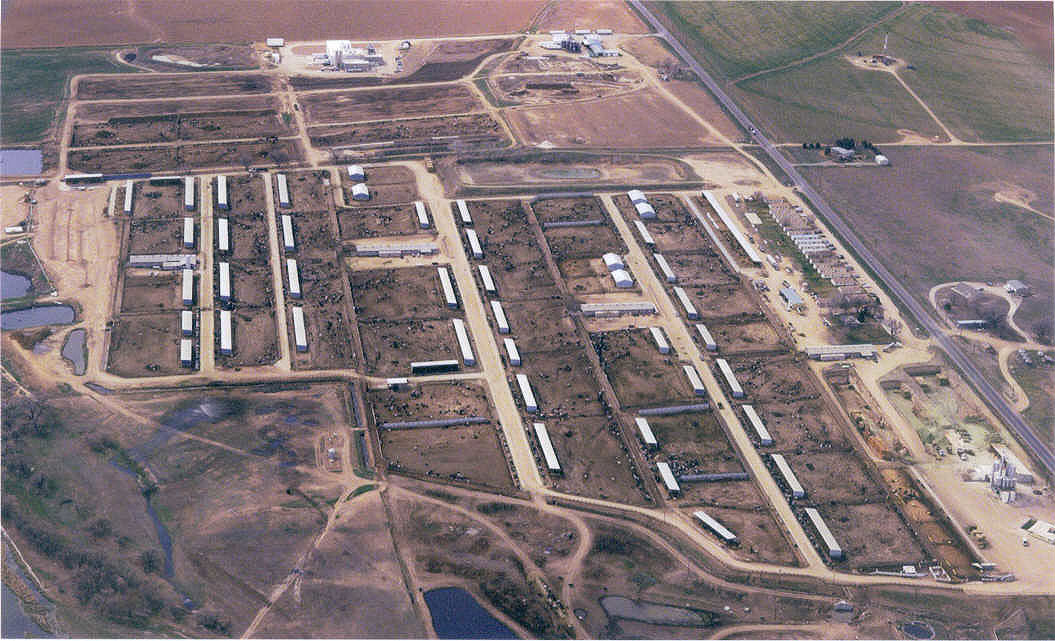 From the plane, Smithfield's farms replicate one another as far as I can see in every direction. Visibility is about four miles. I count the lagoons. There are 103. That works out to at least 50,000 hogs per square mile. You could fly for an hour, Dove says, and all you would see is corporate hog operations, with little towns of modular homes and a few family farms pinioned amid them.
Studies have shown that lagoons emit hundreds of different volatile gases into the atmosphere, including ammonia, methane, carbon dioxide and hydrogen sulfide. A single lagoon releases many millions of bacteria into the air per day, some resistant to human antibiotics. Hog farms in North Carolina also emit some 300 tons of nitrogen into the air every day as ammonia gas, much of which falls back to earth and deprives lakes and streams of oxygen, stimulating algal blooms and killing fish.
Looking down from the plane, we watch as several of Smithfield's farmers spray their hog shit straight up into the air as a fine mist: It looks like a public fountain. Lofted and atomized, the shit is blown clear of the company's property. People who breathe the shit-infused air suffer from bronchitis, asthma, heart palpitations, headaches, diarrhea, nosebleeds and brain damage. In 1995, a woman downwind from a corporate hog farm in Olivia, Minnesota, called a poison control center and described her symptoms. "Ma'am," the poison-control officer told her, "the only symptoms of hydrogen-sulfide poisoning you're not experiencing are seizures, convulsions and death. Leave the area immediately." When you fly over eastern North Carolina, you realize that virtually everyone in this part of the state lives close to a lagoon.

Each of the company's lagoons is surrounded by several fields. Pollution control at Smithfield consists of spraying the pig shit from the lagoons onto the fields to fertilize them. The idea is
borrowed from the past: The small hog farmers that Smithfield drove out of business used animal waste to fertilize their crops, which they then fed to the pigs. Smithfield says that this, in essence, is what it does -- its crops absorb every ounce of its pig shit, making the lagoon-sprayfield system a zero-discharge, nonpolluting waste-disposal operation. "If you manage your fields correctly, there should be no runoff, no pollution," says Dennis Treacy, Smithfield's vice president of environmental affairs. "If you're getting runoff, you're doing something wrong."
In fact, Smithfield doesn't grow nearly enough crops to absorb all of its hog weight. The company raises so many pigs in so little space that it actually has to import the majority of their food, which contains large amounts of nitrogen and phosphorus. Those chemicals -- discharged in pig shit and sprayed on fields -- run off into the surrounding ecosystem, causing what Dan Whittle, a former senior policy associate with the North Carolina Department of Environment and Natural Resources, calls a "mass imbalance." At one point, three hog-raising counties in North Carolina were producing more nitrogen, and eighteen were producing more phosphorus, than all the crops in the state could absorb.
 As we fly over the hog farms, I notice that springs and streams and swamplands and lakes are everywhere. Eastern North Carolina is a coastal plain, grooved and tilted towards the sea -- and Smithfield's sprayfields almost always incline toward creeks or creek-fed swamps. Half perforated pipes called irrigation tiles, commonly used in modern farming, run beneath many of the fields; when they become unplugged, the tiles effectively operate as drainpipes, dumping pig waste into surrounding tributaries. Many studies have documented the harm caused by hog-waste runoff; one showed the pig shit raising the level of nitrogen and phosphorus in a receiving river as much as sixfold. In eastern North Carolina, nine rivers and creeks in the Cape Fear and Neuse River basins have been classified by the state as either "negatively impacted" or environmentally "impaired."
Although Smithfield may not have enough crops to absorb its pig shit, its contract farmers do plant plenty of hay. In 1992, when the number of hogs in North Carolina began to skyrocket, so much hay was planted to deal with the fresh volumes of pig shit that the market for hay collapsed. But the hay from hog farms can be so nitrate-heavy that it sickens livestock. For a while, former governor Jim Hunt -- a recipient of hog-industry campaign money -- was feeding hog-farm hay to his cows. Locals say it made the cows sick and irritable, and the animals kicked Hunt several times, seemingly in revenge. It's a popular tale in eastern North Carolina.
To appreciate what this agglomeration of hog production does to the people who live near it, you have to appreciate the smell of industrial-strength pig shit. The ascending stench can nauseate pilots at 3,000 feet. On the day we fly over Smithfield's operation there is little wind to stir up the lagoons or carry the stink, and the region's current drought means that lagoon operators aren't spraying very frequently. It is the best of times. We can smell the farms from the air, but while the smell is foul it is intermittent and not particularly strong.
To get a really good whiff, I drive down a narrow country road of white sand and walk up to a Smithfield lagoon. At the end of the road stands a tractor and some spraying equipment. The fetid white carcass of a hog lies in a dumpster known as a "dead box." Flies cover the hog's snout. Its hooves look like high heels. Millions of factory-farm hogs -- one study puts it at ten percent -- die before they make it to the killing floor. Some are taken to rendering plants, where they are propelled through meat grinders and then fed cannibalistically back to other living hogs. Others are dumped into big open pits called "dead holes," or left in the dumpsters for so long that they swell and explode. The borders of hog farms are littered with dead pigs in all stages of decomposition, including thousands of bleached pig bones. Locals like to say that the bears and buzzards of eastern North Carolina are unusually lazy and fat.
No one seems to be around. It is quiet except for the gigantic exhaust fans affixed to the six hog houses. There is an unwholesome tang in the air, but there is no wind and it isn't hot, so I can't smell the lagoon itself. I walk the few hundred yards over to it. It is covered with a thick film; its edge is a narrow beach of big black flies. Here, its odor is leaking out. I take a deep breath. Concentrated manure is my first thought, but I am fighting an impulse to vomit even as I am thinking it. I've probably smelled stronger odors in my life, but nothing so insidiously and instantaneously nauseating. It takes my mind a second or two to get through the odor's first coat. The smell at its core has a frightening, uniquely enriched putridity, both deep-sweet and highsour. I back away from it and walk back to the car but I remain sick -- it's a shivery, retchy kind of nausea -- for a good five minutes. That's apparently characteristic of industrial pig shit: It keeps making you sick for a good while after you've stopped smelling it. It's an unduly invasive, adhesive smell. Your whole body reacts to it. It's as if something has physically entered your stomach. A little later I am driving and I catch a crosswind stench -- it must have been from a stirred-up lagoon -- and from the moment it hit me a timer in my body started ticking: You can only function for so long in that smell. The memory of it makes you gag.
 Unsurprisingly, prolonged exposure to hog-factory stench makes the smell extremely hard to get off. Hog factory workers stink up every store they walk into. I run into a few local guys who had made the mistake of accepting jobs in hog houses, and they tell me that you just have to wait the smell out: You'll eventually grow new hair and skin. If you work in a Smithfield hog house for a year and then quit, you might stink for the next three months.
If the temperature and wind aren't right and the lagoon operators are spraying, people in hog country can't hang laundry or sit on their porches or mow their lawns. Epidemiological studies show that those who live near hog lagoons suffer from abnormally high levels of depression,
tension, anger, fatigue and confusion. "We are used to farm odors," says one local farmer. "These are not farm odors." Sometimes the stink literally knocks people down: They walk out of the house to get something in the yard and become so nauseous they collapse. When they retain consciousness, they crawl back into the house.
That has happened several times to Julian and Charlotte Savage, an elderly couple whose farmland now abuts a Smithfield sprayfield -- one of several meant to absorb the shit of 50,000 hogs. The Savages live in a small, modular kit house. Sitting in the kitchen, Charlotte tells me that she once saw Julian collapse in the yard and ran out and threw a coat over his head and dragged him back inside. Before Smithfield arrived, Julian's family farmed the land for the better part of a century. He raised tobacco, corn, wheat, turkeys and chickens. Now he has respiratory problems and rarely attempts to go outside.
Behind the house, a creek bordering the sprayfield flows into a swamp; the Savages have seen hog waste running right into the creek. Once, during a flood, the Savages found pig shit six inches deep pooled around their house. They had to drain it by digging trenches, which took three weeks. Charlotte has noticed that nitrogen fallout keeps the trees around the house a deep synthetic green. There's a big buzzard population.
The Savages say they can keep the pig-shit smell out of their house by shutting the doors and windows, but to me the walls reek faintly. They have a windbreak -- an eighty-foot-wide strip of forest -- between their house and the fields. They know people who don't, though, and when the smell is bad, those people, like everyone, shut their windows and slam their front doors shut quickly behind them, but their coffee and spaghetti and carrots still smell and taste like pig shit. The Savages have had what seemed to be hog shit in their bath water. Their well water, which was clean before Smithfield arrived, is now suspect. "I try not to drink it," Charlotte says. "We mostly just drink drinks, soda and things." While we talk, Julian spends most of the time on the living room couch; his lungs are particularly bad today. Then he comes into the kitchen. Among other things, he says: I can't breathe it, it'll put you on the ground; you can't walk, you fall down; you breathe you gon' die; you go out and smell it one time and your ass is gone; it's not funny to be around it. It's not funny, honey. He could have said all this somewhat tragicomically, with a thin smile, but instead he cries the whole time.
Smithfield is not just a virtuosic polluter; it is also a theatrical one. Its lagoons are historically prone to failure. In North Carolina alone they have spilled, in a span of four years, 2 million gallons of shit into the Cape Fear River, 1.5 million gallons into its Persimmon Branch, one million gallons into the Trent River and 200,000 gallons into Turkey Creek. In Virginia, Smithfield was fined $12.6 million in 1997 for 6,900 violations of the Clean Water Act -- the third-largest civil penalty ever levied under the act by the EPA. It amounted to .035 percent of Smithfield's annual sales.
A river that receives a lot of waste from an industrial hog farm begins to die quickly. Toxins and microbes can kill plants and animals outright; the waste itself consumes available oxygen and suffocates fish and aquatic animals; and the nutrients in the pig shit produce algal blooms that also deoxygenate the water. The Pagan River runs by Smithfield's original plant and headquarters in Virginia, which served as Joseph Luter's staging ground for his assault on the pork-raising and processing industries. For several decades, before a spate of regulations, the Pagan had no living marsh grass, a tiny and toxic population of fish and shellfish and a half foot of noxious black mud coating its bed. The hulls of boats winched up out of the river bore inch thick coats of greasy muck. In North Carolina, much of the pig waste from Smithfield's operations makes its way into the Neuse River; in a five-day span in 2003 alone, more than 4 million fish died. Pig-waste runoff has damaged the Albemarle-Pamlico Sound, which is almost as big as the Chesapeake Bay and which provides half the nursery grounds used by fish in the eastern Atlantic.
The biggest spill in the history of corporate hog farming happened in 1995. The dike of a 120,000-square-foot lagoon owned by a Smithfield competitor ruptured, releasing 25.8 million gallons of effluvium into the headwaters of the New River in North Carolina. It was the biggest environmental spill in United States history, more than twice as big as the Exxon Valdez oil spill six years earlier. The sludge was so toxic it burned your skin if you touched it, and so dense it took almost two months to make its way sixteen miles downstream to the ocean. From the headwaters to the sea, every creature living in the river was killed. Fish died by the millions. It's hard to conceive of a fish kill that size. The kill began with turbulence in one small part of the water: fish writhing and dying. Then it spread in patches along the entire length and breadth of the river. In two hours, dead and dying fish were mounded wherever the river's contours slowed the current, and the riverbanks were mostly dead fish. Within a day dead fish completely covered the riverbanks, and between the floating and beached and piled fish the water scintillated out of sight up and down the river with billions of buoyant dead eyes and scales and white bellies -- more fish than the river seemed capable of holding. The smell of rotting fish covered much of the county; the air above the river was chaotic with scavenging birds. There were far more dead fish than the birds could ever eat.

Spills aren't the worst thing that can happen to toxic pig waste lying exposed in fields and lagoons. Hurricanes are worse. In 1999, Hurricane Floyd washed 120,000,000 gallons of unsheltered hog waste into the Tar, Neuse, Roanoke, Pamlico, New and Cape Fear rivers. Many of the pig-shit lagoons of eastern North Carolina were several feet underwater. Satellite photographs show a dark brown tide closing over the region's waterways, converging on the Albemarle-Pamlico Sound and feeding itself out to sea in a long, well-defined channel. Very little freshwater marine life remained behind. Tens of thousands of drowned pigs were strewn across the land. Beaches located miles from Smithfield lagoons were slathered in feces. A picture taken at the time shows a shark eating a dead pig three miles off the North Carolina coast.
From a waste-disposal perspective, Hurricane Floyd was the best thing that had ever happened to corporate hog farming in North Carolina. Smithfield currently has tens of thousands of gallons of open-air waste awaiting more Floyds.
In addition to such impressive disasters, corporate hog farming contributes to another form of environmental havoc: Pfiesteria piscicida, a microbe that, in its toxic form, has killed a billion fish and injured dozens of people. Nutrient-rich waste like pig shit creates the ideal environment for Pfiesteria to bloom: The microbe eats fish attracted to algae nourished by the waste. Pfiesteria is invisible and odorless -- you know it by the trail of dead. The microbe degrades a fish's skin, laying bare tissue and blood cells; it then eats its way into the fish's body. After the 1995 spill, millions of fish developed large bleeding sores on their sides and quickly died. Fishermen found that at least one of Pfiesteria's toxins could take flight: Breathing the air above the bloom caused severe respiratory difficulty, headaches, blurry vision and logical impairment. Some fishermen forgot how to get home; laboratory workers exposed to Pfiesteria lost the ability to solve simple math problems and dial phones; they forgot their own names. It could take weeks or months for the brain and lungs to recover.
Smithfield is no longer able to disfigure watersheds quite so obviously as in the past; it can no longer expand and flatten small pig farms quite so easily. Several state legislatures have passed laws prohibiting or limiting the ownership of small farms by pork processors. In some places, new slaughterhouses are required to meet expensive waste-disposal requirements; many are forbidden from using the waste-lagoon system. North Carolina, where pigs now outnumber people, has passed a moratorium on new hog operations and ordered Smithfield to fund research into alternative waste-disposal technologies. South Carolina, having taken a good look at its neighbor's coastal plain, has pronounced the company unwelcome in the state. The federal government and several states have challenged some of Smithfield's recent acquisition deals and, in a few instances, have forced the company to agree to modify its waste-lagoon systems.
 These initiatives, of course, come comically late. Industrial hog operations control at least seventy-five percent of the market. Smithfield's market dominance is hardly at risk: Twenty-six percent of the pork processed in this country is Smithfield pork. The company's expansion does not seem to be slowing down: Over the past two years, Smithfield's annual sales grew by $1.5 billion. In September, the company announced that it is merging with Premium Standard Farms, the nation's second-largest hog farmer and sixth-largest pork processor. If the deal goes through, Smithfield will own more pigs than the next eight largest pork producers in the nation combined. The company's market leverage and political clout will allow it to produce ever greater quantities of hog waste.
Smithfield points to the improvements it has made to its waste-disposal systems in recent years. In 2003, Smithfield announced that it was investing $20 million in a program to turn its pig shit in Utah into alternative fuel. It now produces approximately 2,500 gallons a day of biomethanol and has begun building a facility in Texas to produce clean-burning biodiesel fuel.
"We're paying a lot of attention to energy right now," says Treacy, the Smithfield vice president. "We've come such a long way in the last five years." The company, he adds, has undergone a "complete cultural shift on environmental matters."
But cultural shifts, no matter how genuine, cannot counter the unalterable physical reality of Smithfield Foods itself. "All of a sudden we have this 800-pound gorilla in the pork industry," Successful Farming magazine warned -- six years ago. There simply is no regulatory solution to the millions of tons of searingly fetid, toxic effluvium that industrial hog farms discharge and aerosolize on a daily basis. Smithfield alone has sixteen operations in twelve states. Fixing the problem completely would bankrupt the company. According to Dr. Michael Mallin, a marine scientist at the University of North Carolina at Wilmington who has researched the effects of corporate farming on water quality, the volumes of concentrated pig waste produced by industrial hog farms are plainly not containable in small areas. The land, he says, "just can't absorb everything that comes out of the barns." From the moment that Smithfield attained its current size, its waste-disposal problem became conventionally insoluble.
Joe Luter, like his pig shit, has an innate aversion to being contained in any way. Ever since American regulators and lawmakers started forcing Smithfield to spend more money on waste treatment and attempting to limit the company's expansion, Luter has been looking to do business elsewhere. In recent years, his gaze has fallen on the lucrative and unregulated markets of Poland. In 1999, Luter bought a state-owned company called Animex, one of Poland's biggest hog processors. Then he began doing business through a Polish subsidiary called Prima Farms, acquiring huge moribund Communist-era hog farms and converting them into concentrated feeding operations. Pork prices in Poland were low, so Smithfield's sweeping expansion didn't make strict economic sense, except that it had the virtue of pushing small hog farmers toward bankruptcy. By 2003, Animex was operating six subsidiary companies and seven processing plants, selling nine brands of meat and taking in $338 million annually.
The usual violations occurred. Near one of Smithfield's largest plants, in Byszkowo, an enormous pool of frozen pig shit, pumped into a lagoon in winter, melted and ran into two nearby lakes. The lake water turned brown; residents in local villages got skin rashes and eye infections; the stench made it impossible to eat. A recent report to the Helsinki Commission found that Smithfield's pollution throughout Poland was damaging the country's ecosystems. Overapplication was endemic. Farmers without permits were piping liquid pig shit directly into watersheds that fed into the Baltic Sea.
When Joseph Luter entered Poland, he announced that he planned to turn the country into the "Iowa of Europe." Iowa has always been America's biggest hog producer and remains the nation's chief icon of hog farming. Having subdued Poland, Luter announced this summer that all of Eastern Europe -- "particularly Romania" -- should become the "Iowa of Europe." Seventy-five percent of Romania's hogs currently come from household farms. Over the next five years, Smithfield plans to spend $800 million in Romania to change that.

America's top pork producer churns out a sea of waste that has destroyed rivers, killed millions of fish and generated one of the largest fines in EPA history.
Welcome to the dark side of the other white meat.
(photo by doveimaging.com)
JEFF TIETZ
Smithfield Foods, the largest and most profitable pork processor in the world, killed 27 million hogs last year. That's a number worth considering. A slaughter-weight hog is fifty percent heavier than a person. The logistical challenge of processing that many pigs each year is roughly equivalent to butchering and boxing the entire human populations of New York, Los Angeles, Chicago, Houston, Philadelphia, Phoenix, San Antonio, San Diego, Dallas, San Jose, Detroit, Indianapolis, Jacksonville, San Francisco, Columbus, Austin, Memphis, Baltimore, Fort Worth, Charlotte, El Paso, Milwaukee, Seattle, Boston, Denver, Louisville, Washington, D.C., Nashville, Las Vegas, Portland, Oklahoma City and Tucson.
Smithfield Foods actually faces a more difficult task than transmogrifying the populations of America's thirty-two largest cities into edible packages of meat. Hogs produce three times more excrement than human beings do. The 500,000 pigs at a single Smithfield subsidiary in Utah generate more fecal matter each year than the 1.5 million inhabitants of Manhattan. The best estimates put Smithfield's total waste discharge at 26 million tons a year. That would fill four Yankee Stadiums. Even when divided among the many small pig production units that surround the company's slaughterhouses, that is not a containable amount.
Smithfield estimates that its total sales will reach $11.4 billion this year. So prodigious is its fecal waste, however, that if the company treated its effluvia as big-city governments do -- even if it came marginally close to that standard -- it would lose money. So many of its contractors allow great volumes of waste to run out of their slope-floored barns and sit blithely in the open, untreated, where the elements break it down and gravity pulls it into groundwater and river systems. Although the company proclaims a culture of environmental responsibility, ostentatious pollution is a linchpin of Smithfield's business model.
A lot of pig shit is one thing; a lot of highly toxic pig shit is another. The excrement of Smithfield hogs is hardly even pig shit: On a continuum of pollutants, it is probably closer to radioactive waste than to organic manure. The reason it is so toxic is Smithfield's efficiency. The company produces 6 billion pounds of packaged pork each year. That's a remarkable achievement, a prolificacy unimagined only two decades ago, and the only way to do it is to raise pigs in astonishing, unprecedented concentrations.
Smithfield's pigs live by the hundreds or thousands in warehouse-like barns, in rows of wall-towall pens. Sows are artificially inseminated and fed and delivered of their piglets in cages so small they cannot turn around. Forty fully grown 250-pound male hogs often occupy a pen the size of a tiny apartment. They trample each other to death. There is no sunlight, straw, fresh air or earth. The floors are slatted to allow excrement to fall into a catchment pit under the pens, but many things besides excrement can wind up in the pits: afterbirths, piglets accidentally crushed by their mothers, old batteries, broken bottles of insecticide, antibiotic syringes, stillborn pigs -- anything small enough to fit through the foot-wide pipes that drain the pits. The pipes remain closed until enough sewage accumulates in the pits to create good expulsion pressure; then the pipes are opened and everything bursts out into a large holding pond.
The temperature inside hog houses is often hotter than ninety degrees. The air, saturated almost to the point of precipitation with gases from shit and chemicals, can be lethal to the pigs. Enormous exhaust fans run twenty-four hours a day. The ventilation systems function like the ventilators of terminal patients: If they break down for any length of time, pigs start dying. From Smithfield's point of view, the problem with this lifestyle is immunological. Taken together, the immobility, poisonous air and terror of confinement badly damage the pigs' immune systems. They become susceptible to infection, and in such dense quarters microbes or parasites or fungi, once established in one pig, will rush spritelike through the whole population.
Accordingly, factory pigs are infused with a huge range of antibiotics and vaccines, and are doused with insecticides. Without these compounds -- oxytetracycline, draxxin, ceftiofur, tiamulin -- diseases would likely kill them. Thus factory-farm pigs remain in a state of dying until they're slaughtered. When a pig nearly ready to be slaughtered grows ill, workers sometimes shoot it up with as many drugs as necessary to get it to the slaughterhouse under its own power. As long as the pig remains ambulatory, it can be legally killed and sold as meat. The drugs Smithfield administers to its pigs, of course, exit its hog houses in pig shit. Industrial pig waste also contains a host of other toxic substances: ammonia, methane, hydrogen sulfide, carbon monoxide, cyanide, phosphorous, nitrates and heavy metals. In addition, the waste nurses more than 100 microbial pathogens that can cause illness in humans, including salmonella, cryptosporidium, streptocolli and girardia. Each gram of hog shit can contain as much as 100 million fecal coliform bacteria.
Smithfield's holding ponds -- the company calls them lagoons -- cover as much as 120,000 square feet. The area around a single slaughterhouse can contain hundreds of lagoons, some of which run thirty feet deep. The liquid in them is not brown. The interactions between the bacteria and blood and afterbirths and stillborn piglets and urine and excrement and chemicals and drugs turn the lagoons pink.
Even light rains can cause lagoons to overflow; major floods have transformed entire counties into pig-shit bayous. To alleviate swelling lagoons, workers sometimes pump the shit out of them and spray the waste on surrounding fields, which results in what the industry daintily refers to as "overapplication." This can turn hundreds of acres -- thousands of football fields -- into shallow mud puddles of pig shit. Tree branches drip with pig shit. Some pig-farm lagoons have polyethylene liners, which can be punctured by rocks in the ground, allowing shit to seep beneath the liners and spread and ferment. Gases from the fermentation can inflate the liner like a hot-air balloon and rise in an expanding, accelerating bubble, forcing thousands of tons of feces out of the lagoon in all directions.
The lagoons themselves are so viscous and venomous that if someone falls in it is foolish to try to save him. A few years ago, a truck driver in Oklahoma was transferring pig shit to a lagoon when he and his truck went over the side. It took almost three weeks to recover his body. In 1992, when a worker making repairs to a lagoon in Minnesota began to choke to death on the fumes, another worker dived in after him, and they died the same death. In another instance, a worker who was repairing a lagoon in Michigan was overcome by the fumes and fell in. His fifteen-year-old nephew dived in to save him but was overcome, the worker's cousin went in to save the teenager but was overcome, the worker's older brother dived in to save them but was overcome, and then the worker's father dived in. They all died in pig shit.
The chairman of Smithfield Foods, Joseph Luter III, is a funny, jowly, canny, barbarous guy who lives in a multimillion-dollar condo on Park Avenue in Manhattan and conveys himself about the planet in a corporate jet and a private yacht. At sixty-seven, he is unrepentant in the face of criticism. He describes himself as a "tough man in a tough business" and his factories as wholly legitimate products of the American free market. He can be sardonic; he likes to mock his critics and rivals. "The animal-rights people," he once said, "want to impose a vegetarian's society on the U.S. Most vegetarians I know are neurotic." When the Environmental Protection Agency cited Smithfield for thousands of violations of the Clean Water Act, Luter responded by comparing what he claimed were the number of violations the company could theoretically have been charged with (2.5 million, by his calculation) to the number of documented violations up to that point (seventy-four). "A very, very small percent," he said.
Luter grew up butchering hogs in his father's slaughterhouse, in the town of Smithfield, Virginia. When he took over the family business forty years ago, it was a local, marginally profitable meatpacking operation. Under Luter, Smithfield was soon making enough money to begin purchasing neighboring meatpackers. From the beginning, Luter thought monopolistically. He bought out his local competition until he completely dominated the regional pork-processing market.
But Luter was dissatisfied. The company was still buying most of its hogs from local farmers; Luter wanted to create a system, known as "total vertical integration," in which Smithfield controls every stage of production, from the moment a hog is born until the day it passes through the slaughterhouse. So he imposed a new kind of contract on farmers: The company would own the living hogs; the contractors would raise the pigs and be responsible for managing the hog shit and disposing of dead hogs. The system made it impossible for small hog farmers to survive -- those who could not handle thousands and thousands of pigs were driven out of business. "It was a simple matter of economic power," says Eric Tabor, chief of staff for Iowa's attorney general.
Smithfield's expansion was unique in the history of the industry: Between 1990 and 2005, it grew by more than 1,000 percent. In 1997 it was the nation's seventh-largest pork producer; by 1999 it was the largest. Smithfield now kills one of every four pigs sold commercially in the United States. As Smithfield expanded, it consolidated its operations, clustering millions of fattening hogs around its slaughterhouses. Under Luter, the company was turning into a great pollution machine: Smithfield was suddenly producing unheard-of amounts of pig shit laced with drugs and chemicals. According to the EPA, Smithfield's largest farm-slaughterhouse operation -- in Tar Heel, North Carolina -- dumps more toxic waste into the nation's water each year than all but three other industrial facilities in America.
Luter likes to tell this story: An old man and his grandson are walking in a cemetery. They see a tombstone that reads here lies charles w. johnson, a man who had no enemies. "Gee, Granddad," the boy says, "this man must have been a great man. He had no enemies." "Son," the grandfather replies, "if a man didn't have any enemies, he didn't do a damn thing with his life." If Luter were to set this story in Ivy Hill Cemetery in his hometown of Smithfield, it would be an object lesson in how to make enemies. Back when he was growing up, the branches of the cemetery's trees were bent with the weight of scores of buzzards. The waste stream from the Luters' meatpacking plant, with its thickening agents of pig innards and dead fish, flowed nearby.
Luter learned the family trade well. Last year, before he retired as CEO of Smithfield, he took home $10,802,134. He currently holds $19,296,000 in unexercised stock options. One day this fall, a retired Marine Corps colonel and environmental activist named Rick Dove, the former riverkeeper of North Carolina's Neuse River, arranged to have me flown over Smithfield's operation in North Carolina. Dove, a focused guy of sixty-seven years, is unable to talk about corporate hog farming without becoming angry. After he got out of the Marine Corps in 1987, he became a commercial fisherman, which he had wanted to do since he was a kid. He was successful, and his son went into business with him. Then industrial hog farming arrived and killed the fish, and both Dove and his son got seriously ill.
Dove and other activists provide the only effective oversight of corporate hog farming in the area. The industry has long made generous campaign contributions to politicians responsible for regulating hog farms. In 1995, while Smithfield was trying to persuade the state of Virginia to reduce a large fine for the company's pollution, Joseph Luter gave $100,000 to then-governor George Allen's political-action committee. In 1998, corporate hog farms in North Carolina spent $1 million to help defeat state legislators who wanted to clean up open-pit lagoons. The state has consistently failed to employ enough inspectors to ensure that hog farms are complying with environmental standards.
To document violations, Dove and other activists regularly hire private planes to inspect corporate hog operations from the air. The airport Dove uses, in New Bern, North Carolina, is tiny; the plane he uses, a 1975 Cessna single-prop, looks tiny even in the tiny airport. Its cabin has four cracked yellow linoleum seats. It looks like the interior of a 1975 VW bug, but with more dials. The pilot, Joe Corby, is older than I expected him to be. "I have a GPS, so I can kinda guide you," Dove says to Corby while we taxi to the runway. "Oh, you do!" Corby says, apparently unaccustomed to such a luxury. "Well, OK." We take off. "Bunch of turkey buzzards," Dove says, looking out the window. "They're big." "Don't wanna hit them," Corby says. "They would be . . . very destructive."
We climb to 2,000 feet and head toward the densest concentration of hogs in the world. The landscape at first is unsuspiciously pastoral -- fields planted in corn or soybeans or cotton, tree lines staking creeks, a few unincorporated villages of prefab houses. But then we arrive at the global locus of hog farming, and the countryside turns into an immense subdivision for pigs. Hog farms that contract with Smithfield differ slightly in dimension but otherwise look identical: parallel rows of six, eight or twelve one-story hog houses, some nearly the size of a football field, containing as many as 10,000 hogs, and backing onto a single large lagoon. From the air I see that the lagoons come in two shades of pink: dark or Pepto Bismol -- vile, freaky colors in the middle of green farmland.
From the plane, Smithfield's farms replicate one another as far as I can see in every direction. Visibility is about four miles. I count the lagoons. There are 103. That works out to at least 50,000 hogs per square mile. You could fly for an hour, Dove says, and all you would see is corporate hog operations, with little towns of modular homes and a few family farms pinioned amid them. Studies have shown that lagoons emit hundreds of different volatile gases into the atmosphere, including ammonia, methane, carbon dioxide and hydrogen sulfide. A single lagoon releases many millions of bacteria into the air per day, some resistant to human antibiotics. Hog farms in North Carolina also emit some 300 tons of nitrogen into the air every day as ammonia gas, much of which falls back to earth and deprives lakes and streams of oxygen, stimulating algal blooms and killing fish.
Looking down from the plane, we watch as several of Smithfield's farmers spray their hog shit straight up into the air as a fine mist: It looks like a public fountain. Lofted and atomized, the shit is blown clear of the company's property. People who breathe the shit-infused air suffer from bronchitis, asthma, heart palpitations, headaches, diarrhea, nosebleeds and brain damage. In 1995, a woman downwind from a corporate hog farm in Olivia, Minnesota, called a poison control center and described her symptoms. "Ma'am," the poison-control officer told her, "the only symptoms of hydrogen-sulfide poisoning you're not experiencing are seizures, convulsions and death. Leave the area immediately." When you fly over eastern North Carolina, you realize that virtually everyone in this part of the state lives close to a lagoon.
Each of the company's lagoons is surrounded by several fields. Pollution control at Smithfield consists of spraying the pig shit from the lagoons onto the fields to fertilize them. The idea is
borrowed from the past: The small hog farmers that Smithfield drove out of business used animal waste to fertilize their crops, which they then fed to the pigs. Smithfield says that this, in essence, is what it does -- its crops absorb every ounce of its pig shit, making the lagoon-sprayfield system a zero-discharge, nonpolluting waste-disposal operation. "If you manage your fields correctly, there should be no runoff, no pollution," says Dennis Treacy, Smithfield's vice president of environmental affairs. "If you're getting runoff, you're doing something wrong."
In fact, Smithfield doesn't grow nearly enough crops to absorb all of its hog weight. The company raises so many pigs in so little space that it actually has to import the majority of their food, which contains large amounts of nitrogen and phosphorus. Those chemicals -- discharged in pig shit and sprayed on fields -- run off into the surrounding ecosystem, causing what Dan Whittle, a former senior policy associate with the North Carolina Department of Environment and Natural Resources, calls a "mass imbalance." At one point, three hog-raising counties in North Carolina were producing more nitrogen, and eighteen were producing more phosphorus, than all the crops in the state could absorb.
Although Smithfield may not have enough crops to absorb its pig shit, its contract farmers do plant plenty of hay. In 1992, when the number of hogs in North Carolina began to skyrocket, so much hay was planted to deal with the fresh volumes of pig shit that the market for hay collapsed. But the hay from hog farms can be so nitrate-heavy that it sickens livestock. For a while, former governor Jim Hunt -- a recipient of hog-industry campaign money -- was feeding hog-farm hay to his cows. Locals say it made the cows sick and irritable, and the animals kicked Hunt several times, seemingly in revenge. It's a popular tale in eastern North Carolina.
To appreciate what this agglomeration of hog production does to the people who live near it, you have to appreciate the smell of industrial-strength pig shit. The ascending stench can nauseate pilots at 3,000 feet. On the day we fly over Smithfield's operation there is little wind to stir up the lagoons or carry the stink, and the region's current drought means that lagoon operators aren't spraying very frequently. It is the best of times. We can smell the farms from the air, but while the smell is foul it is intermittent and not particularly strong.
To get a really good whiff, I drive down a narrow country road of white sand and walk up to a Smithfield lagoon. At the end of the road stands a tractor and some spraying equipment. The fetid white carcass of a hog lies in a dumpster known as a "dead box." Flies cover the hog's snout. Its hooves look like high heels. Millions of factory-farm hogs -- one study puts it at ten percent -- die before they make it to the killing floor. Some are taken to rendering plants, where they are propelled through meat grinders and then fed cannibalistically back to other living hogs. Others are dumped into big open pits called "dead holes," or left in the dumpsters for so long that they swell and explode. The borders of hog farms are littered with dead pigs in all stages of decomposition, including thousands of bleached pig bones. Locals like to say that the bears and buzzards of eastern North Carolina are unusually lazy and fat.
No one seems to be around. It is quiet except for the gigantic exhaust fans affixed to the six hog houses. There is an unwholesome tang in the air, but there is no wind and it isn't hot, so I can't smell the lagoon itself. I walk the few hundred yards over to it. It is covered with a thick film; its edge is a narrow beach of big black flies. Here, its odor is leaking out. I take a deep breath. Concentrated manure is my first thought, but I am fighting an impulse to vomit even as I am thinking it. I've probably smelled stronger odors in my life, but nothing so insidiously and instantaneously nauseating. It takes my mind a second or two to get through the odor's first coat. The smell at its core has a frightening, uniquely enriched putridity, both deep-sweet and highsour. I back away from it and walk back to the car but I remain sick -- it's a shivery, retchy kind of nausea -- for a good five minutes. That's apparently characteristic of industrial pig shit: It keeps making you sick for a good while after you've stopped smelling it. It's an unduly invasive, adhesive smell. Your whole body reacts to it. It's as if something has physically entered your stomach. A little later I am driving and I catch a crosswind stench -- it must have been from a stirred-up lagoon -- and from the moment it hit me a timer in my body started ticking: You can only function for so long in that smell. The memory of it makes you gag.
Unsurprisingly, prolonged exposure to hog-factory stench makes the smell extremely hard to get off. Hog factory workers stink up every store they walk into. I run into a few local guys who had made the mistake of accepting jobs in hog houses, and they tell me that you just have to wait the smell out: You'll eventually grow new hair and skin. If you work in a Smithfield hog house for a year and then quit, you might stink for the next three months. If the temperature and wind aren't right and the lagoon operators are spraying, people in hog country can't hang laundry or sit on their porches or mow their lawns. Epidemiological studies show that those who live near hog lagoons suffer from abnormally high levels of depression,
tension, anger, fatigue and confusion. "We are used to farm odors," says one local farmer. "These are not farm odors." Sometimes the stink literally knocks people down: They walk out of the house to get something in the yard and become so nauseous they collapse. When they retain consciousness, they crawl back into the house.
That has happened several times to Julian and Charlotte Savage, an elderly couple whose farmland now abuts a Smithfield sprayfield -- one of several meant to absorb the shit of 50,000 hogs. The Savages live in a small, modular kit house. Sitting in the kitchen, Charlotte tells me that she once saw Julian collapse in the yard and ran out and threw a coat over his head and dragged him back inside. Before Smithfield arrived, Julian's family farmed the land for the better part of a century. He raised tobacco, corn, wheat, turkeys and chickens. Now he has respiratory problems and rarely attempts to go outside.
Behind the house, a creek bordering the sprayfield flows into a swamp; the Savages have seen hog waste running right into the creek. Once, during a flood, the Savages found pig shit six inches deep pooled around their house. They had to drain it by digging trenches, which took three weeks. Charlotte has noticed that nitrogen fallout keeps the trees around the house a deep synthetic green. There's a big buzzard population.
The Savages say they can keep the pig-shit smell out of their house by shutting the doors and windows, but to me the walls reek faintly. They have a windbreak -- an eighty-foot-wide strip of forest -- between their house and the fields. They know people who don't, though, and when the smell is bad, those people, like everyone, shut their windows and slam their front doors shut quickly behind them, but their coffee and spaghetti and carrots still smell and taste like pig shit. The Savages have had what seemed to be hog shit in their bath water. Their well water, which was clean before Smithfield arrived, is now suspect. "I try not to drink it," Charlotte says. "We mostly just drink drinks, soda and things." While we talk, Julian spends most of the time on the living room couch; his lungs are particularly bad today. Then he comes into the kitchen. Among other things, he says: I can't breathe it, it'll put you on the ground; you can't walk, you fall down; you breathe you gon' die; you go out and smell it one time and your ass is gone; it's not funny to be around it. It's not funny, honey. He could have said all this somewhat tragicomically, with a thin smile, but instead he cries the whole time.
Smithfield is not just a virtuosic polluter; it is also a theatrical one. Its lagoons are historically prone to failure. In North Carolina alone they have spilled, in a span of four years, 2 million gallons of shit into the Cape Fear River, 1.5 million gallons into its Persimmon Branch, one million gallons into the Trent River and 200,000 gallons into Turkey Creek. In Virginia, Smithfield was fined $12.6 million in 1997 for 6,900 violations of the Clean Water Act -- the third-largest civil penalty ever levied under the act by the EPA. It amounted to .035 percent of Smithfield's annual sales.
A river that receives a lot of waste from an industrial hog farm begins to die quickly. Toxins and microbes can kill plants and animals outright; the waste itself consumes available oxygen and suffocates fish and aquatic animals; and the nutrients in the pig shit produce algal blooms that also deoxygenate the water. The Pagan River runs by Smithfield's original plant and headquarters in Virginia, which served as Joseph Luter's staging ground for his assault on the pork-raising and processing industries. For several decades, before a spate of regulations, the Pagan had no living marsh grass, a tiny and toxic population of fish and shellfish and a half foot of noxious black mud coating its bed. The hulls of boats winched up out of the river bore inch thick coats of greasy muck. In North Carolina, much of the pig waste from Smithfield's operations makes its way into the Neuse River; in a five-day span in 2003 alone, more than 4 million fish died. Pig-waste runoff has damaged the Albemarle-Pamlico Sound, which is almost as big as the Chesapeake Bay and which provides half the nursery grounds used by fish in the eastern Atlantic.
The biggest spill in the history of corporate hog farming happened in 1995. The dike of a 120,000-square-foot lagoon owned by a Smithfield competitor ruptured, releasing 25.8 million gallons of effluvium into the headwaters of the New River in North Carolina. It was the biggest environmental spill in United States history, more than twice as big as the Exxon Valdez oil spill six years earlier. The sludge was so toxic it burned your skin if you touched it, and so dense it took almost two months to make its way sixteen miles downstream to the ocean. From the headwaters to the sea, every creature living in the river was killed. Fish died by the millions. It's hard to conceive of a fish kill that size. The kill began with turbulence in one small part of the water: fish writhing and dying. Then it spread in patches along the entire length and breadth of the river. In two hours, dead and dying fish were mounded wherever the river's contours slowed the current, and the riverbanks were mostly dead fish. Within a day dead fish completely covered the riverbanks, and between the floating and beached and piled fish the water scintillated out of sight up and down the river with billions of buoyant dead eyes and scales and white bellies -- more fish than the river seemed capable of holding. The smell of rotting fish covered much of the county; the air above the river was chaotic with scavenging birds. There were far more dead fish than the birds could ever eat.
Spills aren't the worst thing that can happen to toxic pig waste lying exposed in fields and lagoons. Hurricanes are worse. In 1999, Hurricane Floyd washed 120,000,000 gallons of unsheltered hog waste into the Tar, Neuse, Roanoke, Pamlico, New and Cape Fear rivers. Many of the pig-shit lagoons of eastern North Carolina were several feet underwater. Satellite photographs show a dark brown tide closing over the region's waterways, converging on the Albemarle-Pamlico Sound and feeding itself out to sea in a long, well-defined channel. Very little freshwater marine life remained behind. Tens of thousands of drowned pigs were strewn across the land. Beaches located miles from Smithfield lagoons were slathered in feces. A picture taken at the time shows a shark eating a dead pig three miles off the North Carolina coast.
From a waste-disposal perspective, Hurricane Floyd was the best thing that had ever happened to corporate hog farming in North Carolina. Smithfield currently has tens of thousands of gallons of open-air waste awaiting more Floyds.
In addition to such impressive disasters, corporate hog farming contributes to another form of environmental havoc: Pfiesteria piscicida, a microbe that, in its toxic form, has killed a billion fish and injured dozens of people. Nutrient-rich waste like pig shit creates the ideal environment for Pfiesteria to bloom: The microbe eats fish attracted to algae nourished by the waste. Pfiesteria is invisible and odorless -- you know it by the trail of dead. The microbe degrades a fish's skin, laying bare tissue and blood cells; it then eats its way into the fish's body. After the 1995 spill, millions of fish developed large bleeding sores on their sides and quickly died. Fishermen found that at least one of Pfiesteria's toxins could take flight: Breathing the air above the bloom caused severe respiratory difficulty, headaches, blurry vision and logical impairment. Some fishermen forgot how to get home; laboratory workers exposed to Pfiesteria lost the ability to solve simple math problems and dial phones; they forgot their own names. It could take weeks or months for the brain and lungs to recover.
Smithfield is no longer able to disfigure watersheds quite so obviously as in the past; it can no longer expand and flatten small pig farms quite so easily. Several state legislatures have passed laws prohibiting or limiting the ownership of small farms by pork processors. In some places, new slaughterhouses are required to meet expensive waste-disposal requirements; many are forbidden from using the waste-lagoon system. North Carolina, where pigs now outnumber people, has passed a moratorium on new hog operations and ordered Smithfield to fund research into alternative waste-disposal technologies. South Carolina, having taken a good look at its neighbor's coastal plain, has pronounced the company unwelcome in the state. The federal government and several states have challenged some of Smithfield's recent acquisition deals and, in a few instances, have forced the company to agree to modify its waste-lagoon systems.
Smithfield points to the improvements it has made to its waste-disposal systems in recent years. In 2003, Smithfield announced that it was investing $20 million in a program to turn its pig shit in Utah into alternative fuel. It now produces approximately 2,500 gallons a day of biomethanol and has begun building a facility in Texas to produce clean-burning biodiesel fuel.
"We're paying a lot of attention to energy right now," says Treacy, the Smithfield vice president. "We've come such a long way in the last five years." The company, he adds, has undergone a "complete cultural shift on environmental matters."
But cultural shifts, no matter how genuine, cannot counter the unalterable physical reality of Smithfield Foods itself. "All of a sudden we have this 800-pound gorilla in the pork industry," Successful Farming magazine warned -- six years ago. There simply is no regulatory solution to the millions of tons of searingly fetid, toxic effluvium that industrial hog farms discharge and aerosolize on a daily basis. Smithfield alone has sixteen operations in twelve states. Fixing the problem completely would bankrupt the company. According to Dr. Michael Mallin, a marine scientist at the University of North Carolina at Wilmington who has researched the effects of corporate farming on water quality, the volumes of concentrated pig waste produced by industrial hog farms are plainly not containable in small areas. The land, he says, "just can't absorb everything that comes out of the barns." From the moment that Smithfield attained its current size, its waste-disposal problem became conventionally insoluble.
Joe Luter, like his pig shit, has an innate aversion to being contained in any way. Ever since American regulators and lawmakers started forcing Smithfield to spend more money on waste treatment and attempting to limit the company's expansion, Luter has been looking to do business elsewhere. In recent years, his gaze has fallen on the lucrative and unregulated markets of Poland. In 1999, Luter bought a state-owned company called Animex, one of Poland's biggest hog processors. Then he began doing business through a Polish subsidiary called Prima Farms, acquiring huge moribund Communist-era hog farms and converting them into concentrated feeding operations. Pork prices in Poland were low, so Smithfield's sweeping expansion didn't make strict economic sense, except that it had the virtue of pushing small hog farmers toward bankruptcy. By 2003, Animex was operating six subsidiary companies and seven processing plants, selling nine brands of meat and taking in $338 million annually.
The usual violations occurred. Near one of Smithfield's largest plants, in Byszkowo, an enormous pool of frozen pig shit, pumped into a lagoon in winter, melted and ran into two nearby lakes. The lake water turned brown; residents in local villages got skin rashes and eye infections; the stench made it impossible to eat. A recent report to the Helsinki Commission found that Smithfield's pollution throughout Poland was damaging the country's ecosystems. Overapplication was endemic. Farmers without permits were piping liquid pig shit directly into watersheds that fed into the Baltic Sea.
When Joseph Luter entered Poland, he announced that he planned to turn the country into the "Iowa of Europe." Iowa has always been America's biggest hog producer and remains the nation's chief icon of hog farming. Having subdued Poland, Luter announced this summer that all of Eastern Europe -- "particularly Romania" -- should become the "Iowa of Europe." Seventy-five percent of Romania's hogs currently come from household farms. Over the next five years, Smithfield plans to spend $800 million in Romania to change that.
Friday, February 25, 2011
CAFO's Can Kill You - No Joke.
Flies and cockroaches carry antibiotic-resistant bacteria from factory farms, study finds

What sort of antibiotic-resistant pathogens are growing on factory farms, along with all the cheap pork chops and chicken wings? And what level of threat do they pose to our health?
Well, we know that in total, factory-farm animals consume a jaw-dropping four times as many antibiotics as do people in the United States, thanks to diligent reporting by Maryn McKenna andRalph Loglisci and work by Rep. Louise Slaughter(D-N.Y.).
And we know that a kind of antibiotic-resistant staph infection called MRSA now kills more people than AIDS -- and infects people who never set foot in a hospital, which is the site where MRSA is thought to have originated. We also know, due to the stellar work of Iowa State University researcher Tara Smith, that pigs in confined animal feedlot operations, and the workers who tend them, routinely carry MRSA strains (her paper can be found here).
We also know that, by the FDA's own reckoning, meat on grocery store shelves is routinely infected by pathogens resistant to multiple antibiotics (again, McKenna's work brought the FDA's perhaps intentionally obscure report to light).
And now we know of yet another means by which antibiotic-resistant nasties can make their way from meat factories into the broader community: through the cockroaches and flies drawn to the titanic amounts of manure produced on factory farms. For a paper published last month in the journal Microbiology, researchers from North Carolina State and Kansas State universities took one for the team -- i.e., the public. They did something few of us would want to do: rounded up common flies and roaches hanging around factory hog farms, and tested them to see what kinds of bacteria they were harboring.
Their finding? More than 90 percent of the insects sampled carried forms of the bacteria Enterococci that are resistant to at least one common antibiotic, and often more than one.
Subscribe to:
Posts (Atom)