DOUBLE DIPPING DANGER from NO GMO on Vimeo.
IT'S TIME FOR A FOOD FIGHT from NO GMO on Vimeo.

IT'S TIME FOR A FOOD FIGHT from NO GMO on Vimeo.


Glyphosate (Roundup) or Roundup Ready Crops May Cause Animal Miscarriagesby: Jill Richardson (by way of La Vida Locavore)Fri Feb 18, 2011 at 14:54:30 PM PST |
 Needless to say, the recent deregulation of GE alfalfa is something to think about, because that will dramatically increase the use of Roundup on animal feed and the feeding of Roundup Ready crops to our livestock. There is more to be said on this, but I want to tread carefully and stick to facts that I can confirm, so stay tuned. |
Dear Secretary Vilsack:A team of senior plant and animal scientists have recently brought to my attention the discovery of an electron microscopic pathogen that appears to significantly impact the health of plants, animals, and probably human beings. Based on a review of the data, it is widespread, very serious, and is in much higher concentrations in Roundup Ready (RR) soybeans and corn-suggesting a link with the RR gene or more likely the presence of Roundup. This organism appears NEW to science! |


Good Morning, Secretary Vilsack and USDA/APHIS Hosts. I’m Susan Blasko. I live and work in Falls Church, Virginia. I took a day off to come to Pennsylvania today to attend one of your listening sessions. I consider it a rare opportunity since there are so few of them.
I am a consumer, and I speak for myself. The fact that I am here at all should be an indication to you that the truth is dawning at last on the general population. It has been a gradual awakening, to be sure. For many years your department has been trying to force NAIS on us. What part of “NO” don’t you understand? Yes, the eyes of the public are being pried open by the undeniable, inescapable truth:
I know these truths, and so do my friends, my co-workers, my cancer support group, my church, my family, and every stranger I get a chance to tell in the theatre restroom waiting line. I am the tip of an enormous iceberg that you are beginning to discover as more and more of us turn to locally produced foods, raw milk, and grass-fed meats, because they are safer than the food your department approves. We don’t need a trace-back mechanism. We know where our food comes from.
You should be helping us to access this safe food supply instead of trying to eliminate it. Why won’t you help us by outlawing CAFOs instead of protecting them? You’re supposed to protect us. Implement regulations that will put big-ag out of business if their practices are making us sick. Don’t target small farmers whose food is healing us. You asked for my suggestions for a solution to the growing food safety problem. I hope that you are honestly open to them. Here they are:
I am deeply troubled by what I’ve learned about NAIS. Not only is it expensive, intrusive, discriminatory, and deliberately hostile to small farmers; it is downright unconstitutional. Go back to the drawing board. Stand up to big-ag and industrial food processors. Just imagine what would happen if you do. You could solve the health care crisis, the environmental crisis, and the economic crisis in one fell swoop. For example:
Trying to convince the American people that CAFO meats, GMO crops, and pasteurized dairy are safe and nutritious when you know the opposite to be true is immoral, to say the least, Mr. Secretary. And foisting NAIS on us as consumers and on our farmers is corruption at its worst.
I am appalled. And you should be ashamed.
By Andrew Malone
Last updated at 12:48 AM on 03rd November 2008
When Prince Charles claimed thousands of Indian farmers were killing themselves after using GM crops, he was branded a scaremonger. In fact, as this chilling dispatch reveals, it's even WORSE than he feared.
The children were inconsolable. Mute with shock and fighting back tears, they huddled beside their mother as friends and neighbours prepared their father's body for cremation on a blazing bonfire built on the cracked, barren fields near their home.
As flames consumed the corpse, Ganjanan, 12, and Kalpana, 14, faced a grim future. While Shankara Mandaukar had hoped his son and daughter would have a better life under India's economic boom, they now face working as slave labour for a few pence a day. Landless and homeless, they will be the lowest of the low.

Human tragedy: A farmer and child in India's 'suicide belt'
Shankara, respected farmer, loving husband and father, had taken his own life. Less than 24 hours earlier, facing the loss of his land due to debt, he drank a cupful of chemical insecticide.
Unable to pay back the equivalent of two years' earnings, he was in despair. He could see no way out.
There were still marks in the dust where he had writhed in agony. Other villagers looked on - they knew from experience that any intervention was pointless - as he lay doubled up on the ground, crying out in pain and vomiting.
Moaning, he crawled on to a bench outside his simple home 100 miles from Nagpur in central India. An hour later, he stopped making any noise. Then he stopped breathing. At 5pm on Sunday, the life of Shankara Mandaukar came to an end.
As neighbours gathered to pray outside the family home, Nirmala Mandaukar, 50, told how she rushed back from the fields to find her husband dead. 'He was a loving and caring man,' she said, weeping quietly.
'But he couldn't take any more. The mental anguish was too much. We have lost everything.'
Shankara's crop had failed - twice. Of course, famine and pestilence are part of India's ancient story.
But the death of this respected farmer has been blamed on something far more modern and sinister: genetically modified crops.
Shankara, like millions of other Indian farmers, had been promised previously unheard of harvests and income if he switched from farming with traditional seeds to planting GM seeds instead.

Distressed: Prince Charles has set up charity Bhumi Vardaan Foundation to address the plight of suicide farmers
Beguiled by the promise of future riches, he borrowed money in order to buy the GM seeds. But when the harvests failed, he was left with spiralling debts - and no income.
So Shankara became one of an estimated 125,000 farmers to take their own life as a result of the ruthless drive to use India as a testing ground for genetically modified crops.
The crisis, branded the 'GM Genocide' by campaigners, was highlighted recently when Prince Charles claimed that the issue of GM had become a 'global moral question' - and the time had come to end its unstoppable march.
Speaking by video link to a conference in the Indian capital, Delhi, he infuriated bio-tech leaders and some politicians by condemning 'the truly appalling and tragic rate of small farmer suicides in India, stemming... from the failure of many GM crop varieties'.
Ranged against the Prince are powerful GM lobbyists and prominent politicians, who claim that genetically modified crops have transformed Indian agriculture, providing greater yields than ever before.
The rest of the world, they insist, should embrace 'the future' and follow suit.
So who is telling the truth? To find out, I travelled to the 'suicide belt' in Maharashtra state.
What I found was deeply disturbing - and has profound implications for countries, including Britain, debating whether to allow the planting of seeds manipulated by scientists to circumvent the laws of nature.
For official figures from the Indian Ministry of Agriculture do indeed confirm that in a huge humanitarian crisis, more than 1,000 farmers kill themselves here each month.
Simple, rural people, they are dying slow, agonising deaths. Most swallow insecticide - a pricey substance they were promised they would not need when they were coerced into growing expensive GM crops.
It seems that many are massively in debt to local money-lenders, having over-borrowed to purchase GM seed.
Pro-GM experts claim that it is rural poverty, alcoholism, drought and 'agrarian distress' that is the real reason for the horrific toll.
But, as I discovered during a four-day journey through the epicentre of the disaster, that is not the full story.

Death seeds: A Greenpeace protester sprays milk-based paint on a Monsanto research soybean field near Atlantic, Iowa
In one small village I visited, 18 farmers had committed suicide after being sucked into GM debts. In some cases, women have taken over farms from their dead husbands - only to kill themselves as well.
Latta Ramesh, 38, drank insecticide after her crops failed - two years after her husband disappeared when the GM debts became too much.
She left her ten-year-old son, Rashan, in the care of relatives. 'He cries when he thinks of his mother,' said the dead woman's aunt, sitting listlessly in shade near the fields.
Village after village, families told how they had fallen into debt after being persuaded to buy GM seeds instead of traditional cotton seeds.
The price difference is staggering: £10 for 100 grams of GM seed, compared with less than £10 for 1,000 times more traditional seeds.
But GM salesmen and government officials had promised farmers that these were 'magic seeds' - with better crops that would be free from parasites and insects.
Indeed, in a bid to promote the uptake of GM seeds, traditional varieties were banned from many government seed banks.
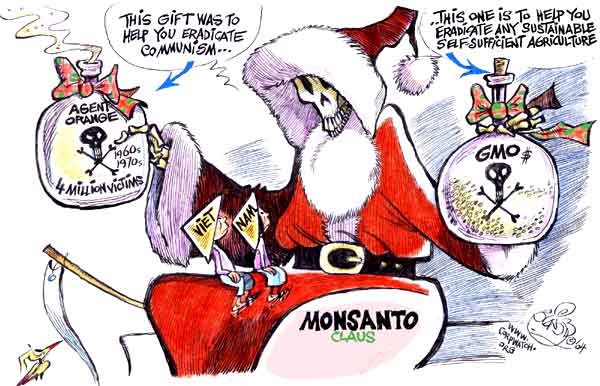
The authorities had a vested interest in promoting this new biotechnology. Desperate to escape the grinding poverty of the post-independence years, the Indian government had agreed to allow new bio-tech giants, such as the U.S. market-leader Monsanto, to sell their new seed creations.
In return for allowing western companies access to the second most populated country in the world, with more than one billion people, India was granted International Monetary Fund loans in the Eighties and Nineties, helping to launch an economic revolution.
But while cities such as Mumbai and Delhi have boomed, the farmers' lives have slid back into the dark ages.
Though areas of India planted with GM seeds have doubled in two years - up to 17 million acres - many famers have found there is a terrible price to be paid.
Far from being 'magic seeds', GM pest-proof 'breeds' of cotton have been devastated by bollworms, a voracious parasite.
Nor were the farmers told that these seeds require double the amount of water. This has proved a matter of life and death.
With rains failing for the past two years, many GM crops have simply withered and died, leaving the farmers with crippling debts and no means of paying them off.
Having taken loans from traditional money lenders at extortionate rates, hundreds of thousands of small farmers have faced losing their land as the expensive seeds fail, while those who could struggle on faced a fresh crisis.
When crops failed in the past, farmers could still save seeds and replant them the following year.
But with GM seeds they cannot do this. That's because GM seeds contain so- called 'terminator technology', meaning that they have been genetically modified so that the resulting crops do not produce viable seeds of their own.
As a result, farmers have to buy new seeds each year at the same punitive prices. For some, that means the difference between life and death.
Take the case of Suresh Bhalasa, another farmer who was cremated this week, leaving a wife and two children.
As night fell after the ceremony, and neighbours squatted outside while sacred cows were brought in from the fields, his family had no doubt that their troubles stemmed from the moment they were encouraged to buy BT Cotton, a geneticallymodified plant created by Monsanto.
'We are ruined now,' said the dead man's 38-year-old wife. 'We bought 100 grams of BT Cotton. Our crop failed twice. My husband had become depressed. He went out to his field, lay down in the cotton and swallowed insecticide.'
Villagers bundled him into a rickshaw and headed to hospital along rutted farm roads. 'He cried out that he had taken the insecticide and he was sorry,' she said, as her family and neighbours crowded into her home to pay their respects. 'He was dead by the time they got to hospital.'
Asked if the dead man was a 'drunkard' or suffered from other 'social problems', as alleged by pro-GM officials, the quiet, dignified gathering erupted in anger. 'No! No!' one of the dead man's brothers exclaimed. 'Suresh was a good man. He sent his children to school and paid his taxes.
'He was strangled by these magic seeds. They sell us the seeds, saying they will not need expensive pesticides but they do. We have to buy the same seeds from the same company every year. It is killing us. Please tell the world what is happening here.'
Monsanto has admitted that soaring debt was a 'factor in this tragedy'. But pointing out that cotton production had doubled in the past seven years, a spokesman added that there are other reasons for the recent crisis, such as 'untimely rain' or drought, and pointed out that suicides have always been part of rural Indian life.
Officials also point to surveys saying the majority of Indian farmers want GM seeds - no doubt encouraged to do so by aggressive marketing tactics.
During the course of my inquiries in Maharastra, I encountered three 'independent' surveyors scouring villages for information about suicides. They insisted that GM seeds were only 50 per cent more expensive - and then later admitted the difference was 1,000 per cent.
(A Monsanto spokesman later insisted their seed is 'only double' the price of 'official' non-GM seed - but admitted that the difference can be vast if cheaper traditional seeds are sold by 'unscrupulous' merchants, who often also sell 'fake' GM seeds which are prone to disease.)
With rumours of imminent government compensation to stem the wave of deaths, many farmers said they were desperate for any form of assistance. 'We just want to escape from our problems,' one said. 'We just want help to stop any more of us dying.'
Prince Charles is so distressed by the plight of the suicide farmers that he is setting up a charity, the Bhumi Vardaan Foundation, to help those affected and promote organic Indian crops instead of GM.
India's farmers are also starting to fight back. As well as taking GM seed distributors hostage and staging mass protests, one state government is taking legal action against Monsanto for the exorbitant costs of GM seeds.
This came too late for Shankara Mandauker, who was 80,000 rupees (about £1,000) in debt when he took his own life. 'I told him that we can survive,' his widow said, her children still by her side as darkness fell. 'I told him we could find a way out. He just said it was better to die.'
But the debt does not die with her husband: unless she can find a way of paying it off, she will not be able to afford the children's schooling. They will lose their land, joining the hordes seen begging in their thousands by the roadside throughout this vast, chaotic country.
Cruelly, it's the young who are suffering most from the 'GM Genocide' - the very generation supposed to be lifted out of a life of hardship and misery by these 'magic seeds'.