Peter Bane in three video talks about permaculture and garden farming.
See http://permaculturehandbook.com/ for more info.

Showing posts with label Peter Bane. Show all posts
Showing posts with label Peter Bane. Show all posts
Thursday, November 15, 2012


Monday, February 27, 2012
The Cybernetic Garden Farm: Information in; information out.
This unprepared, extemporaneous speech was delivered in the Fall of 2010 in Grand Rapids at the International Conference on Sustainability: Energy, Economy, Environment. It followed Nicole Foss's talk (embedded below) on how she prepared her family for peak oil and economic uncertainty.
"As a system of design, Permaculture provides a new vocabulary and pattern language for observation and action, attention and listening, that empowers people to co-design homes, neighborhoods, and communities full of truly abundant food, energy, habitat, water, income, and yields enough to share." - Keith Johnson
Educator Peter Bane is preparing for the local future, beyond the global economy and post peak oil. Bane's talk is the story of the history of permaculture, and how he has used permaculture methods to move towards a self-sustaining homestead using free or low-cost techniques.
Peter Bane has published the Permaculture Activist Magazine since 1990. He is a garden farmer with Keith Johnson in Bloomington, Indiana, where they teach permaculture design at Indiana University and elsewhere.. Peter has a bachelors from University in Illinois in political design and a diploma in permaculture design from the British Academy of Permculture design. He served on the peak oil task force for the City of Bloomington, Indiana, which was adopted in 2009 December and has recently finished working on The Permaculture Handbook: Garden Farming for Town and Country.
In this talk, Bane describes, in his own words, how he is moving beyond the money economy, to providing his essential needs from his homestead, and how he is utilizing the principles of permaculture.
Recorded at the International Conference on Sustainability: Energy, Economy, Environment 2010 hosted by Local Future and directed by Aaron Wissner.
http://www.energybulletin.net/stories/2011-10-11/how-i-prepared-my-family-peak-oil-nicole-foss
Educator Peter Bane is preparing for the local future, beyond the global economy and post peak oil. Bane's talk is the story of the history of permaculture, and how he has used permaculture methods to move towards a self-sustaining homestead using free or low-cost techniques.
Peter Bane has published the Permaculture Activist Magazine since 1990. He is a garden farmer with Keith Johnson in Bloomington, Indiana, where they teach permaculture design at Indiana University and elsewhere.. Peter has a bachelors from University in Illinois in political design and a diploma in permaculture design from the British Academy of Permculture design. He served on the peak oil task force for the City of Bloomington, Indiana, which was adopted in 2009 December and has recently finished working on The Permaculture Handbook: Garden Farming for Town and Country.
In this talk, Bane describes, in his own words, how he is moving beyond the money economy, to providing his essential needs from his homestead, and how he is utilizing the principles of permaculture.
Recorded at the International Conference on Sustainability: Energy, Economy, Environment 2010 hosted by Local Future and directed by Aaron Wissner.
http://www.energybulletin.net/stories/2011-10-11/how-i-prepared-my-family-peak-oil-nicole-foss
Monday, August 31, 2009
Eat Your Meat
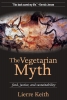
The Vegetarian Myth
Reviewed in Permaculture Activist
 By Peter Bane
Permaculture Activist #72, Summer 2009
Lierre Keith has written a compelling tale of her own near self-destruction from a vegan diet and a broadside against its being perpetrated upon or adopted by any other victims. She has converted 20 years of pain and suffering, and permanent damage to her health into a galvanizing passion to demolish the myth that she believe underpins the worldview of most who adopt vegan diet: "I want to eat without killing." You can't, she says, and if you try you'll die.
The arguments are compelling, and bluntly presented in three large chapters addressing moral, nutritional, and political vegetarians. Every field of grain or soybeans kills ecosystems and a myriad of creatures mostly too small to be seen and thus wept over. But they are just as dead as steers stunned and gutted in a meatpacking plant. At this point the enterprise of agriculture threatens all life on planet Earth.
Humans, unlike ruminants, cannot eat grass and survive. Our digestive systems are tuned for a variety of foods, always including meat. Many vegans, she reports from personal experience, do not know this, and fantasize worlds in which the lamb and the lion shall lie down, if not together, then at least on either side of a big fence from each other—eating the same uncomplaining plants. Can modern people actually be this ignorant? It seems so. Traditional diets have universally recognized the importance of flesh foods, especially animal fats, as the researches of Weston Price and many others have confirmed for over a hundred years. But modern people devoid of dietary or any other cultural traditions have picked up deadly memes, and many, especially younger people, have killed themselves trying to atone for civilizational violence.
Keith is no less an activist for interspecies justice and care of the earth now than she was when eschewing flesh in her diet. Are plants insentient? Do they care naught for their offspring? Of course, and the moral impulses that inform veganism are still sound: we should care for all life—animal, plant, and microbe alike—and especially its higher expressions in the organization of ecosystems and species genomes. She has simply recognized the appalling state of willful ignorance that drew her down a deadly road, and is determined to do all she can through personal testimony and powerful persuasion to prevent any others falling victim to the same form of self-destructive madness.
The author demolishes political vegetarianism by exposing its ignorance. On the pretense (and this is the one that caught me 36 years ago) that surplus grain and oil crops from the western developed countries were needed to feed the hungry of India, Africa, and Asia, many political vegetarians have persuaded themselves to turn away from healthy food and embrace arrangements of power that, were they seen clearly, would be understood as imperialist, racist, even genocidal—certainly unjust. No, people in the majority world don't need U.S. food aid. They don't need GMO corn or inedible soybeans. These countries need us to stop overpowering their own native farm sectors with our subsidized exports and our high-powered trade negotiators. She goes on to peel the covers back from the orgy of interlocked corporate boards that makes up the American food system. Scratch beneath the skin of Dean Foods or Odwalla Juice, Hain Food Group, Cascadian Farms or Muir Glen, and you find the likes of Chevron, General Electric, Monsanto, Nike, Starbucks, Texas Instruments, and WalMart as the majority stockholders. "So you're an environmentalist. Why don't you know any of this?," she asks.
Feedlot finishing, chickens in battery houses, and CAFO pork operations are lousy, and we shouldn't be eating that food, but animals living their lives under the sun on agricultural savannas like those nurtured by intensive graziers such as Joel Salatin and thousands of others are tremendously healthy. These carefully managed pastures are sequestering carbon, increasing plant diversity, and growing healthy food for people. Wake up! The author's words virtually scream out from the page. You who disdain eating flesh are fooling no one but yourselves.
Apart from the gripping passion of Keith's personal narrative, why should anyone already eating meat bother reading this book, with its indictments of fast food addiction, its tight analysis of the downward spiral of anorexia and bulimia, and its chilling litany of the deterioration of the body deprived of saturated fats and animal proteins? Because control of food is central to the control of our bodies, our minds, and the political system itself. The author has done a tremendous amount of focused research on the issues of diet and nutrition, ecosystem destruction, agriculture, and the manipulation of the food system, and the chain of money and control that weave an insidious trap for us all. You will learn many things you need to know here. Things on which your very life depends.
This book is a political exposé, a diet book, a treatise on anthropology, and a roaring condemnation of grain agriculture. Keith looks at agriculture's destruction of the land, amped up by fossil fuels to a massive holocaust in the past five decades, and finds no redemption anywhere. She admits that the Land Institute's project to breed seed-heavy perennial grasses could prevent much of the destruction of plow agriculture, but asks "why would we want to?" When Kansas and the rest of the Great Plains virtually overflowed with bison, antelope, and a host of other ruminants, flesh of which is superb food for humans, why would we try to replace it with something that may not ever work, and certainly stands little chance of feeding anyone for decades?
Grain isn't good for us. We love it because its seeds contain small amounts of opioids that give our brains a rush, but it causes all our tissues to swell when we eat it: our joints, our livers, our nerves, our blood vessels. Most of the degenerative diseases of modern life are linked to the inflammatory influence of a diet rich in refined carbohydrates and vegetable oils. We eat them also because they are the cheapest and most profitable calories that industrial farming and food processing can put on the shelf, and Money wants us to eat them.
Meat, Keith reminds us, especially organ meats with their superb assembly of minerals and saturated fats, literally made humans into our modern form. These readily absorbed, nutrient-dense foods allowed our brains to grow and our digestive tracts to shrink. We are still dependent on this complex of foods for wholesome nutrition, but most of us don't know it. Or should I say that the cultures that reminded us of its importance are eroding and disappearing from the modern world. And that the manipulation of memes by corporate advertising is killing us, one cheese puff at a time.
In the nature of a book that attempts to integrate personal passion and scholarship to a high degree, it might be too much to expect a program of reform to be well articulated. In her fourth chapter, Keith expounds on a simple formula for saving the world: Refrain from having children; stop driving your car; and grow your own food. Many will take issue with at least the first, though by any account we need to reduce the human population humanely and as fast as possible, but there can be little quarrel with the science of the latter two points. You won't find a lot here about how to make the changes happen—and let me tell you they are tough in the aggregate—though the author gives a good account of the logic of permaculture and the importance of perennial polycultures, rotational grazing, and no-till gardening. In recommending how "To Save the World," Keith takes a good lick at patriarchy and monotheism along with industrial farming and soy pseudofoods. By this point in the argument, you don't have to care if her polemic is over-the-top. The point has been driven home. Our food system is killing us—resist!
Published with the blessing and under the imprint of Derrick Jensen's Flashpoint Press, The Vegetarian Myth is an attractive and information-rich book that lives up to its subtitle. Aside from a few graphs used to illustrate the manipulation of cholesterol studies, the books consists of text only. The cover theme of Lascaux cave art is carried through on most pages with tiny glyphs of bison marking transition points in the text. No matter the lack of illustration, the writing is powerful and persuasive. Keith has every reason to be bitter and angry, but she has transmuted her anger and seasoned it well with a self-reflective humor that sweeps us along this road to recovery from a scorched earth. As I read her description of her first meat meal in 20 years (a can of tuna eaten reluctantly with a plastic fork), I found myself in tears. Ten years recovering from a quarter century of vegetarian folly myself, I never went through the agony that Keith lives with yet, but I knew the shattering epiphany she experienced with that first bite—coming home to the truth of her body, and of life itself.
Whether you are a vegan (run, if you can, to the bookstore), vegetarian, recovering from either diet, or never gave up meat at all, you will benefit from this author's painful mistakes and her laser-like focus on the path to a sane diet and all that it entails. Mark this one for the top shelf on cultural recovery.
Tuesday, August 11, 2009
First Annual PDC in Bloomington, IN!

The time has come! Permaculture is a great foundation for the transitional and regenerative work our generation needs to be doing. This course is designed to give us all a solid starting place.
Peter Bane, publisher of the Permaculture Activist; Keith Johnson, who has been practicing permaculture for over 25 years; and Rhonda Baird, originator of the Bloomington Permaculture Guild team up with Kevin Glenn of Owl Creek Programs and other guests to offer a fun, fast-paced, and transformative course.
The cost of the course is $750 (or $700 if registered by Sept. 15). This is a deal for anyone and meant for those who work and can't take time away for a two-week course.
This course is designed for busy, working adults and meant to be affordable. We are so pleased to offer a weekend permaculture design course this fall/winter for people in the Bloomington, IN region.
We will gather at the Friend's Meeting House Friday (3820 E. Moores Pike) evenings, Saturday all day, and Sunday afternoons on October 16-18, Oct. 31-Nov. 1, Nov. 13-15, Feb. 19-21 and March 5-7. We would be happy to help those traveling from out of town find accommodations. The cost of the course is $750 (or $700 if paid by 9/15). This includes Saturday lunches and materials for the course. You may pay for the course using Paypal (though you will need to contact Rhonda for registration materials). Please contact Rhonda Baird at 812.323.1058 or rhonda.kb[at]yahoo[dot]com for more information.
Tuesday, December 9, 2008
Peter Bane - articles
 These articles by publisher / editor Peter Bane appeared in the Permaculture Activist magazine over recent years....
Another Kind of Energy or ComPost-Modernism
Designing for Change
Lessons In Village Design
Keystones and Cops: An Eco-Mystery Thriller
Rocky Mountain Magic: High, Dry and Flourishing
Time to Garden the Planet
New! Coppice-with-Standards: New Forestry with Ancient Roots
Wednesday, October 8, 2008
Plan C: cooperate, conserve, curtail....
 Plan C: Individual and Community Survival Strategies for the Energy Crisis
The Fifth Annual US Conference on Peak Oil and Community Solutions October 31 - November 2, 2008 Oakland University, Rochester, Michigan www.plancconference.org
At this groundbreaking conference participants will explore strategies for reducing energy use in the areas of housing, food and transportation, including both theory and practice. We will examine the long energy decline of the 21st century, the psychological barriers to rapid change, and the challenge of persuading our communities to embrace local, low-energy living. Attendance at this conference may be of critical importance at this time when the ongoing energy crisis is being compounded by the very real threat of credit and financial collapse.
Our survival is now, more than ever, in question. And it is more urgent than ever that we gather in Michigan to evaluate survival strategies and disseminate skills for growing food, creating local food security in their communities, retrofitting homes to reduce reliance on fossil fuels, and educating their communities to prepare for the difficult times we are facing.
Skyrocketing oil prices, mounting geopolitical tensions, grave economic realities, and dangerous climate changes are threatening our lives and communities like never before. The age of cheap, abundant fossil fuels is coming to an end, and urgent action is required to transform our overly consumptive society into one that uses far less energy.
By acting now, you can significantly cut your personal household energy use and overall consumption, support more localized economic production, and reduce your dependence on high energy transportation in your daily life. By doing this, you will be helping to create a more resilient and sustainable community adapted to the coming economic and ecological storms.
The conference will also feature in-depth workshops and panels, Connection Café discussion tables with area experts, an eco tour slide show, screenings of award winning films, entertainment, tours of local green buildings, a Green Living Expo, and healthy shared meals.Schedule of Presentations and Workshops:
* Keynoter John Michael Greer, author of the forthcoming The Long Descent: A User’s Guide to the End of the Industrial Age
* Keynoter Dmitry Orlov, author of Reinventing Collapse: Soviet Example and American Prospects
* Richard Heinberg, Senior Fellow, Post Carbon Institute, author of The Party’s Over and Powerdown (via webcast)
* Katrin Klingenberg, director of the Passive House Institute US
* Peter Bane, editor of Permaculture Activist
* Christopher Bedford, President of the Center for Economic Security and the Sweetwater Local Foods Market
* John Richter, co-founder of the Institute for Sustainable Energy Education
* Pat Murphy, author of Plan C: Community Survival Strategies for Peak Oil and Climate Change
* Megan Quinn Bachman, Outreach Director of Community Solutions; co-producer of The Power of Community: How Cuba Survived Peak Oil
For more information and to register, go to www.plancconference.org, contact Jill Hollowell at Upland Hills Ecological Awareness Center at 248-693-1021, or email info@plancconference.org. Note: Members of an organization or activist network are encouraged to attend as a group and receive substantial discounts for 3+ and 5+ member groups.
Monday, September 8, 2008

Plan C 5.0: Community Solutions to Climate Change and Peak Oil
From Global Climate Solutions http://globalclimatesolutions.org/2 09 2008
By RYAN HOTTLE
Relocalization—the process of creating sustainable and largely self-reliant communities that are all at once beautiful, prosperous, and meaningful places to live—is perhaps the single greatest step we can take to “decarbonize” our lives and thereby prepare for climate change and peak oil simultaneously.
It’s a shame and a testament to our highly compartmentalized 21st century mindset that many within the “climate change community” and the larger “sustainability community” don’t know about peak oil and the potentially damning effects it could have on our social and economic systems. For example, I take courses from highly, highly educated climate scientists who can speak for hours on, for example, the intricacies of cloud formation as it relates to sulfate particles in the atmosphere and how they are expected to change with a warming atmosphere. But ask them about “peak oil?” They don’t know what it is. Never heard of it.
You might be able to claim ignorance, but you can’t say there wasn’t anybody warning you about it or describing the solutions either. Community Solutions (www.communitysolution.org), a vibrant non-profit organization out of Yellow Springs, Ohio, has been ringing the clarion call for solutions to climate change and peak oil for over half a decade now and are preparing to host their 5th annual conference on “Plan C: Individual Survival Strategies for the Energy Crisis.” (Conference website available here: www.plancconference.info.)
You might be able to claim ignorance, but you can’t say there wasn’t anybody warning you about it or describing the solutions either. Community Solutions (www.communitysolution.org), a vibrant non-profit organization out of Yellow Springs, Ohio, has been ringing the clarion call for solutions to climate change and peak oil for over half a decade now and are preparing to host their 5th annual conference on “Plan C: Individual Survival Strategies for the Energy Crisis.” (Conference website available here: www.plancconference.info.)
To say that the list of speakers they have lined up are good would be a gross understatement—it would be worthy to travel to hear any one of the seven amazing visionaries they have scheduled.
Among them John Michael Greer (who has recently been called “the greatest peak oil historian in the English language), Richard Heinberg (easily the most influential and prolific writer on peak oil ), Peter Bane (probably one of the top Permaculture practitioners and teachers in the world, co-editor of Permaculture Activist [www.permacultureactivist.net], and also my PC design course teacher;) and—let us not forget—Megan Quinn Bachman (Outreach director of Community Solutions—young, passionate, articulate, and a global leader—what more could you ask for?!)
The conference is scheduled to take place October 31st-November 2nd in Rochester, Michigan. In order to receive Early Registration prices you have to sign up before September 30th. The cost for the conference is a steal, in my opinion, with extremely low costs . (I should note that I am not affiliated whatsoever with the conference—I am merely a strong supporter of the great work and leadership Community Solutions has been providing over the years.)
It is function of our modernistic society that we believe that all of our problems—energy, climate, and environment—are capable of being solved with techno-fixes. Unfortunately, we may simply be out of time and energy resources to redesign our entire transportation and energy infrastructure. It’s a hard truth that many don’t want to face, but it may well be true.
- Peter Bane: Permaculture wizard, activist, and friend!

Personally, I believe we should be actively working to research and develop renewable energy sources (particularly Carbon Negative Energy with biochar production in a process called pyrolysis in addition to wind and solar energy technologies), but the very first place to work on, the lowest-hanging fruit where we can save the most money and energy and where we can simultaneously prepare for peak oil and mitigate the threat of climate change is by relocalizing our communities; weatherizing and retrofitting our buildings; creating local sustainable food systems; generating healthy local economies; and utilizing the inherent wisdom of Permaculture design principles.
We have but one beautiful planet to protect and but precious little time to do it in. What we choose to do—or not to do—in the next five to ten years will make all the difference. Be prepared to work hard and work together—that’s the only way we’re going to win!
Wednesday, March 5, 2008
"PERMACULTURE - FARMING AND LIVING WITH NATURE"
 LISTEN TO ARCHIVED VERSION - download/open | stream
"Permaculture" or "permanent agriculture" was originally conceived almost 30 years ago by Australian ecologists Bill Mollison and David Holmgren. Observing aboriginal culture and forest ecosystems, he conlcuded that we could deliberately design agriculturally productive ecosystems, echoing diversity, stability, and resillience of natural ecosystems.
Permaculture designs provide food, energy, and shelter for people and animal inhabitants while linking the needs and outputs of each element.
Permaculture is a holistic approach to land use, which works with nature's rhythm and patterns, weaving together the elements of microclimate, annual and perennial plants, animal, water and soil management, and human needs into intricately connected and productive communities.
Guests
Gregoire Lamoureux - Kootenay Permaculture Institute/Spiral Farm - The Kootenay Permaculture Institute is located just outside of Winlaw in the Slocan Valley of British Columbia. Gregoire is a permaculture designer, consultant, and teacher. He has worked with permaculture systems for over 15 years and taught courses in many parts of Canada. He taught the permaculture design course as a Summer Session at the University of Manitoba in 2005. Gregoire is on the Board of Directors of the Slocan River Streamkeepers and has served on the Board of Seeds of Diversity Canada for seven years. He is a founding member of the Kootenay Organic Growers Society. He has written for Natural Life Magazine. He has been a guest lecturer at the BC Organic Agriculture Conference, and the Guelph Organic Agriculture Conference.
Peter Bane - Publisher, The Permaculture Activist - North America's leading (and the world's oldest) permaculture periodical. Based in Bloomington, Indiana, since 1985 the publication has informed on permaculture design, edible landscaping, bioregionalism, cooperative action, aquaculture, natural building, earthworks, renewable energy and more.
Thursday, April 5, 2007
Time to Garden the Planet
Time to Garden the Planet
©2006 Peter Bane
Politics has captured the attention of Americans again after a generation of lethargy because the world's problems are growing more complex with each passing day. We face endless war over oil, rampant consumerism, a hollow economy and a crumbling dollar, an epidemic of obesity, toxicity and illness, and a medical system out of control. Hunger and plague stalk the global South.
At the risk of being thought romantic or utopian, I assert that the solutions to these and most of the world's dramatic crises rests in a rather simple shift of our awareness and our behavior. We must care for the Earth and for people, and share that which is surplus to our needs so that others may meet their own. We must also consciously limit our consumption and population. These ethics are central to permaculture: they belong to no nation or creed but to all of humanity. It's time to garden the planet.
When human beings shifted our economy from the wild harvesting of nature's surpluses to the cultivation of cereal crops at the end of the last ice age, we started on a course of collective self-discovery: Will the clever monkeys solve the puzzle in time? Can they figure out how to grow enough food to keep up with their sex drive?
So far, the answer is no. The Agricultural Revolution, sparked in the semi-arid regions of the Near East about 10,000 years ago, has been a failure. The production of surplus grains has always led to increases in population that outstrip the productive capacity of their regions, leading to war, empire, destruction of forests, and migrations. On a shrinking planet, there's nowhere else to go.
All politics hinges on the question, "Who eats?" To get to the root of politics we have to talk and act on food. Freedom isn't just "nothin' left to lose," rather it's an abundant supply of locally grown food for every household. Our current food system, and with it the entire economy of the now hyperlinked world is balanced precariously on a dwindling supply of fossil oil and gas, controlled by a tiny elite of mostly foreign powers.This is not a temporary problem to be solved by technology or better management. It is a structural problem of geological limits and burgeoning population that will never go away until we break our addiction to oil.
Thirty years ago, two Australians, David Holmgren and Bill Mollison discovered in their conversation about energy and equity that they had something to say about this problem. They described their response to global limits and the failure of central authority with the made-up word, "Permaculture," or "permanent agriculture."
In the generation since Permaculture I was published, a hundred thousand others have joined this conversation around the world and Permaculture has come to mean "permanent culture," because, of course, no system of farming can exist without a just and stable society to support it.
Besides being a paradox ("permanent" means long-lasting while "culture" is about continuous change and adaptation"), Permaculture is a way of seeing the world that emphasizes context and processes. It requires a shift of focus from objects and actors—which is the cultural bias of western civilization and of our English language in particular—to relationships. Whether seen as feminine or right-brained or Eastern because these qualities have been suppressed in our culture, the capacity for holistic thinking is really about balance —drawing on both sides of the brain and emphasizing the connections between them.
Permaculture is also a design system, based on ecology and taught by grassroots networks, for creating human habitats—homes, neighborhoods, towns, and the countryside—that capture energy, grow food, and recycle wastes, as they grow ever more diverse and abundant. The principles are simple but not trivial:
• Humans must be engaged interactively with the natural world around us;
• Our chief task is to capture and cycle solar energy, using it to meet our needs;
• We have to feed ourselves and regulate our behaviors to fit in with nature;
• Biological systems work best;
• Waste equals food;
• The patterns of natural systems show us how to create cultivated ones;
• Combine top-down thinking with bottom-up action;
• Always integrate elements and systems for mutual support;
• Choose small and slow means;
• Cultivate diversity and look to the margins for action;
• Be prepared for change.
These have endless ramifications.
And out of these networks of "each one, teach one," has grown a social movement for people-centered development and grassroots scientific research that has successfully demonstrated pathways for a low-energy future in 100 countries. The abundance of cheap fossil fuel and the material excesses of USA culture have retarded Americans' awareness of Permaculture, but the rise of energy prices and the continued contraction of the global economy are helping awaken more people to the need for which Permaculture was created.
Permaculture has a great analysis of the world—Energy comes from the sun, therefore it's time to reorganize our economy and technology to recognize that (Think biology.); The Earth has limits, of which energy, water, tree cover, and soil minerals are especially critical to life; People, once educated, are best able solve their own problems and meet their own needs locally, so teach them to teach others. The household, not the factory, is the source of prosperity, so create edible landscapes everywhere people live. But the Permaculture story would be empty theory if it didn't lead to positive action for change.
If you want to turn the world on its head, it takes a really good idea and a lot of practice. And that's where the design system comes in. You apply these principles to your own life, your own household, your own economy to make permaculture happen where you live. And every one is different. Starting at the back door, permaculture designers and activists have created city farms, food forests, solar homes, living roofs, edible parks and schoolgrounds, backyard fish ponds, community health centers, water gardens, local currencies and credit unions, farmers markets, ecovillages, and a worldwide university.
What will be your part of this story?
The true test of permanent agriculture is whether it builds and maintains carbon (organic matter) levels in soil. This takes trees, animals, careful observation, persistence, and a new worldview. No mechanized agriculture can do it, only people who understand their kinship with all of life can. The land needs people. At the same time, there can never be enough "stuff" in the marketplace to satisfy our profound need for love and meaning. These can only come from relationship—people need the land and each other. In a world of diminishing resources, the only inexhaustible resource is our creativity and our undying connection with the Earth. These come together in the garden, and while Permaculture is much more than can be imagined by one person or captured in an essay, it is most often and truly associated with the garden, our deepest image of connectedness with the original source and of a world filled with pleasure and delight.
Bloomington resident Peter Bane publishes Permaculture Activist, the world's longest-running journal of permaculture design. He can be reached at pcactivist@mindspring.com
This article also appears at http://www.relocalize.net/time_to_garden_the_planet
Subscribe to:
Posts (Atom)