Tuesday, December 2, 2008

ACRES of wisdom....

More excellent articles from ACRES USA (all PDFs):

Defending the Family Farm Interview: Thomas Linzey

Balance: Stability for Your Life & Farm by Joel Salatin

Everything I Want to Do Is Illegal by Joel Salatin

Industry vs. BiologyTaking on the Ethics of Industrial Agriculture by Joel Salatin

The Soil Food WebTuning in to the World Beneath Our Feet by Mary-Howell R. Martens

Seeds of Deception: Author Exposes the Corrupt Science of GMOs Interview: Jeff Smith

One Corporate World Interview: Gregory Palast

'Sound Science' Is Killing Us by Joel Salatin

Terra Preta: Magic Soil of the Lost Amazon by Allan Balliett

Health from the Ocean Deep: A New Approach to Holistic Healing with Sea Minerals & Herbs Interview: Gerry Amena

Soil is the FIRST crop...all else follows.

Great (PDF) article about soil improvement from ACRES USA. You can read many more here.

Chicken Soup for the Soil
by Jerry Brunetti

(snip)
Estimated Numbers of Common Micro-Organisms Found in Healthy Agricultural Soils

Bacteria 3,000,000 to 500,000,000 in 1 g.
Actinomycetes 1,000,000 to 20,000,000 in 1 g.
Fungi 5,000 to 1,000,000 in 1 g.
Protozoa 1,000 to 500,000 in 1 g.
Algae 1,000 to 500,000 in 1 g.
Yeasts 1,000 to 100,000 in 1 g.
Nematodes 10 to 5,000 in 1 g.

Monday, December 1, 2008

Learn Urban Farming

More cities ought to be thinking along these lines. Here, in Bloomington, IN, we are planning to start a similar school. More details later.

Urban farming school takes root

Instruction would be based on intensive farming on small plots

Larry Pynn, Vancouver Sun

Published: Saturday, November 29, 2008

A school of urban farming -- a North American first -- is finding fertile soil in Richmond.

Richmond's parks, recreation, and cultural services committee has unanimously endorsed the concept of an urban farm school and directed staff to investigate city land for such a project, either at Terra Nova park at the west end of Westminster Highway, or the south end of Gilbert Road.

Instruction would be based on intensive farming on small plots, a heavy dependence on physical labor, ecological sustainability and meeting local market demands, including the food needs of ethnic and immigrant communities.

Steve Bosch, Vancouver Sun

"It's human-scale agriculture, labor-intensive and production-intensive," said Kent Mullinix, a sustainable agriculture specialist at Kwantlen Polytechnic University's Institute for Sustainable Horticulture.

"Produce a lot on a little bit of land, which is entirely doable."

With the green light from Richmond, "We can now go forward and make this happen," Mullinix said in an interview.

"We're quite serious about this, about the need to advance this kind of agriculture."

Kwantlen and the Richmond food security task force have joined forces to launch the ground-breaking program in 2009 as a way to allow young farmers to get into the industry and to meet the growing demand for locally produced food.

"The potential for this kind of agriculture to develop into a substantial component of the local and regional economy cannot be understated," Mullinix said.

The program would require about two hectares of land to start, and could partner with the Richmond Fruit Tree Sharing Project, which already has a presence at the proposed city sites and is growing food for local food banks.

The school's topics would include soil management, plant science, animal husbandry and farm infrastructure, but would cover all steps in the food chain, including value-added processing, marketing, and sales.

Mullinix said the program would be flexible for students who want part-time and short-term instruction as well as those seeking a full-time four-year baccalaureate program, with an emphasis on teaching in the field rather than the traditional classroom setting.

The goal is to start the program in early 2009 with perhaps a dozen students and build from there.

In later years, students might be allocated a portion of city lands where, short of outright ownership, they could operate their own farm operation under supervision.

Fish Provide Clues to New Energy Source.

Ocean currents can power the world, say scientists

A revolutionary device that can harness energy from slow-moving rivers and ocean currents could provide enough power for the entire world, scientists claim.

Ocean currents can power the world, say scientists
Existing technologies require an average current of five or six knots to operate efficiently, while most of the earth's currents are slower than three knots. Photo: AP

The technology can generate electricity in water flowing at a rate of less than one knot - about one mile an hour - meaning it could operate on most waterways and sea beds around the globe.

Existing technologies which use water power, relying on the action of waves, tides or faster currents created by dams, are far more limited in where they can be used, and also cause greater obstructions when they are built in rivers or the sea. Turbines and water mills need an average current of five or six knots to operate efficiently, while most of the earth's currents are slower than three knots.

The new device, which has been inspired by the way fish swim, consists of a system of cylinders positioned horizontal to the water flow and attached to springs.

As water flows past, the cylinder creates vortices, which push and pull the cylinder up and down. The mechanical energy in the vibrations is then converted into electricity.

Cylinders arranged over a cubic metre of the sea or river bed in a flow of three knots can produce 51 watts. This is more efficient than similar-sized turbines or wave generators, and the amount of power produced can increase sharply if the flow is faster or if more cylinders are added.

A "field" of cylinders built on the sea bed over a 1km by 1.5km area, and the height of a two-storey house, with a flow of just three knots, could generate enough power for around 100,000 homes. Just a few of the cylinders, stacked in a short ladder, could power an anchored ship or a lighthouse.

Systems could be sited on river beds or suspended in the ocean. The scientists behind the technology, which has been developed in research funded by the US government, say that generating power in this way would potentially cost only around 3.5p per kilowatt hour, compared to about 4.5p for wind energy and between 10p and 31p for solar power. They say the technology would require up to 50 times less ocean acreage than wave power generation.

The system, conceived by scientists at the University of Michigan, is called Vivace, or "vortex-induced vibrations for aquatic clean energy".

Michael Bernitsas, a professor of naval architecture at the university, said it was based on the changes in water speed that are caused when a current flows past an obstruction. Eddies or vortices, formed in the water flow, can move objects up and down or left and right.

"This is a totally new method of extracting energy from water flow," said Mr Bernitsas. "Fish curve their bodies to glide between the vortices shed by the bodies of the fish in front of them. Their muscle power alone could not propel them through the water at the speed they go, so they ride in each other's wake."

Such vibrations, which were first observed 500 years ago by Leonardo DaVinci in the form of "Aeolian Tones", can cause damage to structures built in water, like docks and oil rigs. But Mr Bernitsas added: "We enhance the vibrations and harness this powerful and destructive force in nature.

"If we could harness 0.1 per cent of the energy in the ocean, we could support the energy needs of 15 billion people. In the English Channel, for example, there is a very strong current, so you produce a lot of power."

Because the parts only oscillate slowly, the technology is likely to be less harmful to aquatic wildlife than dams or water turbines. And as the installations can be positioned far below the surface of the sea, there would be less interference with shipping, recreational boat users, fishing and tourism.

The engineers are now deploying a prototype device in the Detroit River, which has a flow of less than two knots. Their work, funded by the US Department of Energy and the US Office of Naval Research, is published in the current issue of the quarterly Journal of Offshore Mechanics and Arctic Engineering.

Watch video demonstrations here: www.vortexhydroenergy.com

Empower Yourself and Your Community


TRANSITION UNITED STATES is a networking site for those interested in exploring and/or implementing the Transition model in their community. This site is being created through grassroots participation, and is continually evolving. It is a spontaneously arising effort to connect 'transitioners' with each other and to encourage and support the development of local Transition Initiatives.

The Transition approach empowers communities to squarely face the challenges of peak oil and climate change, and to unleash the collective genius of their own people to find the answers to this momentous question:


For all those aspects of life that this community needs in order to sustain itself and thrive, how are we going to:
  • drastically reduce carbon emissions (in response to climate change);
  • significantly rebuild resilience (in response to peak oil);
  • and greatly strengthen our local economy (in response to economic instability)?

Transition Initiatives make no claim to have all the answers, but by building on the wisdom of the past and accessing the pool of ingenuity, skills and determination in our communities, the solutions can readily emerge. Now is the time for us to take stock and start re-creating our future in ways that are not based on cheap, plentiful and polluting oil but on localized food, sustainable energy sources, resilient local economies and an enlivened sense of community well-being.

Wednesday, November 26, 2008

The Greatest Nature Essay Ever

by Brian Doyle

Published in the November/December 2008 issue of Orion magazine

. . .would begin with an image so startling and lovely and wondrous that you would stop riffling through the rest of the mail, take your jacket off, sit down at the table, adjust your spectacles, tell the dog to lie down, tell the kids to make their own sandwiches for heavenssake, that’s why god gave you hands, and read straight through the piece, marveling that you had indeed seen or smelled or heard exactly that, but never quite articulated it that way, or seen or heard it articulated that way, and you think, man, this is why I read nature essays, to be startled and moved like that, wow.

The next two paragraphs would smoothly and gently move you into a story, seemingly a small story, a light tale, easily accessed, something personal but not self-indulgent or self-absorbed on the writer’s part, just sort of a cheerful nutty everyday story maybe starring an elk or a mink or a child, but then there would suddenly be a sharp sentence where the dagger enters your heart and the essay spins on a dime like a skater, and you are plunged into waaay deeper water, you didn’t see it coming at all, and you actually shiver, your whole body shimmers, and much later, maybe when you are in bed with someone you love and you are trying to evade his or her icy feet, you think, my god, stories do have roaring power, stories are the most crucial and necessary food, how come we never hardly say that out loud?

The next three paragraphs then walk inexorably toward a line of explosive Conclusions on the horizon like inky alps. Probably the sentences get shorter, more staccato. Terser. Blunter. Shards of sentences. But there’s no opinion or commentary, just one line fitting into another, each one making plain inarguable sense, a goat or even a senator could easily understand the sentences and their implications, and there’s no shouting, no persuasion, no eloquent pirouetting, no pronouncements and accusations, no sermons or homilies, just calm clean clear statements one after another, fitting together like people holding hands.

Then an odd paragraph, this is a most unusual and peculiar essay, for right here where you would normally expect those alpine Conclusions, some Advice, some Stern Instructions & Directions, there’s only the quiet murmur of the writer tiptoeing back to the story he or she was telling you in the second and third paragraphs. The story slips back into view gently, a little shy, holding its hat, nothing melodramatic, in fact it offers a few gnomic questions without answers, and then it gently slides away off the page and off the stage, it almost evanesces or dissolves, and it’s only later after you have read the essay three times with mounting amazement that you see quite how the writer managed the stagecraft there, but that’s the stuff of another essay for another time.

And finally the last paragraph. It turns out that the perfect nature essay is quite short, it’s a lean taut thing, an arrow and not a cannon, and here at the end there’s a flash of humor, and a hint or tone or subtext of sadness, a touch of rue, you can’t quite put your finger on it but it’s there, a dark thread in the fabric, and there’s also a shot of espresso hope, hope against all odds and sense, but rivetingly there’s no call to arms, no clarion brassy trumpet blast, no website to which you are directed, no hint that you, yes you, should be ashamed of how much water you use or the car you drive or the fact that you just turned the thermostat up to seventy, or that you actually have not voted in the past two elections despite what you told the kids and the goat. Nor is there a rimshot ending, a bang, a last twist of the dagger. Oddly, sweetly, the essay just ends with a feeling eerily like a warm hand brushed against your cheek, and you sit there, near tears, smiling, and then you stand up. Changed.

Invest in Blue Gold

With water becoming ever more valuable, an investment in necessary texts will help you grow new yields in and with water...ponds have excellent potential for many crops.
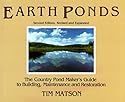
Earth Ponds: The Country Pond Maker's Guide to Building, Maintenance and RestorationEarth Ponds Sourcebook: The Pond Owner's Manual and Resource Guide, Second EditionEarth Ponds A to Z: An Illustrated Encyclopedia
Earth Ponds: The Country Pond Maker's Guide...
by Tim Matson
$16.46
Earth Ponds Sourcebook: The Pond Owner's Ma...
by Tim Matson
$14.93
Earth Ponds A to Z: An Illustrated Encyclop...
by Tim Matson
$12.89

Aquaculture: The Farming and Husbandry of Freshwater and Marine OrganismsEnvironmental Impacts of Aquaculture (Sheffield Biological Sciences)Aquaculture: Farming Aquatic Animals and Plants (Fishing News Books)
Aquaculture: The Farming and Husbandry of F...
by John E. Bardach
$150.00
Environmental Impacts of Aquaculture (Sheff...
Aquaculture: Farming Aquatic Animals and Pl...
$99.89
Changing the Face of the Waters: The Promise and Challenge of Sustainable Aquaculture (Agriculture and Rural Development Series) (Agriculture and Rural Development Series)Freshwater Crayfish Aquaculture in North America, Europe, and Australia: Families Astacidae, Cambaridae, and ParastacidaeDynamics of Pond Aquaculture
Changing the Face of the Waters: The Promis...
by World Bank
$25.00
Freshwater Crayfish Aquaculture in North Am...
by Jay Huner
$39.37
Dynamics of Pond Aquaculture
by Claude E. Boyd
Swimming in Circles: Aquaculture and the End of Wild OceansFreshwater Aquaculture: A Handbook for Small Scale Fish Culture in North AmericaUrban Aquaculture (Cabi Publishing)
Swimming in Circles: Aquaculture and the En...
by Paul Molyneaux
$12.44
Freshwater Aquaculture: A Handbook for Smal...
by William McLarney
Urban Aquaculture (Cabi Publishing)

Zombie Economics

By James Howard Kunstler for ClusterFuck Nation


Though Citicorp is deemed too big to fail, it's hardly reassuring to know that it's been allowed to sink its fangs into the Mother Zombie that the US Treasury has become and sucked out a multi-billion dollar dose of embalming fluid so it can go on pretending to be a bank for a while longer. I employ this somewhat clunky metaphor to point out that the US Government is no more solvent than the financial zombies it is keeping on walking-dead support. And so this serial mummery of weekend bailout schemes is as much of a fraud and a swindle as the algorithm-derived-securities shenanigans that induced the disease of bank zombification in the first place. The main question it raises is whether, eventually, the creation of evermore zombified US dollars will exceed the amount of previously-created US dollars now vanishing into oblivion through compressive debt deflation.

My guess, given the usual time-lag factor, is that the super-inflation snap-back will occur six to eighteen months from now. And the main result of all this will be our inability to buy the imported oil that comprises two-thirds of the oil we require to keep WalMart and Walt Disney World running. At some point, then, in the early months of the Obama administration, we'll learn that "change" is not a set of mere lifestyle choices but a wrenching transition away from all our familiar and comfortable habits into a stark and rigorous new economic landscape.

The credit economy is dead and the dead credit residue of that dead economy is going where dead things go. It came into the world as "money" and it is going out of this world as a death-dealing disease, and we're not going to get over this disease until we stop generating additional zombie money out of no productive activity whatsoever. The campaign to sustain the unsustainable is, besides war, the greatest pitfall this society can stumble into. It represents a squandering of our remaining scant resources and can only produce the kind of extreme political disappointment that wrecks nations and leads to major conflicts between them. I don't know how much Mr. Obama buys into the current adopt-a-zombie program -- his Treasury designee Timothy Geithner was apparently in on this weekend's Citicorp deal -- but the President would be wise to steer clear of whatever the walking dead in the Bush corner are still up to.

All the activities based on getting something-for-nothing are dead or dying now, in particular buying houses and cars on credit and so it should not be a surprise that the two major victims are the housing and car industries. Notice, by the way, that these are the two major ingredients of an economy based on building suburban sprawl. That's over, too. We're done building it and the stuff we've already built is destined to loose both money value and usefulness as the wrenching transition goes forward.

All this obviously begs the question: what kind of economy are we going to live in if the old one is toast? Well, it's also pretty obvious that it will have to be based on activities productively aimed at keeping human beings alive in an ecology that has a future. Once you grasp this, you will see that there is no reason to despair and more than enough for all of us to do, so we can recover from the zombie nation disease and get on with the next chapter of American history -- and I sure hope that Mr. Obama will get with the new program.

To be specific about this new economy, we're going to have to make things again, and raise things out of the earth, locally, and trade these things for money of some kind that we earn through our own productive activities. Don't make the mistake of thinking this is optional. The only other option is to go through a violent sociopolitical convulsion. We ought to know from prior examples in world history that this is not a desirable experience. So, to avoid that, we really have to put our shoulders to the wheel and get to work on things that matter, and do it at a scale that is consistent with what the world really has to offer right now, especially in terms of available energy.

In my view -- and I know this is controversial -- a much larger proportion of the US population will have to be employed in growing the food we eat. There are many ways of arranging this, some more fair than others, and I hope the better angels of our nature steer us in the direction of fairness and justice. The prospects of a devalued dollar imply that we very shortly will not be able to get the all the oil-and-gas based "inputs" that have made petro-agriculture possible the past century. The consequences of this are so unthinkable that we have not been thinking about it. And, of course, the further implications of current land-use allocation, and the property ownership issues entailed, suggests formidable difficulties in re-arranging the farming sector. The sooner we face all this, the better.

As the fiesta of "globalism" (Tom Friedman-style) draws to a close -- another consequence of currency problems -- we'll have to figure out how to make things in this country again. We will not be manufacturing things at the scale, or in the manner, we were used to in, say, 1962. We'll have to do it far more modestly, using much more meager amounts of energy than we did in the past. My guess is that we will get the electricity for doing this mostly from water. It may actually be too late -- from a remaining capital resources point-of-view -- to ramp up a new phase of the nuclear power industry (and there are plenty of arguments from the practical and economic to the ethical against it). But we have to hold a public discussion about it, if only to clear the air and get on with other things, namely the new activities of alt.energy. But I would hasten to warn readers (again!) that we'll probably have to do these things more modestly too (don't count on giant wind "farms"), and that we are liable to be disappointed by what they can actually provide for us (don't expect to run WalMart on wind, solar, algae-fuels, etc).

In any case, we're not going back to a "consumer" economy. We're heading into a hard work economy in which people derive their pleasures and gratification more traditionally -- mainly through the company of their fellow human beings (which is saying a lot, for those of you who have forgotten what that's about). Our current investments in "education" -- i.e. training people to become marketing executives for chain stores -- will delude Americans for a while about what kind of work is really available. But before long, the younger adults will realize that there are enormous opportunities for them in a new and very different economy. We will still have commerce -- even if it's not the K-Mart blue-light-special variety -- and the coming generation will have to rebuild all the local, multi-layered networks of commercial inter-dependency that were destroyed by the rise of the chain stores. In short, get ready for local business. It will surely be part-and-parcel of our local food-growing and manufacturing activities.

I hate to keep harping on this -- but since nobody else is really talking about it, at least in the organs of public discussion, the job is left to me -- we have to get cracking on the revival of the railroad system in this country, if we expect to remain a united country. This is such a no-brainer that the absence of any talk about it is a prime symptom of the zombie disease that has eaten away our brains. Automobiles (the way we use them) and airplanes are utterly dependent on liquid hydrocarbon fuels, and you can be certain we'll have trouble getting them. You can run trains by other means -- electricity being state-of-the-art in those parts of the world that do it most successfully. I know that California just voted to create a high-speed rail link between Los Angeles and San Francisco. It's an optimistic sign, but it shows more than a little techno-grandiose over-reach. High speed rail would require a mega-expensive re-do of the tracks. We need to scale our ambitions for this more realistically. California (and every other region of America) would benefit much more from normal-speed trains running every hour on the hour on tracks that already exist than from a mega-expensive, grandiose sci-fi program that might not get built for ten years. The dregs of the Big Three automakers can and should be reorganized to produce the rolling stock for a revived railroad system.

Even amidst the financial carnage underway right now, the public is enjoying a respite from high-priced gasoline, but it is due to be short-lived. As I've already said, we are in danger not just of oil prices going way back up again, but of losing access to our supplies from the exporting countries. In other words, we're just as likely to face shortages as high prices, and soon. Oil shortages are certain to produce a political freak-out here unless we get our heads screwed on right -- and this means that Mr. Obama had better prepare quickly for a comprehensive action plan in the face of such an emergency (which has to include a robust public information initiative).

In the meantime, Mr. Obama must dissociate himself from all activities aimed at the care-and-feeding of zombies. Mr. Obama is correct that there is one president and one government at a time, and since this is the case in reality, he must avoid being contaminated by the choices they make as their clock ticks out. Obviously, world markets might be more disturbed if Mr. Obama were to step up and actively contradict everything that is being done to cultivate zombies right now. He is in a very delicate position. But being a man of intelligence and sensibility, he may successfully navigate this rough passage.

That this melt-down is building straight into the Christmas holidays is one of those accidents of history that leaves one reeling in wonder and nausea. The cable networks better be prepared to bombard the public with round-the-clock showings of It's A Wonderful Life, because they're going to need all the moral support they can get as zombies stalk through the silent night, holy night.

Friday, November 21, 2008

"What is the most beautiful thing I can do?"

Money and the Crisis of Civilization

Charles Eisenstein

Suppose you give me a million dollars with the instructions, "Invest this profitably, and I'll pay you well." I'm a sharp dresser -- why not? So I go out onto the street and hand out stacks of bills to random passers-by. Ten thousand dollars each. In return, each scribbles out an IOU for $20,000, payable in five years. I come back to you and say, "Look at these IOUs! I have generated a 20% annual return on your investment." You are very pleased, and pay me an enormous commission.

Now I've got a big stack of IOUs, so I use these "assets" as collateral to borrow even more money, which I lend out to even more people, or sell them to others like myself who do the same. I also buy insurance to cover me in case the borrowers default -- and I pay for it with those self-same IOUs! Round and round it goes, each new loan becoming somebody's asset on which to borrow yet more money. We all rake in huge commissions and bonuses, as the total face value of all the assets we've created from that initial million dollars is now fifty times that.

Then one day, the first batch of IOUs comes due. But guess what? The person who scribbled his name on the IOU can't pay me back right now. In fact, lots of the borrowers can't. I try to hush this embarrassing fact up as long as possible, but pretty soon you get suspicious. You want your million dollars back -- in cash. I try to sell the IOUs and their derivatives that I hold, but everyone else is suspicious too, and no one buys them. The insurance company tries to cover my losses, but it can only do so by selling the IOUs I gave it!

So finally, the government steps in and buys the IOUs, bails out the insurance company and everyone else holding the IOUs and the derivatives stacked on them. Their total value is way more than a million dollars now. I and my fellow entrepreneurs retire with our lucre. Everyone else pays for it.

This is the first level of what has happened in the financial industry over the past decade. It is a huge transfer of wealth to the financial elite, to be funded by US taxpayers, foreign corporations and governments, and ultimately the foreign workers who subsidize US debt indirectly via the lower purchasing power of their wages. However, to see the current crisis as merely the result of a big con is to miss its true significance.

I think we all sense that we are nearing the end of an era. On the most superficial level, it is the era of unregulated casino-style financial manipulation that is ending. But the current efforts of the political elites to fix the crisis at this level will only reveal its deeper dimensions. In fact, the crisis goes "all the way to the bottom." It arises from the very nature of money and property in the world today, and it will persist and continue to intensify until money itself is transformed. A process centuries in the making is in its final stages of unfoldment.

Money as we know it today has crisis and collapse built into its basic design. That is because money seeks interest, bears interest, and indeed is born of interest.

Read the rest...