From Yuba Bikes the Mundo cargo bike:Yuba was launched in 2006 to build and provide affordable mobility solutions with a particular emphasis on distributing them to those most in need. The founders of Yuba came together to advance economic and social development, to promote self-reliance, and to emphasize better environmental awareness and lifestyle choices – all through the use of bicycles. Because bicycles are one of the most energy efficient, financially affordable, mechanically reliable, and environmentally friendly vehicles, we believe that a more bike-centric world makes for a better world, a more connected world.
Designed for maximum bicycle mobility, the all-terrain Mundo offers an affordable and sustainable alternative for:
environmentally friendly transportation economic viability unsurpassed cargo capacity the ability to carry passengers affordable mobility
See Worldbike for "open-source" bicycle designs:"Worldbike is an international network of bicycle designers and industry leaders, and international development professionals, working together to provide transportation solutions and create income-generating opportunities for the world’s poor. All across the developing world, people use bicycles the way we use pickup trucks and school buses. However, the bicycles sold in developing countries are those designed for recreation and are ill-suited to carrying loads. Worldbike designs higher-strength, longer-wheelbase bicycles with integrated cargo capacity. We conduct trial markets to determine the ideal price levels, work with the bike industry to get the best quality parts and frames at the lowest cost, and partner with international development organizations like Kickstart International to sell and distribute the bicycles..."
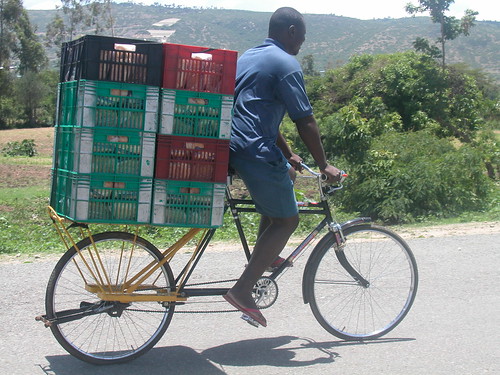
"The bicycle is the most efficient transportation device yet invented. Trouble is, modern bicycle design has been far more influenced by the needs of racers than by the needs of everyday riders like you. The result: your bike is compact, light, and strong, but it doesn’t have a good place to carry a week’s groceries, waterproof storage capacity, or a good seat for a passenger. Xtracycle solves these problems.Imagine your favorite bike with the rear wheel stretched out behind the seat, a big, stable platform for a load or a passenger, and elegant saddlebags on either side that are expandable when you need them and are cleanly out of the way when you don’t. Best of all, your bike is still lightweight and fast, and because the load is centered between your two wheels, the whole package handles with ease. Suddenly you have much less need or desire to drive around town for your errands. Picture this: riding breezily unloaded to your favorite grocery store, coasting reliably around corners; arriving ahead of traffic; parking at the rack directly in front of the entrance; shopping and easily loading your four bags of groceries; then pedaling home, care-free on a bike that handles just as swiftly now that it’s loaded." WorkCycles: Transport bike, cargo trike & handmade Dutch city bike specialist [These are beautiful and VERY functional bikes. Visit their site for a view of many other styles-KJ]
WorkCycles is the specialist in quality utility bicycles for commercial, family and personal use. We develop our own models and also sell bikes from Azor, Bakfiets.nl, De Redding, Monark, Nijland, Onderwater and others. WorkCycles bicycles are known for their timeless design, top quality and attention to detail. Whether you need a bike to safely carry your children, a classic Dutch city bike or tough industrial bikes we we've got it.
OMG! It carries 12 kids! Look into The International Bicycle Fund especially their page on (work bikes): A non-governmental, nonprofit, advocacy organization, providing information and resources promoting sustainable transport and international understanding to make this planet a healthier and happier place to live. Major areas of activity are non-motorized urban planning, economic development, bike safety education, responsible travel and bicycle tourism, and cross-cultural, educational programs.
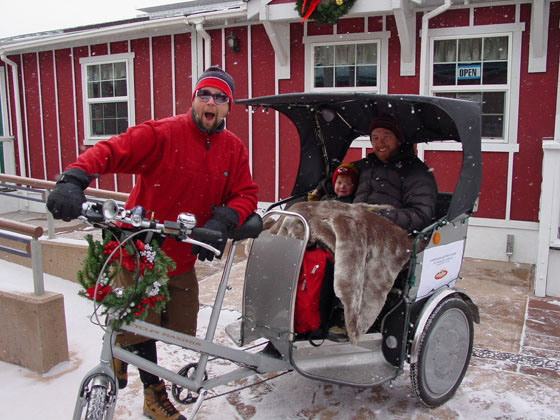
Bicycle Taxis are becoming popular in NY and other cities:
BicyTaxi has fast become a common sight in many environmentally-conscious cities worldwide. Because our cities are becoming increasingly crowded and busy, we must consider new and innovative concepts in order to maintain, or even improve, the quality of life for residents. Bicytaxi is the ideal solution to these problems as it ecologically and efficiently reduces urban emissions and therefore pollution. Urban transportation is enhanced through a flexible and reliable mobility system. BicyTaxi pedicabs which are similar to a rickshaw or riksha, however, are not only excellent means of transport for urban areas but also excel at events. They may further be used as a shuttle service and are, of course, one of the best and most effective advertising media in the outdoor sector.

"We set out to build a high capacity tricycle that provides a practical, environmentally friendly solution to your local transport needs. The modular construction offers a wide choice of applications, pioneering design and craftsmanship combine to provide a viable alternative to the internal combustion engine."
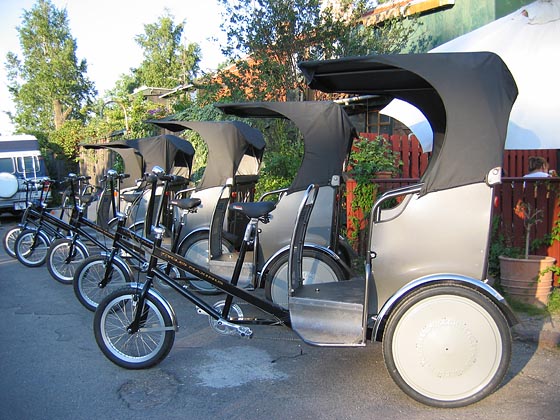
Cyclestone Pedicabs, Inc. has been doing business with pedicab since 2004. Our main partners company(Starbike Ltd.) doing business with cycles since 1988. We can offer all kind of pedicab, three cycles and bike configurations to the local and worldwide wholesaler and retail customers. Cyclestone Pedicabs goals; well quality, fast service, enjoyable pedicab & bike and lower price for all kind of our products.
(France)
In Germany:
In India: Present activities are in sustainable transport, lighting , environment pollution abatement, handicapped rickshaw, etc.
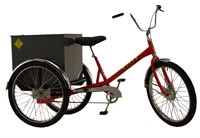
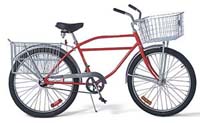
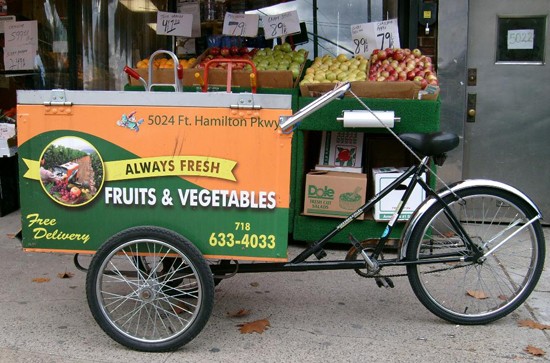
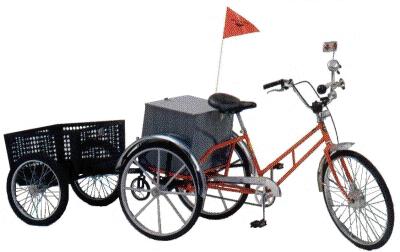
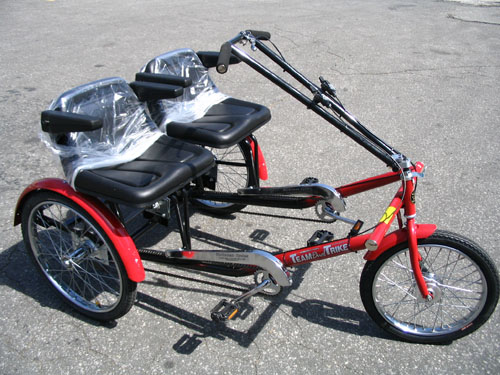
In a previous post I featured Bikes At Work's trailers for converting your bike to a work bike. These will undoubtedly become a primary means of transport as the economy shifts to a post-petroleum future...(watch for more donkeys and horses, too.) Here's a few more sources for work bikes: Worksman Bikes: I first learned about these folks through CoEvolution Quarterly (Whole Earth Review):"Worksman Cycles has long been known as the world-leader in Industrial Cycles (Bicycles and Tricycles). Today more than ever, leading companies call upon our Worksman Business Cycle System to safely and efficiently move key personnel and supplies within large industrial facilities. Our customer list is incredibly diverse and impressive, featuring the world's largest and most respected companies. These companies know that for durable, emission-free transportation, Worksman Business Cycles are the only smart choice." The vegetable delivery cart (which I'd love to have) and the hand-pedaled bike are very cool.
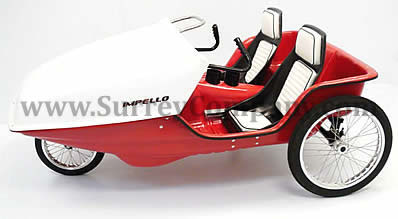
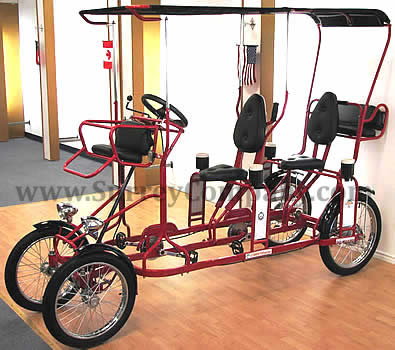
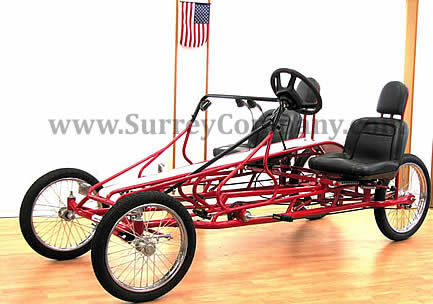
International Surrey Co., LTD: "Offering the finest four (4) wheel Surrey bikes in the world. No other Surrey bicycle company has rented, distributed and manufactured these distinctive four wheel bicycles. Our pledge is to continue to offer innovative two person and four person four wheel Surrey bikes for your business or home and CYCLES THAT MOVE YOU™."
Check out this Wiki page featuring work bikes from around the planet, many of them homemade.
More books are cropping up with solutions to the crumbling of Empire. Not surprisingly, many of them are suggesting that the collapse of empire IS the solution. The challenge, of course, is to survive and maybe even thrive on a low-energy solar budget. Here's one you can read online:
A Matter of Scale by Keith Farnish A Book, A Solution, A Future
"For hundreds of millennia, humans connected tightly to the land and the life forms their survival depended upon, because that was how it had to be. Failure to connect was not an option; if you didn’t know how plants grew, how animals bred, how rivers ran, how the seasons and the weather changed, then you did not survive. In some parts of the world – the Native American tribal lands of West Coast USA, the dense forests of West Papua, the deep valleys and jagged mountains of northern India – these connections remain, and cling on despite the best efforts of those who seek to gain more from the land than 'mere' survival. This connection has ebbed away from the majority of humanity, in many cases to the extent that people feel nothing for anything humans have not created themselves. But we cannot eat concrete; we cannot breathe television; we cannot drink money."
A Matter Of Scale is a free, online book which you can read here, or download to read whenever you like. Enjoy it, but don't get too comfortable...
The Author: Keith Farnish is an environmental writer, philosopher and activist. He founded The Earth Blog (www.theearthblog.org) in 2006, and writes The Unsuitablog (www.unsuitablog.com). He is also a guest author on The Sietch Blog. Keith lives in Essex with his wife and children. He is also the author of TIME'S UP!, a book about survival; about ensuring that every individual human has the means to save herself or himself from the global crisis that is unfolding.
Good evening, ladies and gentlemen. I am not an expert or a scholar or an activist. I am more of an eye-witness. I watched the Soviet Union collapse, and I have tried to put my observations into a concise message. I will leave it up to you to decide just how urgent a message it is.
My talk tonight is about the lack of collapse-preparedness here in the United States. I will compare it with the situation in the Soviet Union, prior to its collapse. The rhetorical device I am going to use is the "Collapse Gap" – to go along with the Nuclear Gap, and the Space Gap, and various other superpower gaps that were fashionable during the Cold War.
One important element of collapse-preparedness is making sure that you don't need a functioning economy to keep a roof over your head. In the Soviet Union, all housing belonged to the government, which made it available directly to the people. Since all housing was also built by the government, it was only built in places that the government could service using public transportation. After the collapse, almost everyone managed to keep their place.
In the United States, very few people own their place of residence free and clear, and even they need an income to pay real estate taxes. People without an income face homelessness. When the economy collapses, very few people will continue to have an income, so homelessness will become rampant. Add to that the car-dependent nature of most suburbs, and what you will get is mass migrations of homeless people toward city centers.
Soviet public transportation was more or less all there was, but there was plenty of it. There were also a few private cars, but so few that gasoline rationing and shortages were mostly inconsequential. All of this public infrastructure was designed to be almost infinitely maintainable, and continued to run even as the rest of the economy collapsed.
The population of the United States is almost entirely car-dependent, and relies on markets that control oil import, refining, and distribution. They also rely on continuous public investment in road construction and repair. The cars themselves require a steady stream of imported parts, and are not designed to last very long. When these intricately interconnected systems stop functioning, much of the population will find itself stranded.
Economic collapse affects public sector employment almost as much as private sector employment, eventually. Because government bureaucracies tend to be slow to act, they collapse more slowly. Also, because state-owned enterprises tend to be inefficient, and stockpile inventory, there is plenty of it left over, for the employees to take home, and use in barter. Most Soviet employment was in the public sector, and this gave people some time to think of what to do next.
Private enterprises tend to be much more efficient at many things. Such laying off their people, shutting their doors, and liquidating their assets. Since most employment in the United States is in the private sector, we should expect the transition to permanent unemployment to be quite abrupt for most people.
The Soviet agricultural sector was notoriously inefficient. Many people grew and gathered their own food even in relatively prosperous times. There were food warehouses in every city, stocked according to a government allocation scheme. There were very few restaurants, and most families cooked and ate at home. Shopping was rather labor-intensive, and involved carrying heavy loads. Sometimes it resembled hunting – stalking that elusive piece of meat lurking behind some store counter. So the people were well-prepared for what came next.
In the United States, most people get their food from a supermarket, which is supplied from far away using refrigerated diesel trucks. Many people don't even bother to shop and just eat fast food. When people do cook, they rarely cook from scratch. This is all very unhealthy, and the effect on the nation's girth, is visible, clear across the parking lot. A lot of the people, who just waddle to and from their cars, seem unprepared for what comes next. If they suddenly had to start living like the Russians, they would blow out their knees.
There are some things that I would like the government to take care of in preparation for collapse. I am particularly concerned about all the radioactive and toxic installations, stockpiles, and dumps. Future generations are unlikely to able to control them, especially if global warming puts them underwater. There is enough of this muck sitting around to kill off most of us. I am also worried about soldiers getting stranded overseas – abandoning one's soldiers is among the most shameful things a country can do. Overseas military bases should be dismantled, and the troops repatriated. I'd like to see the huge prison population whittled away in a controlled manner, ahead of time, instead of in a chaotic general amnesty. Lastly, I think that this farce with debts that will never be repaid, has gone on long enough. Wiping the slate clean will give society time to readjust. So, you see, I am not asking for any miracles. Although, if any of these things do get done, I would consider it a miracle.
Certain types of mainstream economic behavior are not prudent on a personal level, and are also counterproductive to bridging the Collapse Gap. Any behavior that might result in continued economic growth and prosperity is counterproductive: the higher you jump, the harder you land. It is traumatic to go from having a big retirement fund to having no retirement fund because of a market crash. It is also traumatic to go from a high income to little or no income. If, on top of that, you have kept yourself incredibly busy, and suddenly have nothing to do, then you will really be in rough shape.
Economic collapse is about the worst possible time for someone to suffer a nervous breakdown, yet this is what often happens. The people who are most at risk psychologically are successful middle-aged men. When their career is suddenly over, their savings are gone, and their property worthless, much of their sense of self-worth is gone as well. They tend to drink themselves to death and commit suicide in disproportionate numbers. Since they tend to be the most experienced and capable people, this is a staggering loss to society.
If the economy, and your place within it, is really important to you, you will be really hurt when it goes away. You can cultivate an attitude of studied indifference, but it has to be more than just a conceit. You have to develop the lifestyle and the habits and the physical stamina to back it up. It takes a lot of creativity and effort to put together a fulfilling existence on the margins of society. After the collapse, these margins may turn out to be some of the best places to live.