
 Photo by Charles N. Brown
After devouring his latest trilogy which highlighted Permaculture for millions of readers (Thank you very much, Stan!) I contacted the acclaimed science fiction author, Kim Stanley Robinson, and he consented to the following interview. If you haven't read his work, I recommend it VERY highly. See the links at the bottom of this interview for other mentions of his work on this blog.
I am very grateful to Mr. Robinson for taking the time to engage my questions and curiosity. I hope you enjoy it. Keith
KEITH: Permaculturists are trained to recognize 'leaks' in, or 'damage to, the landscape (or a continent) so that appropriate strategies can be applied to restore and enhance life support for all organisms that could be sustained in that environment...in essence a kind of localized 'terraforming' using simple earthworks to manage water and other flows. How do you imagine that we can accelerate the adoption of these terraforming practices and what might they look like in the places most people now live: cities?
Kim Stanley Robinson: It would be really good if ecological and permaculture principles were taught in schools as a basic part of the science curriculum and one's general education. I think to an extent this is happening, it's getting more common to learn ecology and earth sciences by studying where your food and water come from, and the energy and carbon and water cycles, and so on. These educational basics are needed to make sense of the oncoming problems of this century. It would help also if this education led to a more realistic economics, in which there wasn't so much false pricing based on theft from the future generations. This would take legislation and run into opposition from "free enterprise" (read free to steal from the future).
Making things cost what they really cost; this would be part of any real solution.
I think the "terraforming" of cities will involve a melange of approaches that will run the gamut from ancient "low tech" technologies to still emerging "high tech" technologies. To generalize, I think the best way forward would be to use all "appropriate technologies" in the sense Victor Papanek used the term. I'd also like to point out that the appropriate technologies for bridging from the current unsustainable population and technology set to true sustainability might not be the same technologies as those that will be appropriate once we have bridged to true sustainability.
I would hate to see permaculture used as a term only to describe a hypothetical sustainable population much smaller than what we really have. It needs to describe also the way forward from this actual moment in history.
Cities: maybe there will be streetgrasses and cities become kind of prairies, and maybe the streetgrasses would be a GMO. Then also intensive gardening where we don't usually think of it, as on rooftops, interior floors, balconies, streets [vertical surfaces - Keith]. Also a lot of tearing down and rebuilding to better design and materials, a centuries-long project for sure, but cities are always doing this anyway.
In compact cities, walking, bikes and trolleys could all happen on street prairies. In extensive autopias like southern California, freeways could be converted so that the fast lane was railed for light rail, the middle lane for golf cart type cars, and the slow lane for bikes. White bicycles everywhere (the Amsterdam model) using also big group bikes or bike-trolleys, could make transport a really low-carbon and fun activity. In general I've been trying to make the point that decarbonization will raise our quality of life rather than lower it.
At sea, big sailing ships should come back, they could be made much safer than a hundred years ago when the last generation of really big ones all disappeared, presumably sunk in storms from problems of scale engineers weren't seeing. Now they could do better and it would be a much cleaner tech than what we use now. Of course it would help too to bioregionalize things so that there is less pointless global transport.
In the air, blimps and zeppelins. All these transformations would require an adjustment in our sense of the need for speed. There is no human need for the speed of transport we have. If there is a system of continuous supply in which a unit is appearing every week, then it doesn't matter how many weeks at sea or in air any unit took to make its trip. So there are adjustments that could be made. They would often require more human labor, which while only a "cost" in current economics might really be a benefit in human terms. Ships' crews as parties, colleges, prison sentences, simple cruises, or other.
Maybe this train of thought (that slow isn't necessarily bad) should cause us reconsider even the idea that we need to "accelerate" these better technologies and practices. Granted we appear to be facing a crisis moment, but maybe that will force the action in a natural way, so that we don't have to always feel that we are failing because of the slow pace of change relative to our perception, the discrepancy between biological time and historical time. If it's slow relative to our need, that's indeed bad, and that may be happening.
Maybe the real acceleration needed now is in everyone's sense of how badly capitalism is failing us, tearing the human and natural world apart. So many of these issues raised by the concept permaculture are more economic, political and social than specifically technological; I know it's all bundled together but given the immense power in many possible technologies, it's the political/economic/cultural element that is the crucial point of decision.
Keith: Another interviewer said, "It seems so easy [to terraform] on Mars, and looks so hard on earth, which is kind of ironic," to which you replied, "It's infinitely more difficult when there's already an established ecology. There's no room for error. And also, alas, there are some mistakes that we simply don't have the power to correct"...such as "ocean acidity." Do you think that huge engineering projects will be necessary or could many small human-scale solutions (where, for example, bulldozers and other heavy equipment are used to shape earth for ponds and in-ground water storage with contour infiltration channels) produce similar results?
KSR: This is a tough question because I'm not sure which problems will really eventuate. I don't think we can do anything to alter the acidity of the oceans by any engineering project large or small; and I wonder if we go to more than 450 parts per million of carbon dioxide in the atmosphere, if we could do anything to stop the resulting major climate change. I doubt it.
Once we push over relatively delicate tipping points the climactic momentum is massive, beyond the forces we can marshal with any kind of engineering. If big environmental changes start to occur that have positive feedbacks and are far beyond our powers to reverse, maybe society will then try the various space projects now being proposed, launching clouds of solar deflectors or particulates or whatnot, in the desperate hope of trying to reverse things by initiating what would really be the start of a kind of artificial ice age. But what a scary thought.
Thermostatting Earth's average temperature; I don't think we'll be very good at that as a species. Certainly it would be better to engineer it by way of a great number of small early human-scale solutions, as you suggest in your question. Treat each watershed as a water and carbon repository of a certain capacity, and coordinate action over all the world; it comes down to a matter of continuous landscape restoration and biome management. But starting this in the next ten or twenty years may be the crucial factor.
There's a philosophical impact to this realization that humans have to take on responsibility for stewardship of the biosphere, as a highly conscious Gaia sort of action. It's scary and it seems presumptuous and really beyond our knowledge, power, and wisdom. And yet since we clearly have the power to wreck the whole thing and create a mass extinction event, the burden of responsibility for avoiding that falls on us more or less inevitably, and permanently from now on. It's as if permaculture is now required, both morally and in sheer survival terms.
Keith: How are you applying permaculture principles in your own life and landscape? Has the example of Village Homes and its extensive food forest / edible landscape / swale infiltration system been inspirational to you?
KSR: Oh yes, most definitely. Village Homes has changed my life. My wife and I fell into Village Homes by accident; we did not seek it out, and if we had not fallen into it, we would have lived a much more ignorant and conventional life. So we were very lucky.
Also, I should say that VH is not that extraordinary a place, but merely a kind of tweaked suburbia, in which some of the ordinary bad design of suburbia has been mitigated by the application of some fairly simple tweaks, which nevertheless violate some of most American cities' zoning and building codes, so that it was a political hassle to get the approvals and do it. Some of the tweaks just come out of condominium complexes, others from East Coast earlier practices, some from British garden cities of the 19th century, others from 1960s ideals, which themselves usually had older roots. So, it's only 80 acres and about 220 units in west Davis, and the housing density is not great. But the swales and ponding of rainwater, the common ownership of all the land not occupied by houses, the communal buildings for daycare and offices and restaurant and meetings, the bike paths and de-emphasis of streets, the edible landscaping, the many garden spaces, the orchards and vineyards, the open space for gatherings and sports—all these are really great ideas, and they combine to make something wonderful.
If every suburb built since WWII in America had been built to the Village Homes plan, we would have a much saner society, and be burning much less carbon (energy use in VH is about half the normal American rate.) Without claiming too much for it—it is not an intensive effort nor rigorously applied—it has still been a profoundly calming and educational place for me and my family to live, and I would imagine about two-thirds of the neighbors feel the same (the rest don't seem to notice it is any different, and often move away).
Living here had a huge impact on my Mars novels and really all my books since 1991, and when I look at my utopian novel Pacific Edge from 1987, written before I knew about VH, I am surprised to see that I was longing for something like this place, thinking about alterations in the suburbia I came out of in southern California. Living here the last 17 years I've learned gardening, and grow about five percent of my family's food, variable by season of course; I've experienced village life, both the social life and sense of community, and the nano-politics of managing a commons together; I've brought up two boys who don't know how good they've had it; and I've greatly enjoyed my place. All this feels rare and lucky in the postmodern American context. There is room for further progress and improvement, of course, but it shows what can be done and how much urban/suburban design matters.
Keith: Water is a major theme in your Mars trilogy and also your Science in the Capital series. In the former humans had to deal with too little of it (extreme aridity and the necessity of importing it via comets) and in the latter too much (storm surge, flooding, rising sea levels, lots of snow). Currently our planet has an abundance of H2O but very little fresh water. 97% of Earth's water is saline. Of the remaining 3% which is fresh water, 75% is stored in ice and glaciers (this figure is subject to rapid change), 13.5% is in aquifers 2500+ ft deep, 11% is in shallower aquifers less than 2500 ft, .3% is in lakes and ponds, .06% is in soils near the surface, .035% is in the atmosphere, and .03% is in rivers.
Humans are using the available fresh water faster than its replacement rate such that we are reaching what Richard Heinberg and others call "Peak Water". Currently 31 countries are dealing with severe shortages and lack of access to clean water. What do think it will take for humans to become adept at managing water resources half as well as beavers did for this continent before they were decimated?
KSR: "Peak Water"—that's a powerful concept! Again, education about this matter of fossil water and our unsustainable mining of it is an important part of the story. The standard economic answer to this would be price, I guess. Do we pay less for water than it really costs? Is this yet another case of "predatory dumping" therefore, with the ones predated on being the future generations? Theft from our grandchildren, again? It would be good to be always asking these questions and "costing out" answers. But it's also dangerous to play these economic games, as that seems to concede that economics really is what it says it is, which is a rational system of evaluating our ecologies and their healthy actions. It isn't really so, as permaculture theory tries to show, as I understand it. But it may be a powerful rhetorical or persuasive strategy, to be able to use economic theory to show that even in standard economic terms, the system is not sustainable. Talking about spending capital as if it were disposable income, etc. Always reminding people that many real costs have been externalized, and that standard economics is often a big lie about reality, trying to justify the privileges of the powerful few. Comparing it to the use of astrology in the middle ages, calling it just another pseudo-science justifying power. But also trying to reform it to make it a truly useful tool of evaluation of practices.
If economics were real, it it was based in ecology and admitted to having values embedded in it, and explicitly tried to include positive human values like the simplest ones of justice and sustainability, it would become a very important tool, a human science. It is not that now, but it could and should be. So many of these problematic issues, like water and food, will come to the forefront of the attention of our society either by war, economic depression, natural catastrophe, or ongoing successful education. Looking at that list, it becomes clear that education is very important.
Keith: The aim of permaculture is to liberate people everywhere to provide for their own and their communities' needs for food, energy, shelter, and a decent life without exploitation or pollution and from the smallest practical area of land. Cuba had to adapt in three years to the sudden unavailability of fuel but they were successful even though most adult Cubans lost 20 - 30 lbs. How do you think Americans will adapt to energy decline, especially since we are not blessed with Cuba's climate? [See The Power of Community: How Cuba Survived Peak Oil]
KSR: But soon we may have Cuba's climate, right? And a lot of us want to lose ten or fifteen pounds, right?
Anyway, jokes aside, whatever climate we have in the USA is adequate for the needs you list in your question, and there is no requirement that we do not engage in some trade to get some things distributed around from watershed to watershed. That would be part of any solution and would be okay. Purity is not really an idea I like in any realm. Food, water, shelter, clothing, health care, education, and a decent life: these have been my definition of utopia for a long time.
I think you are right to include energy, which at a certain quantity forms the basis for many of the other things; though we don't need as much as we use in the USA today. So, it's a good list to focus on.
I don't know how Americans will do. Right now we are caught up in a culture of capitalist hyper-consumption, also ideological fantasies about any number of things; what constitutes a good life, what America has been about historically, where we stand in the world community, what would make us happy. In many cases, for many of these questions, we are completely deceived and living as rats on a wheel in a cage, even though the cage has an open door and a better life lies just outside it waiting to be constructed. So it's a desperately deceived culture, neurotic, ill-educated, over-worked. And yet we are social creatures, and we tend to do what everyone else does, what our culture suggests is normal to do. We strive to be normal.
So... I try to imagine cultural revolution, which is to say changing the idea of what is normal. Big cultural revolutions have happened before from time to time. But analogies to past situations seldom work, they were all so different from now. Now there is a level of faux affluence created by stealing from the future, a sense that there is just enough stuff and just enough leisure time and just enough conformist triumphalist American theory, to keep people grinding on in lives that only intermittently reveal their Thoreauvian "quiet desperation," mostly at moments of bad health or unemployment, which we try to imagine will never happen to us. Risk is being privatized, and Americans are nervous and unhappy and resentful about it, but until the crisis hits, not miserable, and often distracted along the way by various future-stealing techno-euphorias that substitute for or mask what would constitute a truly good or decent life. So it will be a strange and potentially awful century.
But cultural changes sometimes happen very rapidly, even explosively. So maybe the task now is to try to set the ground for change and work on various starts. Just keep talking and even proselytizing for a different normal, for permaculture as a goal norm. I've started giving copies of Walden to every teenager I know. You can buy copies for a dollar, every used bookstore (including amazon.com) has tons of them, and even new they're usually only five dollars. Maybe only one kid in ten reads it, maybe one in ten of those is impressed by it. But it's like a kind of sign or symbol. And symbolic actions are also real actions. I mention this as just one example, because I am so impressed by Thoreau as a thinker and writer, scientist and artist. The case could be made that he is the greatest American writer ever, Walden the greatest American book; people often do this; and so this points to a strong strand of permaculture in the middle of American thinking, going back to the transcendentalists, the Quakers, the Shakers, many of the early utopian movements. And also Thoreau was a small town guy, living a pretty ordinary small town or suburban life, impure and compromised; you don't have to leave society for some heroic wilderness action like Muir's to follow Thoreau's example of daily permaculture practice in the American context of waste. So it's one way in, and has a historical, literary, and spiritual component that I like.
Keith: Confined Animal Feed Operations (CAFOs), dependent upon hormones, antibiotics (without which most of the animals would die before going to market) and GMO feedstocks, are the norm for American's meat supply. What do think about these practices in regard to a sustainable future food supply especially as famine looks more and more a real likelihood for many people?
KSR: Meat might be the crucial word here. Americans eat 800 kg of grain a year while south Asian poor people eat 200 kg of grain per year, and Italians 400 kg of grain a year, probably the healthiest, and most of the differences here are because of the pyramids involved with feeding grain to cows for beef. It would be better for the earth and for our bodies to eat a lot less meat. Eating healthier is better for the planet, and more and more this is common knowledge.
I would separate out GMOs from this problem for a separate consideration. To me the problem there is not so much the actual genetic engineering, which in many ways is only a heightened or more knowledgable form of the selective breeding that we have been practicing for thousands of years, but rather the corporate ownership of the results, and the stealing of the commons involved. As so often, the problem here is not intrinsic to science and technology, but to capitalism and its hierarchy of power and ownership. It's really important always to separate these two out and support the one (a utopian drive by way of science to a clean tech and to justice) and attack the other (the urge to power of the few over the many, and the destruction that results). In today's world this often is a delicate matter of surgically separating conjoined twins, but it's important to do it on a consistent basis, or else our way off the rickety tower of prostheses will not be clear to us.
Science is a utopian process, permaculture is a kind of science, science itself is full of half-hidden good values. I could go into this at much great length and often do, but will desist here, except to repeat I have no automatic objection to the concept of genetic engineering.
Keith: You said in another interview, "It's likely that we'll cause a small mass extinction, but I believe that ultimately reason will prevail. If the amount of money going into the war economy were invested in landscape restoration, we would be in a far more positive position. It may get a little dire before we pull together, but I think when the prosperous nations, and in particular the US, realise they're wrecking their own kids' lives, there will be a mass change in value. It will be a difficult century, and ugly, but I don't think that in the end people are so stupid as to kill themselves off." This same "hopefulness"(?) permeates your novels. What degree of "small mass extinction" are you imagining and how "dire"? (BTW, the universal permaculture answer to questions of this, or any other, kind is, "It all depends...," followed by a list of limiting factors.)
KSR: Yes, you have to say "it all depends." It could be conceptualized as an array of possible futures that extend out from the present moment and its realities, possibilities that range from very good to very bad, and bulking in some middle, as in any probabilities chart or weather forecast. Science fiction is the detailed description of this array of possibilities; but it's not like weather in that it depends on the choices we make now, and in every moment to come.
From this present moment, it's hard to see any possible future that doesn't include some damage to the environment in the coming half century, just from a matter of historical and technological inertia, path dependency, and selfish and destructively applied political power. But the response in each year creates a new set of possible futures arrayed before it. Right now it would be really counter-productive, even irresponsible, to be pessimistic. "We don't have the luxury of pessimism any more," and besides it would be factually wrong, because it is undoubtedly physically possible to proceed from this moment in a way that would save many many species and biomes.
We have the theory, we have the technologies. What we lack is the political power, the will, the cultural support, the supportive economics. So to say at this point that it's impossible to avoid a crash is factually wrong, and it really only is saying that we are whipped politically and can never win, or that people are too stupid and selfish, greedy or fearful, ever to do things right. That's a view that feeds into the power of the few over the many, that obstructs progress, that also, given the various hard-won successes of past history and politics, is factually wrong and cheaply cynical. Too easy, even cowardly. Well, I don't need to be saying this to a permaculture audience. The optimism I advocate as policy (and temperament if you're lucky!) is inherent in the philosophy and practice of permaculture.
All that said, six to nine (though my guess is it will never surpass about 7 or 8) billion people on Earth, using the current technology set, is a dangerous thing; and worse yet is capitalism's extractive strip-mining of everything. And capitalism does LOOK massively entrenched, and has tried to buy all the governments, armies, laws, and the future itself, in the form of debts, mortgages, contracts and laws. It is one dangerous awful system, appealing to the worst in us, and also trying its best to create and expand the worst in us (fear and greed, but all the deadly sins really) to increase power of the few, over the many and over the world at large. So in that context I think it is right to call the coming situation "dire," even though the biosphere is robust, and hard to damage in any permanent way.
Keith: You said in 2005, "The current guy is worthless, probably the worst president in American history. There's a sort of stupid, small-minded meanness - a pathological assholery - to him. I think he likes doing bad things." No doubt your opinion is only further confirmed since then. What can we hope for in terms of a realistic governmental-corporate response to our escalating crises? Any hopeful candidates in the current lineup?
KSR: Yes, I like a lot of the candidates in various partial ways, always keeping in mind that they are mainstream capitalist politicians, but I'm talking about what is available in the current election. This has indeed been the worst administration in American history by a long shot. Its impact could be either good or bad, in a range like everything else. It's been so bad it may have shaken people, and so prove useful in the long run. On the other hand it may have just lowered the bar and helped destroy the very idea of good government, which was part of their project, and must be resisted. It's important to work to create politics of a more democratic, progressive and future-oriented sort. That would be one way to resist the Bush jihad against government, to say "we were better than that, those were dismal years." That particular nightmare will soon be over, but repairing the damage will be a long project.
You are right to point out the corporate nature of the problem, but I tend to think of government as the commons, as "we the people," a commons under assault by a process of enclosure that never ended ("privatization"). We should never fall for the Reagan-Thatcherite assault on the idea of government, their assertion that government itself a bad thing. We are the government, and government is the vestige of the commons and the collective, with huge potential to do good in the name of all. But it needs to resist being bought; we need to make the demands and collect the votes, and try to free up government from being bought by private interests to become in effect their private Blackwater against us. Partly that depends on us conceptualizing government as a good force.
Therefore you shouldn't, to my way of thinking, speak of "government-corporate" as if this were one entity. Capitalist power tries to buy governments because they are immensely dangerous to it. In theory a democratic government could be elected that would rewrite the laws in a month and nationalize all kinds of things (public utilities!), tax corporate "profits" so intensively that surplus value is returned to those who created it, redefine property and ownership, reconfigure work and health care—and all of that be just as legal as can be, because of it being enacted by the legal government, and enforced by the police, courts, and military.
The New Deal is only a (very encouraging) partial indication of what could happen; it could go further. So democratic government is immensely dangerous to corporate-feudal hierarchy, and thus the capitalist response is to buy government to the extent possible (which is big right now), and to confuse the issue as much as possible with talk of "freedom," "government is bad," etc. etc. Keep your mind clear on that, and keep the faith that democratic government can change the laws and make things better, as a collective exercise. Losing that faith is a victory for feudalism.


 [Image: The face of Nicholson Crater, Mars, courtesy of the
 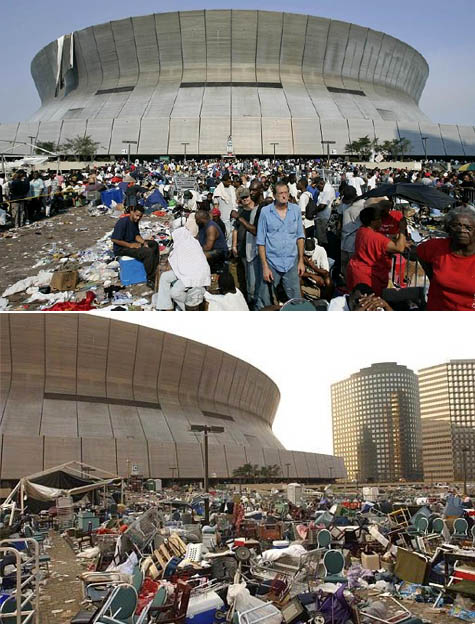 [Image: Refugees gather outside the Superdome, New Orleans, post-Katrina].
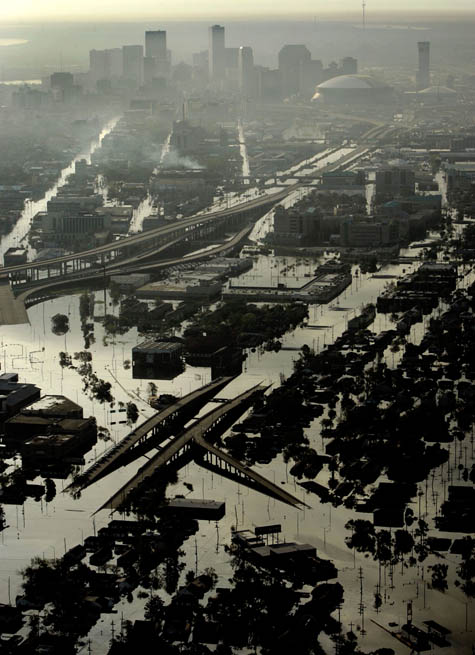 [Image: New Orleans under water, post-Katrina; photographer unknown].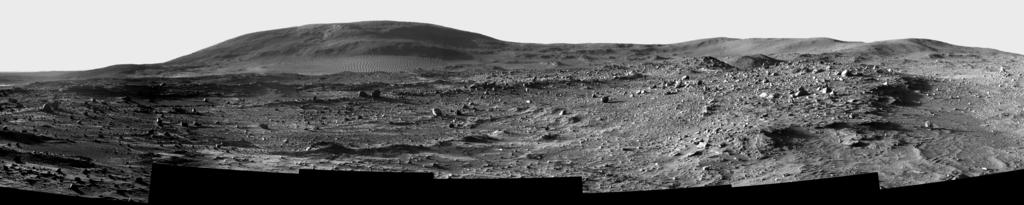
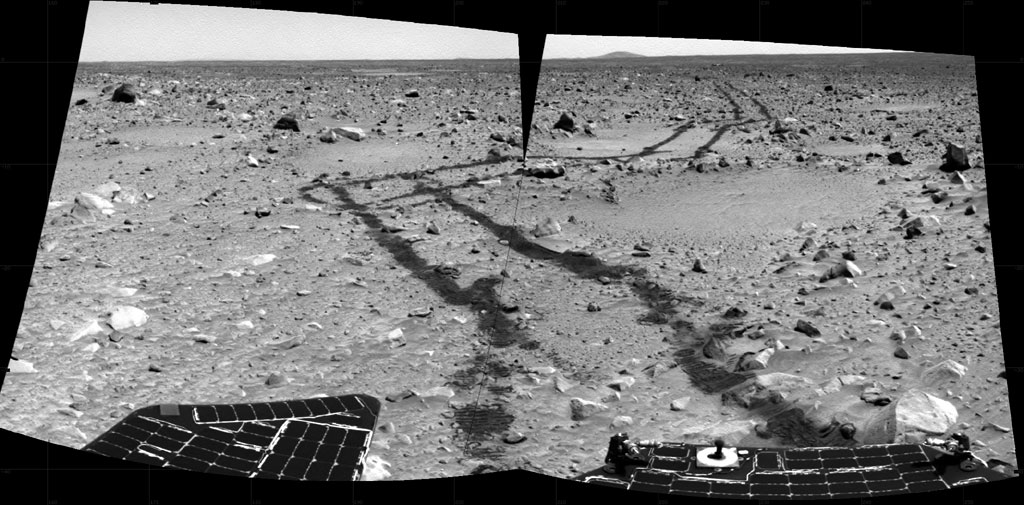

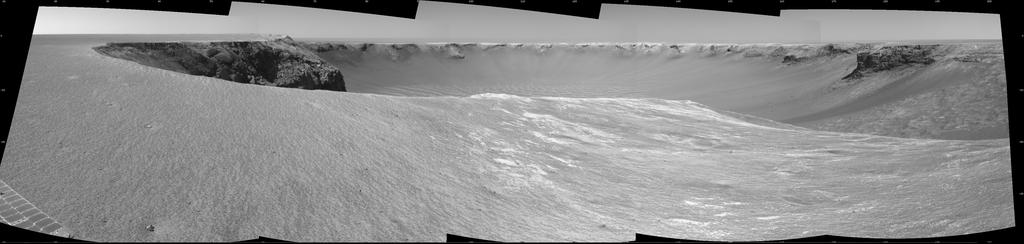
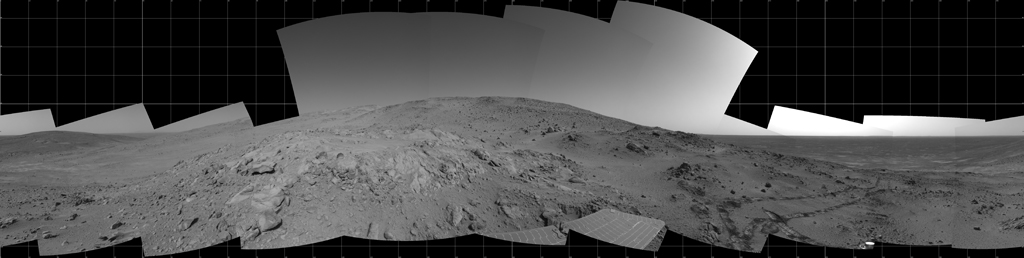 [Images: Mars, courtesy of NASA].
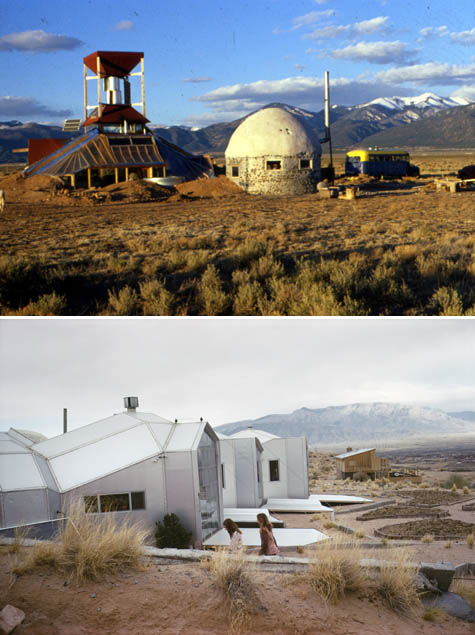 [Images: (top) Michael Reynolds, architect. Turbine House, Taos, New Mexico. Photograph © Michael Reynolds, 2007. (bottom) Steve Baer, designer. House of Steve Baer, Corrales, New Mexico, 1971. Photography © Jon Naar, 1975/2007. Courtesy of the Canadian Centre for Architecture, from their excellent, and uncannily well-timed, exhibition
 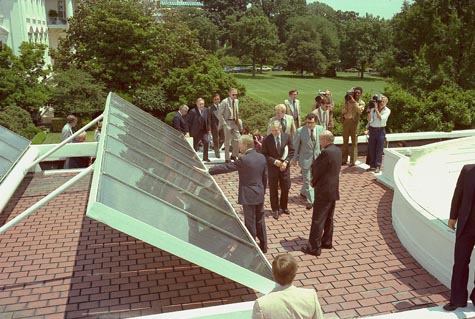 [Image: American President Jimmy Carter dedicates the White House solar panels, 20 June 1979. Photograph © Jimmy Carter Library. Courtesy of the
 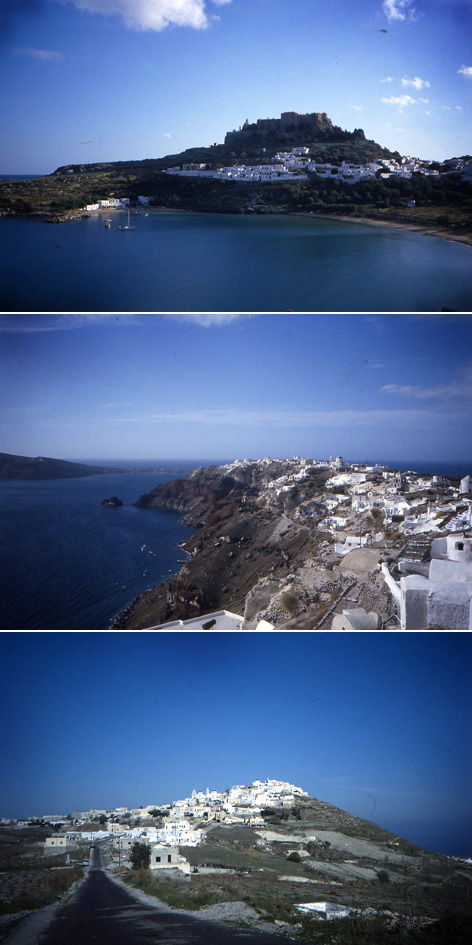 [Image: Photos of Greece, inspiration for life on Mars, taken by Kim Stanley Robinson].
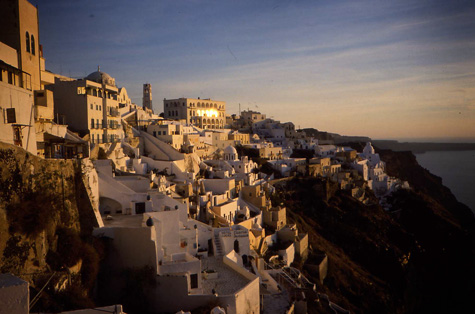 [Image: A photograph of Santorini taken by Kim Stanley Robinson].
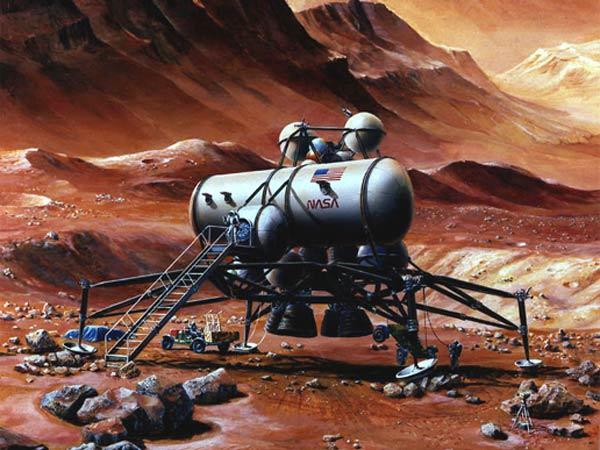 [Image: Two painted views of a human future on Mars, courtesy of NASA].
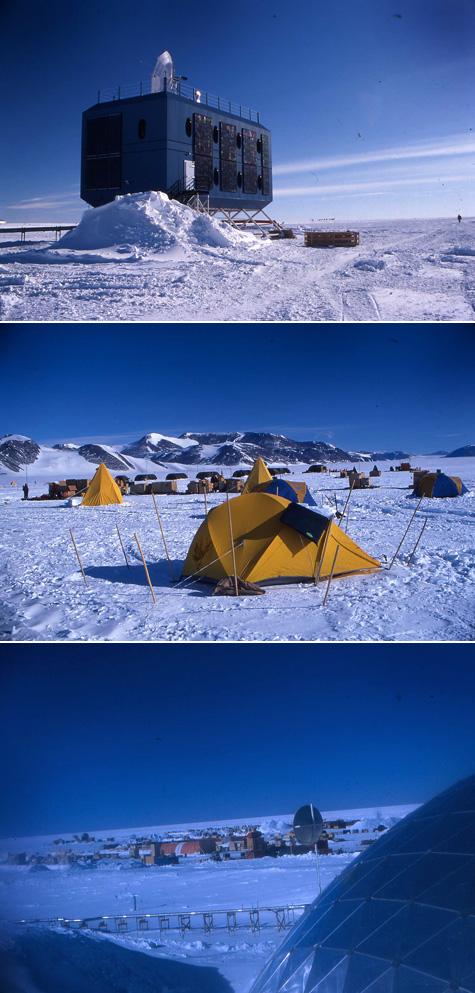 [Image: Architecture in Antarctica, photographed by Kim Stanley Robinson].
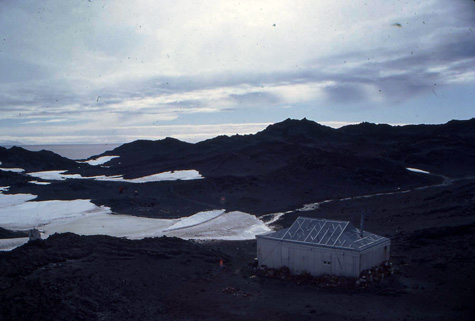 [Image: Shackleton's hut, Antarctica, photographed by Kim Stanley Robinson].


