Showing posts with label climate change. Show all posts

Saturday, May 16, 2015

Peak Oil: A Graphic Story

Peak Oil: A Graphic Story

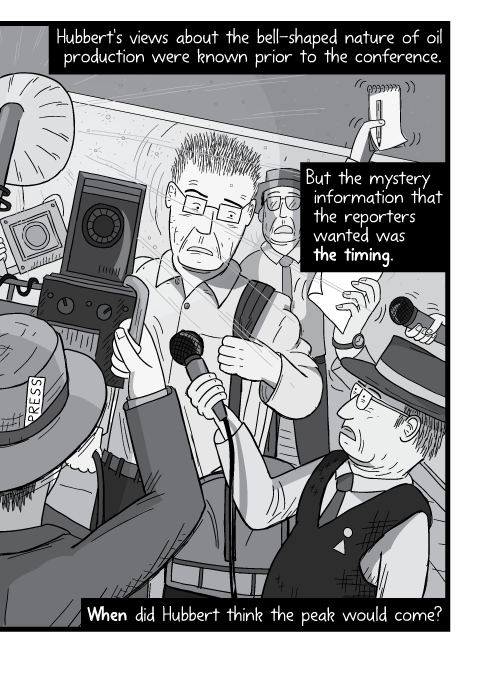
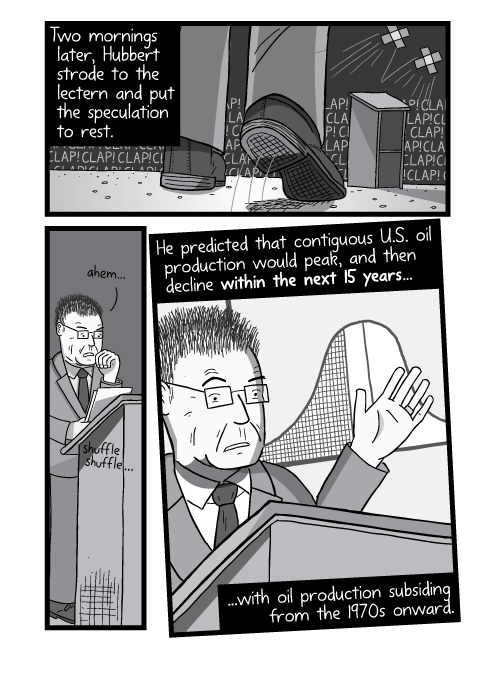
Australian artist Stuart MacMillan has spent over 700 hours creating this amazing cartoon of the life and work of M.King Hubbert. Below are just 2 images of the 139 that make up the full story.
US oil graphic US oil graphic

For more about the project, or to find out how to support Stuart's work read his blog and watch the video.

Thursday, January 6, 2011

A stunning year in climate science reveals that human civilization is on the precipice

The last year or so has seen more scientific papers and presentations that raise the genuine prospect of catastrophe (if we stay on our current emissions path) that I can recall seeing in any other year.
Perhaps the media would have ignored that science anyway, but Climategate appears to be a key reason “less than 10 percent of the news articles written about last year’s climate summit in Copenhagen dealt primarily with the science of climate change, a study showed on Monday.”
But for those interested in the real climate science story of the past year, let’s review a couple dozen studies of the most important findings.  Any one of these would be cause for action — and combined they vindicate the final sentence of Elizabeth Kolbert’s  Field Notes from a Catastrophe:  “It may seem impossible to imagine that a technologically advanced society could choose, in essence, to destroy itself, but that is what we are now in the process of doing.”
1. Nature: “Global warming blamed for 40% decline in the ocean’s phytoplankton”:  “Microscopic life crucial to the marine food chain is dying out. The consequences could be catastrophic.”
If confirmed, it may represent the single most important finding of the year in climate science.  Seth Borenstein of the AP explains, “plant plankton found in the world’s oceans  are crucial to much of life on Earth. They are the foundation of the bountiful marine food web, produce half the world’s oxygen and suck up harmful carbon dioxide.” Boris Worm, a marine biologist and co-author of the study said, “We found that temperature had the best power to explain the changes.”  He noted, “If this holds up, something really serious is underway and has been underway for decades. I’ve been trying to think of a biological change that’s bigger than this and I can’t think of one.”
2.  Science: Vast East Siberian Arctic Shelf methane stores destabilizing and venting:  NSF issues world a wake-up call: “Release of even a fraction of the methane stored in the shelf could trigger abrupt climate warming.”
Methane release from the not-so-perma-frost is the most dangerous amplifying feedback in the entire carbon cycle. This research finds a key “lid” on “the large sub-sea permafrost carbon reservoir” near Eastern Siberia “is clearly perforated, and sedimentary CH4 [methane] is escaping to the atmosphere.”
The permafrost permamelt contains a staggering “1.5 trillion tons of frozen carbon, about twice as much carbon as contained in the atmosphere,” much of which would be released as methane.  Methane is  is 25 times as potent a heat-trapping gas as CO2 over a 100 year time horizon, but 72 times as potent over 20 years!
The carbon is locked in a freezer in the part of the planet warming up the fastest (see “Tundra 4: Permafrost loss linked to Arctic sea ice loss“).  Half the land-based permafrost would vanish by mid-century on our current emissions path (see “Tundra, Part 2: The point of no return” and below).  No climate model currently incorporates the amplifying feedback from methane released by a defrosting tundra.
The NSF is normally a very staid organization.  If they are worried, everybody should be.
It is increasingly clear that if the world strays significantly above 450 ppm atmospheric concentrations of carbon dioxide for any length of time, we will find it unimaginably difficult to stop short of 800 to 1000 ppm.
3.  Must-read NCAR analysis warns we risk multiple, devastating global droughts even on moderate emissions path.
Dust-Bowlification may be the impact of human-caused climate change that hits the most people by mid-century, as the figure below suggests (“a reading of -4 or below is considered extreme drought”):
drought map 3 2060-2069
The PDSI in the Great Plains during the Dust Bowl apparently spiked very briefly to -6, but otherwise rarely exceeded -3 for the decade (see here).  The National Center for Atmospheric Research notes “By the end of the century, many populated areas, including parts of the United States, could face readings in the range of -8 to -10, and much of the Mediterranean could fall to -15 to -20. Such readings would be almost unprecedented.”

Read the rest at Climate Progress and share it broadly...

Wednesday, February 3, 2010

Water abuses magnify climate disruption.

Published Jan 19 2010 by On The Commons

To curb climate change, we need to protect water

by Maude Barlow
An international rescue plan for fresh water
It is widely acknowledged that greenhouse gas emission-fueled climate change is having a profound and negative impact on fresh water systems around the world. Warmer weather causes more rapid evaporation of lakes and rivers, reduced snow and ice cover on open water systems, and melting glaciers.
(Photo by Suneel Madhekar from Flickr.com under a Creative Commons 
License - no commercial use or alteration)(Photo by Suneel Madhekar from Flickr.com under a Creative Commons License - no commercial use or alteration)What is less understood is that our collective abuse and displacement of fresh water is also a serious cause of climate change and global warming. If we are to successfully address climate change, it is time to include an analysis of how our abuse of water is an additional factor in the creation of global warming as well as solutions that protect water and watersheds.

There are two major factors. The first is the actual displacement of water from where it is sustaining a healthy ecosystem as well as healthy hydrologic cycles. Because humanity has polluted so much surface water on the planet, we are now mining the groundwater far faster than it can be replaced by nature. New Scientist reports of a "little-heralded crisis" all over Asia as a result of the exponential drilling of groundwater. Water is moved from where nature has put it in watershed and aquifers (where we can access it) to other place where it is used for flood irrigation and food production - where much of it lost to evaporation - or to supply the voracious thirst of mega cities, where it is usually dumped as waste into the ocean.

Water is also lost to ecosystems through global trade - water used in the in the production of crops or manufactured goods that are then exported (known as virtual trade in water). Over 20% of daily water used for human purpose is exported out of watersheds in this way. Water is also piped across long distances for industry leaving behind parched landscapes.

The second factor is the removal of the vegetation needed for a healthy hydrologic cycle. Urbanization, deforestation and wetland destruction greatly destroy water-retentive landscapes and lead to the loss of precipitation over the affected area.

Slovakian scientist Michal Kravcik and his colleagues explain that the living world influences the climate mainly by regulating the water cycle and the huge energy flows linked to it. Transpiring plants, especially forests, work as a kind of biotic pump, causing humid air to be sucked out of the ocean and transferred to dry land. If the vegetation is removed from the land, this natural system of biosphere regulation is interrupted. Soil erodes, reducing the content of organic material in the ground, thus reducing its ability to hold water. Dry soil from lost vegetation traps solar heat, sharply increasing the local temperature and causing a reduction in precipitation over the affected area. This process also destroys the natural sequestration of carbon in the soil, leading to carbon loss.

Of course, these two factors are deeply related. Just as removing vegetation from an ecosystem will dry up the soil, so too will removing water from an ecosystem mean reduced or non-existent vegetation.

Taken together, these two factors are hastening the desertification of the planet, and intensifying global warming. Even if we successfully address and reverse greenhouse gas emissions and our dependence on fossil fuels, Kravcik says, we will not be able to stop climate change if we do not deal with the impact of our abuse of water on the planet.

Unless we collectively address the crisis of fresh water and our cavalier treatment of the world's water systems, we will not restore the climate to health.

Restoration of Watersheds
The solution to the water half of this crisis is the massive restoration of watersheds. Bring water back into parched landscapes. Return water that has disappeared by retaining as much rainwater as possible within the ecosystem so that water can permeate the soil, replenish groundwater systems, and return to the atmosphere to regulate temperatures and renew the hydrologic cycle. All human, industrial and agricultural activity must become part of this project, which could employ millions and alleviate poverty in the global South. Our cities must be ringed with green conservation zones and we must restore forests and wetlands - the lungs and kidneys of fresh water. For this to be successful, three basic laws of nature must be addressed.
  1. It is necessary to create the conditions that allow rainwater to remain in local watersheds. This means restoring the natural spaces where rainwater can fall and where water can flow. Water retention can be carried out at all levels: roof gardens in family homes and office buildings; urban planning that allows rain and storm water to be captured and returned to the earth; water harvesting in food production; capturing daily water discharge and returning it clean to the land, not to the rising oceans. 
  2. We cannot continue to mine groundwater supplies at a rate greater than natural recharge. If we do, there will not be enough water for the next generation. Governments everywhere must undertake intensive research into their groundwater supplies and regulate groundwater takings before these underground reservoirs are gone. This may mean a shift in policy from export to domestic and local production.
  3. We must stop polluting our surface and groundwater sources - and we must back up this intention with strict legislation. Water abuse in oil and methane gas production and in mining must stop. We must wean ourselves of industrial and chemical-based agricultural practices and listen to the many voices sounding the alarm about the rush toward water-guzzling bio fuel farming. We need to promote "subsidiarity," whereby national policies and international trade rules support local food production in order to protect the environment and promote local sustainable agriculture. Such policies also discourage the virtual trade in water. Countries should also limit or ban the mass movement of water by pipeline. Government investment in water and wastewater infrastructure would save huge volumes of water lost every day. Local laws could enforce water-harvesting practices at every level.
Toward a Water Secure World
Clearly, for this rescue plan to be successful, governments around the world must acknowledge the water crisis and the part the role water abuse plays in the warming (and drying) of the planet. This in turn means that a nation's water resources must be considered in every government policy at all levels. Nations must undertake intensive studies to ascertain the health of watersheds and groundwater reserves. All activities that will impact water must conform to a new ethic - backed by law - that protects water sources from pollution and over-pumping. This will likely mean a strong challenge to government policies that favour unlimited global economic growth.

Nearly two billion people live in water-stressed regions of the earth. Until now, the UN has addressed this terrible reality with a program to give them access to groundwater sources. But current levels of groundwater takings are unsustainable. To truly realize the universal right to water, and to protect water for nature's own uses, means a revolution in the way we treat the world's finite water resources. There is no time to lose.

This work is licensed under a Creative Commons License
Maude Barlow chairs the board of Food and Water Watch and is the senior adviser on water to the president of the U.N. General Assembly. Her new book is "Blue Covenant, The Global Water Crisis and the Coming Battle For the Right to Water" (McClelland & Stewart, 2007).
~~~~~~~~~~~~~~~ Editorial Notes ~~~~~~~~~~~~~~~~~~~
Maud Barlow is a Canadian activist concerned with water issues.
The article doesn't mention the important relationship between water and energy. Processing and distributing fresh water requires quantities of energy. Generating energy in turn requires water. For example:

The California State Water Project is the largest single user of energy in California. In the process of delivering water from the San Francisco Bay-Delta to Southern California, the project uses 2 to 3 percent of all electricity consumed in the state.
- "Energy Down the Drain"
See:
Maud Barlow's article is also posted at Common Dreams.

Friday, January 22, 2010

Resilience Thinking

by Rob Hopkins
Resilience; “the capacity of a system to absorb disturbance and reorganize while undergoing change, so as to retain essentially the same function, structure, identity and feedbacks”.


Resilience Thinking. Why ‘resilience thinking’ is a crucial missing piece of the climate-change jigsaw and why resilience is a more useful concept than sustainability.


In July 2009, UK Secretary of State for Energy and Climate Change Ed Miliband unveiled the government’s UK Low Carbon Transition Plan, a bold and powerful statement of intent for a low-carbon economy in the UK. It stated that by 2020 there would be a five-fold increase in wind generation, feed-in tariffs for domestic energy generation, and an unprecedented scheme to retrofit every house in the country for energy efficiency. In view of the extraordinary scale of the challenge presented by climate change, I hesitate to criticise steps in the right direction taken by government. There is, though, a key flaw in the document, which also appears in much of the wider societal thinking about climate change. This flaw is the attempt to address the issue of climate change without also addressing a second, equally important issue: that of resilience.

The term ‘resilience’ is appearing more frequently in discussions about environmental concerns, and it has a strong claim to actually being a more useful concept than that of sustainability. Sustainability and its oxymoronic offspring sustainable development are commonly held to be a sufficient response to the scale of the climate challenge we face: to reduce the inputs at one end of the globalized economic growth model (energy, resources, and so on) while reducing the outputs at the other end (pollution, carbon emissions, etc.). However, responses to climate change that do not also address the imminent, or quite possibly already passed, peak in world oil production do not adequately address the nature of the challenge we face.

Let’s take a supermarket as an example. It may be possible to increase its sustainability and to reduce its carbon emissions by using less packaging, putting photovoltaics on the roof and installing more energy-efficient fridges. However, resilience thinking would argue that the closure of local food shops and networks that resulted from the opening of the supermarket, as well as the fact that the store itself only contains two days’ worth of food at any moment – the majority of which has been transported great distances to get there – has massively reduced the resilience of community food security, as well as increasing its oil vulnerability. One extreme, but relevant, example of where sustainability thinking falls short was Tesco’s recent ‘Flights for Lights’ promotion, where people were able to gain air miles when they purchased low-energy light bulbs!

Some people believe that we can move from our current ‘high carbon’ model, where goods are transported at great distances, to a ‘low carbon’ information economy, where it is ideas that are exchanged rather than goods, and where we operate in a virtual world with few impacts. Yet such an economy still depends on fossil fuels: to power the vast internet servers as we check our morning emails, not to mention the breakfast we eat and the coffee we drink that continue to be sourced from far and wide, often with a disastrous impact on the local food systems that would have supported us in the past. Despite the temptation to believe otherwise, we still operate in the physical world with very real and pressing energy and resource constraints.

The concept of resilience emerged from within the ecological sciences as a way of looking at why some systems collapse when they encounter shock, and some don’t. The insights gleaned now offer a very useful overview for determining how systems can adapt and thrive in changing circumstances. Resilience within communities, for example, depends upon;”

  • Diversity: a broader base of livelihoods, land use, enterprise and energy systems than at present
  • Modularity: not advocating self-sufficiency, but rather an increased self-reliance; with ‘surge protectors’ for the local economy, such as local food production and decentralised energy systems
  • Tightness of feedbacks: bringing the results of our actions closer to home, so that we cannot ignore them
A recent report by the think tank DEMOS, Resilient Nation, raised the question, “Resilient to what?” Are we building resilience in the face of peak oil and climate change, or of terrorism and pandemics? While it is clearly not an either/or situation, I would argue strongly that peak oil and climate change are so far-reaching and destabilizing that we really must give them precedence, the solutions that arise being markedly different from addressing terrorism or pandemics. But what would this kind of resilience thinking look like in practice?

For many years, those writing and campaigning on relocalization have argued that it is a good idea because it produces a better, more equitable economy. Now, as the potential impacts of peak oil and climate change become clearer, an additional and very strong argument has emerged: that as the net energy underpinning society inevitably contracts, so the focus of our economies and our daily lives will inexorably shift, at least in terms of manufacturing and trade, from the global to the local.

It requires a huge amount of cheap oil thundering around the superhighways and shipping lanes of the world to bring to our shops the things we now feel we need, much of which we would have grown or made ourselves not all that long ago. But creating a different way of doing things takes time, resources and proactive and creative design.

Often, climate-change thinking doesn’t question the notion that higher rates of consumption lead to individual happiness – it focuses rather on low-carbon ways of making the same consumer goods. Yet as we enter the world of volatile oil prices, resource constraints, and the need to situate ourselves more within the local economy than the global one, we will need to link satisfaction and happiness to other less tangible things like community, meaningful work, skills and friendships.

When I give talks on this subject, there are always some who interpret the concept of increasing localization to mean that building resilience in the West – increasing national food security, rebuilding local manufacturing and so on – will by necessity lead to increased impoverishment in the developing world. I don’t believe this to be the case. Will the developing world be lifted out of poverty by continuing to dismantle its own food resilience and becoming increasingly dependent on global trade, which is itself massively dependent on the cheap oil we can no longer rely on? Is the way out of poverty really an increasing reliance on the utterly unreliable? Rather than communities meeting each other as unskilled, unproductive, dependent and vulnerable settlements, they would meet as skilled, abundantly productive, self-reliant and resilient communities. It is a very different quality of relationship, and one that could be hugely beneficial to both.

In any event, work by people such as Mike Davis in his book Late Victorian Holocausts shows how the impact of famine was enormously magnified by the forced introduction of India into the international money/cash-crop nexus. As Amartya Sen has shown, famine occurs more from the way in which food is distributed, and inequality, than from food shortage. Even that analysis now needs to be revisited from a ‘resilience’ perspective. Over the last few years we’ve started to see clear impacts of tying the developing world into global commercial food webs, as food prices rose in step with oil and fertilizer prices. In fact, I’d argue that tying developing-world food producers into the globalized system leads to their exposure to both food and money shortages.

The need to cut carbon emissions is even more urgent than the government’s Transition Plan acknowledges. NASA scientist James Hansen, one of the world’s leading climate scientists, now argues that we have already passed the climate tipping point at our current level of 387ppm, when the safe level of carbon in the atmosphere is at most 350ppm. While the UK government argues that we need to stay below 450ppm, it is clear that even that is a huge ask. If you were to step outside your front door today and ask the first ten people you met what your town or city might look like in ten years’ time if it began today to cut its emissions by 9% a year starting today, I imagine most people would say something between the Flintstones and Mad Max! We have a paucity of stories that articulate what a lower-energy world might sound like, smell like, feel like and look like. What is hard, but important, is to be able to articulate a vision of a post-carbon world so enticing that people leap out of bed every morning and put their shoulders to the wheel of making it happen.

Resilience thinking can inspire a degree of creative thinking that might actually take us closer to solutions that will succeed in the longer term. Resilient solutions to climate change might include community-owned energy companies that install renewable energy systems in such a way as to generate revenue to resource the wider relocalization process; the building of highly energy-efficient homes that use mainly local materials (clay, straw, hemp), thereby stimulating a range of potential local businesses and industries; the installation of a range of urban food production models; and the re-linking of farmers with their local markets. By seeing resilience as a key ingredient of the economic strategies that will enable communities to thrive beyond the current economic turmoil the world is seeing, huge creativity, reskilling and entrepreneurship are unleashed.

The Transition Movement is a rapidly growing, ‘viral’ movement, which began in Ireland and is now under way in thousands of communities around the world. Its fundamental premise is that a response to climate change and peak oil will require action globally, nationally, and at the scale of local government, but it also needs vibrant communities driving the process, making unelectable policies electable, creating the groundswell for practical change at the local level.
It explores the practicalities of building resilience across all aspects of daily life. It catalyses communities to ask, “How are we going to significantly rebuild resilience in response to peak oil and drastically reduce carbon emissions in response to climate change?”

By putting resilience alongside the need to reduce carbon emissions, it is catalyzing a broad range of initiatives, from Community Supported Agriculture and garden-share schemes to local food directories and new Farmers’ Markets. Some places, such as Lewes and Totnes, have set up their own energy companies, in order to resource the installation of renewable energy. The Lewes Pound, the local currency that can only be spent in Lewes, recently expanded with the issuing of new £5, £10 and £20 notes. Stroud and Brixton are set to do the same soon.
The Scottish government is using its Climate Challenge Fund to fund Transition Scotland Support, seeing Transition initiatives as a key component of the country’s push on climate change (and thanks also to that fund, a number of Transition initiatives have received substantial financial support: for example, Transition Forres received £184,000 and has become a real force for local resilience-building). In England, Somerset and Leicestershire County Councils have both passed resolutions committing themselves to support local Transition initiatives. What underpins these responses is the idea that meeting our climate emissions responsibilities and preparing proactively for the end of the age of cheap oil can either be seen as enormous crises, or as tremendous opportunities.

Capitalism as if the World
 MattersIt is clear, as Jonathon Porritt argues in Living Within Our Means, that attempting to get out of the current recession with the thinking that got us into it in the first place (unregulated banking, high levels of debt, high-carbon lifestyles) will get us into a situation that we simply cannot win. A friend of mine who works as a sustainability consultant in the North West talks of a meeting he had with a leading local authority there. Having read their development plan for the next twenty years, he told them, “Your Plan is based on three things: building cars, building airplanes and the financial services sector. Do you have anything else up your sleeves?” As John Michael Greer says, we’re in danger of turning what could still be a soluble problem into an insoluble predicament. Transition is an exploration of what we need to have ‘up those sleeves’, an optimistic exploration of the practicalities of relocalisation, creating, as Jeremy Leggett puts it, “scaleable microcosms of hope”.

However, resilience is not just an outer process: it is also an inner one, of becoming more flexible, robust and skilled. Transition initiatives try to promote this through offering skills-sharing, building social networks and creating a shared sense of this being a historic opportunity to build the world anew.

Navigating a successful way through climate change and peak oil will require a journey of such bravery, commitment and vision that future generations will doubtless tell stories and sing great songs about it. But as with any journey, having a clear idea of where you are headed and the resources that you have at your disposal is essential in order to most skilfully maximize your chances of success. If we leave resilience thinking out, we may well end up an extremely long way from where we initially thought we were headed.

Rob Hopkins is co-founder of the Transition Network and is the author of The Transition Handbook. You can download the pdf (with wonderful illustrations) of this article here Originally published in Resurgence Magazine.

Thursday, September 10, 2009

Thursday, January 8, 2009

Umm...plant more trees maybe?...Terra preta?..Carbon Farming?

How humans cooled the earth -- 500 years ago

From Salon.com

One of the tell-tale signs of a really thought-provoking book is that soon after reading it, you start seeing its thesis replicated everywhere you look. So it has been with one of the tomes I referred to in yesterday's post "Polynesian Chickens in Peru and other Mysteries," Charles Mann's "1491: New Revelations of the Americas Before Columbus."

The massive depopulation of the Americas via smallpox, hepatitis and other diseases introduced by Westerners (perhaps as much as 95 percent of the existing population died in vast pandemics) and the large landscape-altering scale of agriculture practiced across the "New World" by pre-Columbian cultures are two of the big themes of "1491." Both popped up in a presentation made by two scientists at the annual meeting of the American Geophysical Union last December. (Thanks to MongaBay for the tip.)

The scientists contend that after the die-off, massive reforestation on abandoned agricultural land occurred on a large enough scale to contribute significantly to the period of global cooling between 1500 and 1750 known as the "Little Ice Age."

After examining soil samples and sediment cores from numerous locations in Central and South America, Richard Nevle, a visiting scholar at Stanford's Department of Geological and Environmental Sciences at Stanford, and Dennis Bird, also from Stanford, concluded that the reforestation sequestered as much as 10 to 50 percent of the carbon necessary to cool the earth. Up until 1500, the soil samples showed a steady increase in charcoal content, likely generated from human-caused fire used to clear forest. After 1500, the scientists discovered a drastic drop in charcoal content. No more burning.

The scientists acknowledge that reforestation was just one factor in contributing to global cooling. It may not even have been the most critical factor. But the research is sobering nonetheless, in its hint as to humanity's power to alter the fundamental characteristics of life on this planet, long before we were burning fossil fuels as if there were no tomorrow. We did it back then, we're doing it now, and maybe, just maybe, if we exert our collective will in the proper direction, we can fix our mistakes.

Let's just hope it doesn't require another vast die-off to set things to rights.

Tuesday, January 6, 2009

Weather (catastrophe) or not.

When contemplating the imminence of climate change and peak oil you may find it useful to remember that catastrophe is a matter of perspective. My sister forwarded this notice from 'The Mining Journal', Marquette , Mi.
The text is purportedly from a county emergency manager out in the western part of the Upper Peninsula of Michigan after a snow storm last winter. (Snopes has declared it an urban legend.)

"WEATHER BULLETIN
Up here in the Northern part of Michigan we just recovered from an Historic Event --- may I even say a "Weather Event" of "Biblical Proportions" --- with an historic blizzard of up to 44" inches of snow and winds to 90 MPH that broke trees in half, knocked down utility poles, stranded hundreds of motorists in lethal snow banks, closed ALL roads, isolated scores of communities and cut power to 10's of thousands.

FYI:
George Bush did not come.
FEMA did nothing.
No one howled for the government.
No one blamed the government.
No one even uttered an expletive on TV.
Jesse Jackson or Al Sharpton did not visit.
Our Mayors did not blame Bush or anyone else.
Our Governor did not blame Bush or anyone else either
CNN, ABC, CBS, FOX, or NBC did not visit - or report on this category 5 snow storm
Nobody demanded $2,000 debit cards.
No one asked for a FEMA Trailer House.
No one looted.
Nobody - I mean NOBODY - demanded the government do something.
Nobody EXPECTED the government to do anything either.
No Larry King, no Bill O'Reilly, no Oprah, no Chris Mathews and no Geraldo Rivera.
No Sean Penn, no Barbara Streisand, no Hollywood types to be found.
Nope, we just melted the snow for water, sent out caravans of SUV's to pluck people out of snow engulfed cars.
The tow truck drivers pulled people out of snow banks and didn't ask for a penny!
Local restaurants made food, and the police and fire departments delivered it to the snow bound families....
Families took in the stranded people - total strangers.
We fired up wood stoves, broke out coal oil lanterns or Coleman lanterns.
We put on an extra layers of clothes because up here it is "Work or Die".
We did not wait for some affirmative action government to get us out of a mess created by being immobilized by a welfare program that trades votes for "sittin' at home" checks.
Even though a Category "5" blizzard of this scale has never fallen this early, we know it can happen and how to deal with it ourselves.
"In my many travels, I have noticed that once one gets north of about 48 degrees North Latitude, 90% of the world's social problems evaporate."
It does seem that way, at least to me.
I hope this gets passed on..
Maybe .... SOME people will get the message... The world does NOT owe you a living."

Ok, so Yoopers (as they are called) barely blink when their world is inundated by conditions that would cripple most communities. And, as this report illustrates, there's a bit of "Nyahh, nyahh, you pussy wusses" attitude. Can they deal as effectively with an economic crisis of "Biblical" proportions or a changing climate that delivers similar weather more often? Will they have the funds to maintain and fuel the army of snow plows? Time will tell. Still it makes you think. Are they truly more prepared and resilient?

Wednesday, December 17, 2008

Peak Oil Is Now History

The Peak Everything Year

by Richard Heinberg

For those who understand the overwhelming importance of fossil fuel depletion, the signal event of 2008 was without doubt the oil price spike that sent the cost of a barrel of crude rocketing to $147. Knock-on effects were as anticipated: the airline industry contracted, the auto industry went on life support, food prices jolted upward, and the overall economy went into reverse (more on that below). Due to all of these things, the demand for oil subsequently peaked and began to slide, which in turn caused the price to plummet, with no end currently in sight.

I am among several commentators who have gone on record as saying that July 2008 will turn out to have been the all-time record month for world petroleum production. With the price so high (in July), all producers were pumping flat out. And now, with the price so low, there is no incentive to make the required enormous investments in future productive capacity, so that when demand picks up again (and it may be a few years before that happens), new additions to supply will not be sufficient to overcome the capacity erosion that will have accumulated in the interim due to depletion and decline in existing oilfields. Say goodbye to Peak Oil: it's history now.

Fortunately, high oil prices during the early months of the year led to an explosion of Peak Oil awareness. There was an unprecedented frequency of discussion of the issue in the mainstream media, with T. Boone Pickens doing much of the heavy lifting, but also we saw the release of several film documentaries, along with dozens of radio and television interviews of Post Carbon Institute fellows and board members. Transition Initiatives sprang up in scores of towns and cities around the world, and more communities began to assess their vulnerability to future oil shocks.

The climate continued changing this year, with a new record set for the melting rate of the north polar ice cap. Even more ominously, plumes of methane were observed rising from thawing permafrost in Siberia, leading some researchers to speculate that at least one of several potential "doomsday" reinforcing global warming feedback loops has been triggered.

Negotiations over the treaty that will replace the Kyoto Protocol have begun. Environmental organizations are planning to spare no strategic option (including massive direct action campaigns) to press for maximum emissions reduction commitments from the world's nations, but the economic crisis will likely weigh heavily on the minds of world leaders, whose top priority is the futile quest for a return to growth.

Which brings us to the subject of that annoying economic collapse that everyone keeps talking about. The "slowdown," as our government officials like to call it, actually started in 2007 when housing prices weakened and mortgage-backed securities started tanking, but over the past six months the low hissing noise that wary commentators have attributed to a deflation of the debt-credit bubble has turned into a vaporizing explosion.

In a commentary a few weeks ago I opined that 2008 will eventually be seen to have been the last year of aggregate world economic growth (as currently defined). Ever. That's a big, nasty prediction to make, but somebody needs to be pointing out the obvious: economic growth is, almost by definition, something that can't go on forever on a finite planet, and things that can't go on forever cease at some definable point in time. Given Peak Oil, I think we can define that point as now.

On the bright side, we are very nearly at the end of the Bush Administration, and we have just seen a historic election in which hope triumphed over cynicism. Despite realistic concerns that the Obama team faces unmanageable economic and geopolitical crises left over from its predecessors, and that the new Cabinet consists of insiders who are unlikely to grasp the unprecedented nature of the circumstances facing us, or to propose the kinds of bold policies that are called for in a post-Peak era, nevertheless it is clearly a time to offer every possible encouragement and support to our articulate and optimistic President-Elect.

Monday, December 1, 2008

Empower Yourself and Your Community


TRANSITION UNITED STATES is a networking site for those interested in exploring and/or implementing the Transition model in their community. This site is being created through grassroots participation, and is continually evolving. It is a spontaneously arising effort to connect 'transitioners' with each other and to encourage and support the development of local Transition Initiatives.

The Transition approach empowers communities to squarely face the challenges of peak oil and climate change, and to unleash the collective genius of their own people to find the answers to this momentous question:


For all those aspects of life that this community needs in order to sustain itself and thrive, how are we going to:
  • drastically reduce carbon emissions (in response to climate change);
  • significantly rebuild resilience (in response to peak oil);
  • and greatly strengthen our local economy (in response to economic instability)?

Transition Initiatives make no claim to have all the answers, but by building on the wisdom of the past and accessing the pool of ingenuity, skills and determination in our communities, the solutions can readily emerge. Now is the time for us to take stock and start re-creating our future in ways that are not based on cheap, plentiful and polluting oil but on localized food, sustainable energy sources, resilient local economies and an enlivened sense of community well-being.

Wednesday, November 12, 2008

Demand Fuel Efficient Cars & Trains from the Big 3 Automakers

Subject: We need real solutions to fight climate change.

Dear Friends,

Global climate change is perhaps the greatest challenge of our generation. What we do (or don't do) affects not only our nation, but the world. You might thank that, with a new president poised to take office, we're in a great position to take serious action to address climate change. Unfortunately, a grizzled legislator named John Dingell, known as the "Congressman from General Motors," is standing in our way.

The most important pieces of legislation addressing climate change must pass through the House Energy and Commerce Committee. As chair of that committee, Congressman Dingell has exerted his power time and again to kill bills that could roll back global warming. Dingell has lined his campaign war chest with millions of dollars of contributions from electric, oil and coal companies. His wife (and potential successor to his Congressional seat) is a senior executive at General Motors. What's more, until recently, he wouldn't even admit that climate change was a real threat.

I just signed a petition calling on my member of Congress to vote for Congressman Henry Waxman (a staunch environmentalist) to replace Dingell as the Energy and Commerce Chair -- I hope you will too.

Please have a look and take action.

http://act.credoaction.com/campaign/energy_chair/?r_by=-743059-3SEhjgx&rc=paste

Thanks!
Keith Johnson

New Books in Pc Activist Catalog

Now we need a book about farming and gardening responses to climate change.

Extreme Weather Hits Home
Protecting Your Buildings from Climate Change
By John C. Banta
256pp, 2007, $23

We know how to prepare our homes for each seasonal change, but do we know how to prepare for climate change? Violent weather events like floods, tornadoes, ice storms and hurricanes only tell part of the story. Climate change is frequently more subtle but its effects on our homes and properties can still be devastating.

Nearly 50 percent of North America has a potential for structural damage from shifting moisture in expansive clay soils; a condition that is already costing billions of dollars each year. Humidity is projected to increase, trapping moisture in wall cavities and resulting in deterioration. As the climate changes and moisture levels adjust, there are a number of proactive steps that can be taken to prevent or lessen expensive repairs.

Extreme Weather is the only book of its kind that shows how to protect your home or business from climate change, by focusing on the following areas:

* Risk and causal assessment, due to region and soil
* Extreme weather’s rapid and slow effects
* Site, foundation, wall, and roof considerations and modifications
* Insurance options
* Anticipated changes for the United States, Canada and Mexico

Post Carbon Cities: Planning for Energy and Climate Uncertainty:
A Guidebook on Peak Oil and Global Warming for Local Governments

by Daniel Lerch 2007, 113pp, $28

Post Carbon Cities: Planning for Energy and Climate Uncertainty is a guidebook on peak oil and global warming for people who work with and for local governments in the United States and Canada. It provides a sober look at how these phenomena are quickly creating new uncertainties and vulnerabilities for cities of all sizes, and explains what local decision-makers can do to address these challenges.

Post Carbon Cities fills an important gap in the resources currently available to local government decision-makers on planning for the changing global energy and climate context of the 21st century.

"How will we cope with a future of energy scarcity? As a policy maker I look to other communities for inspiration and ideas, but there's been a lack of information on what local governments are doing to adapt to Peak Oil. Post Carbon Cities fills this gap: herein lies the roadmap plotted by the cities that are leading the way. Enthusiastically recommended!"
Dave Rollo, City Council President, Blooomington, Indiana

"Post Carbon Cities is an exceptionally clear and comprehensive call-to-action to those who actually work in the trenches of city governance. We don't have any more time to waste getting ready for an energy-scarcer future, and for those who remain dazed and confused, this book is an excellent place to start."
--James Howard Kunstler, author of The Long Emergency and The Geography of Nowhere

Monday, September 8, 2008

Plan C 5.0: Community Solutions to Climate Change and Peak Oil

From Global Climate Solutions http://globalclimatesolutions.org/
2 09 2008

By RYAN HOTTLE
Relocalization—the process of creating sustainable and largely self-reliant communities that are all at once beautiful, prosperous, and meaningful places to live—is perhaps the single greatest step we can take to “decarbonize” our lives and thereby prepare for climate change and peak oil simultaneously.
It’s a shame and a testament to our highly compartmentalized 21st century mindset that many within the “climate change community” and the larger “sustainability community” don’t know about peak oil and the potentially damning effects it could have on our social and economic systems. For example, I take courses from highly, highly educated climate scientists who can speak for hours on, for example, the intricacies of cloud formation as it relates to sulfate particles in the atmosphere and how they are expected to change with a warming atmosphere. But ask them about “peak oil?” They don’t know what it is. Never heard of it.

You might be able to claim ignorance, but you can’t say there wasn’t anybody warning you about it or describing the solutions either. Community Solutions (www.communitysolution.org), a vibrant non-profit organization out of Yellow Springs, Ohio, has been ringing the clarion call for solutions to climate change and peak oil for over half a decade now and are preparing to host their 5
th annual conference on “Plan C: Individual Survival Strategies for the Energy Crisis.” (Conference website available here: www.plancconference.info.)

To say that the list of speakers they have lined up are good would be a gross understatement—it would be worthy to travel to hear any one of the seven amazing visionaries they have scheduled.

Among them John Michael Greer (who has recently been called “the greatest peak oil historian in the English language), Richard Heinberg (easily the most influential and prolific writer on peak oil ), Peter Bane (probably one of the top Permaculture practitioners and teachers in the world, co-editor of Permaculture Activist [www.permacultureactivist.net], and also my PC design course teacher;) and—let us not forget—Megan Quinn Bachman (Outreach director of Community Solutions—young, passionate, articulate, and a global leader—what more could you ask for?!)
The conference is scheduled to take place October 31st-November 2nd in Rochester, Michigan. In order to receive Early Registration prices you have to sign up before September 30th. The cost for the conference is a steal, in my opinion, with extremely low costs . (I should note that I am not affiliated whatsoever with the conference—I am merely a strong supporter of the great work and leadership Community Solutions has been providing over the years.)
It is function of our modernistic society that we believe that all of our problems—energy, climate, and environment—are capable of being solved with techno-fixes. Unfortunately, we may simply be out of time and energy resources to redesign our entire transportation and energy infrastructure. It’s a hard truth that many don’t want to face, but it may well be true.


Peter Bane: Permaculture wizard, activist, and friend!

Personally, I believe we should be actively working to research and develop renewable energy sources (particularly Carbon Negative Energy with biochar production in a process called pyrolysis in addition to wind and solar energy technologies), but the very first place to work on, the lowest-hanging fruit where we can save the most money and energy and where we can simultaneously prepare for peak oil and mitigate the threat of climate change is by relocalizing our communities; weatherizing and retrofitting our buildings; creating local sustainable food systems; generating healthy local economies; and utilizing the inherent wisdom of Permaculture design principles.
We have but one beautiful planet to protect and but precious little time to do it in. What we choose to do—or not to do—in the next five to ten years will make all the difference. Be prepared to work hard and work together—that’s the only way we’re going to win!

Wednesday, June 25, 2008

Twenty Years Later: Tipping Points Near on Global Warming

Published on Tuesday, June 24, 2008 by The Huffington Post

Twenty Years Later: Tipping Points Near on Global Warming
Dr. James Hansen by James Hansen

[Monday] I testified to Congress about global warming, 20 years after my June 23, 1988 testimony, which alerted the public that global warming was underway. There are striking similarities between then and now, but one big difference.

Again a wide gap has developed between what is understood about global warming by the relevant scientific community and what is known by policymakers and the public. Now, as then, frank assessment of scientific data yields conclusions that are shocking to the body politic. Now, as then, I can assert that these conclusions have a certainty exceeding 99 percent.

The difference is that now we have used up all slack in the schedule for actions needed to defuse the global warming time bomb. The next president and Congress must define a course next year in which the United States exerts leadership commensurate with our responsibility for the present dangerous situation.

Otherwise it will become impractical to constrain atmospheric carbon dioxide, the greenhouse gas produced in burning fossil fuels, to a level that prevents the climate system from passing tipping points that lead to disastrous climate changes that spiral dynamically out of humanity’s control.

Changes needed to preserve creation, the planet on which civilization developed, are clear. But the changes have been blocked by special interests, focused on short-term profits, who hold sway in Washington and other capitals.

I argue that a path yielding energy independence and a healthier environment is, barely, still possible. It requires a transformative change of direction in Washington in the next year.

On June 23, 1988 I testified to a hearing, organized by Senator Tim Wirth of Colorado, that the Earth had entered a long-term warming trend and that human-made greenhouse gases almost surely were responsible. I noted that global warming enhanced both extremes of the water cycle, meaning stronger droughts and forest fires, on the one hand, but also heavier rains and floods.

My testimony two decades ago was greeted with skepticism. But while skepticism is the lifeblood of science, it can confuse the public. As scientists examine a topic from all perspectives, it may appear that nothing is known with confidence. But from such broad open-minded study of all data, valid conclusions can be drawn.

My conclusions in 1988 were built on a wide range of inputs from basic physics, planetary studies, observations of on-going changes, and climate models. The evidence was strong enough that I could say it was time to “stop waffling.” I was sure that time would bring the scientific community to a similar consensus, as it has.

While international recognition of global warming was swift, actions have faltered. The U.S. refused to place limits on its emissions, and developing countries such as China and India rapidly increased their emissions.

What is at stake? Warming so far, about two degrees Fahrenheit over land areas, seems almost innocuous, being less than day-to-day weather fluctuations. But more warming is already “in the pipeline,” delayed only by the great inertia of the world ocean. And climate is nearing dangerous tipping points. Elements of a “perfect storm,” a global cataclysm, are assembled.

Climate can reach points such that amplifying feedbacks spur large rapid changes. Arctic sea ice is a current example. Global warming initiated sea ice melt, exposing darker ocean that absorbs more sunlight, melting more ice. As a result, without any additional greenhouse gases, the Arctic soon will be ice-free in the summer.

More ominous tipping points loom. West Antarctic and Greenland ice sheets are vulnerable to even small additional warming. These two-mile-thick behemoths respond slowly at first, but if disintegration gets well under way, it will become unstoppable. Debate among scientists is only about how much sea level would rise by a given date. In my opinion, if emissions follow a business-as-usual scenario, sea level rise of at least two meters is likely within a century. Hundreds of millions of people would become refugees, and no stable shoreline would be reestablished in any time frame that humanity can conceive.

Animal and plant species are already being stressed by climate change. Species can migrate in response to movement of their climatic zone, but some species in polar and alpine regions will be pushed off the planet. As climate zones move farther and faster, climate change will become the primary cause of species extinction. The tipping point for life on the planet will occur when so many interdependent species are lost that ecosystems collapse.

The shocking conclusion, documented in a paper2 I have written with several of the world’s leading climate experts, is that the safe level of atmospheric carbon dioxide is no more than 350 ppm (parts per million), and it may be less. Carbon dioxide amount is already 385 ppm and rising about 2 ppm per year. Shocking corollary: the oft-stated goal to keep global warming less than two degrees Celsius (3.6 degrees Fahrenheit) is a recipe for global disaster, not salvation.

These conclusions are based on paleoclimate data showing how the Earth responded to past levels of greenhouse gases and on observations showing how the world is responding to today’s carbon dioxide amount. The consequences of continued increase of greenhouse gases extend far beyond extermination of species and future sea level rise.

Arid subtropical climate zones are expanding poleward. Already an average expansion of about 250 miles has occurred, affecting the southern United States, the Mediterranean region, Australia and southern Africa. Forest fires and drying-up of lakes will increase further unless carbon dioxide growth is halted and reversed.

Mountain glaciers are the source of fresh water for hundreds of millions of people. These glaciers are receding world-wide, in the Himalayas, Andes and Rocky Mountains. They will disappear, leaving their rivers as trickles in late summer and fall, unless the growth of carbon dioxide is reversed.

Coral reefs, the rainforest of the ocean, are home to one-third of the species in the sea. Coral reefs are under stress for several reasons, including warming of the ocean, but especially because of ocean acidification, a direct effect of added carbon dioxide. Ocean life dependent on carbonate shells and skeletons is threatened by dissolution as the ocean becomes more acid.

Such phenomena, including the instability of Arctic sea ice and the great ice sheets at today’s carbon dioxide amount, show that we have already gone too far. We must draw down atmospheric carbon dioxide to preserve the planet we know. A level of no more than 350 ppm is still feasible, with the help of reforestation and improved agricultural practices, but just barely ­ time is running out.

The steps needed to halt carbon dioxide growth follow from the size of fossil carbon reservoirs. Coal towers over oil and gas. Phase out of coal use except where the carbon is captured and stored below ground is the primary requirement for solving global warming.

Oil is used in vehicles, where it is impractical to capture the carbon. But oil is running out. To preserve our planet we must also ensure that the next mobile energy source is not obtained by squeezing oil from coal, tar shale or other fossil fuels.

Fossil fuel reservoirs are finite, which is the main reason that prices are rising. We must move beyond fossil fuels eventually. Solution of the climate problem requires that we move to carbon-free energy promptly.

Special interests have blocked transition to our renewable energy future. Instead of moving heavily into renewable energies, fossil companies choose to spread doubt about global warming, as tobacco companies discredited the smoking-cancer link. Methods are sophisticated, including disguised funding to shape school textbook discussions.

CEOs of fossil energy companies know what they are doing and are aware of long-term consequences of continued business as usual. In my opinion, these CEOs should be tried for high crimes against humanity and nature. If their campaigns continue and “succeed” in confusing the public, I anticipate testifying against relevant CEOs in future public trials.

Conviction of ExxonMobil and Peabody Coal CEOs will be no consolation, if we pass on a runaway climate to our children. Humanity would be impoverished by ravages of continually shifting shorelines and intensification of regional climate extremes. Loss of countless species would leave a more desolate planet.

If politicians remain at loggerheads, citizens must lead. We must demand a moratorium on new coal-fired power plants. We must block fossil fuel interests who aim to squeeze every last drop of oil from public lands, off-shore, and wilderness areas. Those last drops are no solution. They provide continued exorbitant profits for a short-sighted self-serving industry, but no alleviation of our addiction or long-term energy solution.

Moving from fossil fuels to clean energy is challenging, yet transformative in ways that will be welcomed. Cheap, subsidized fossil fuels engendered bad habits. We import food from halfway around the world, for example, even with healthier products available from nearby fields. Local produce would be competitive if not for fossil fuel subsidies and the fact that climate change damages and costs, due to fossil fuels, are also borne by the public.

A price on emissions that cause harm is essential. Yes, a carbon tax. Carbon tax with 100 percent dividend is needed to wean us off fossil fuel addiction. Tax and dividend allows the marketplace, not politicians, to make investment decisions.

Carbon tax on coal, oil and gas is simple, applied at the first point of sale or port of entry. The entire tax must be returned to the public, an equal amount to each adult, a half-share for children. This dividend can be deposited monthly in an individual’s bank account.

Carbon tax with 100 percent dividend is non-regressive. On the contrary, you can bet that low and middle income people will find ways to limit their carbon tax and come out ahead. Profligate energy users will have to pay for their excesses.

Demand for low-carbon high-efficiency products will spur innovation, making our products more competitive on international markets. Carbon emissions will plummet as energy efficiency and renewable energies grow rapidly. Black soot, mercury and other fossil fuel emissions will decline. A brighter, cleaner future, with energy independence, is possible.

Washington likes to spend our tax money line-by-line. Swarms of high-priced lobbyists in alligator shoes help Congress decide where to spend, and in turn the lobbyists’ clients provide “campaign” money.

The public must send a message to Washington. Preserve our planet, creation, for our children and grandchildren, but do not use that as an excuse for more tax-and-spend. Let this be our motto: “One hundred percent dividend or fight! No more alligator shoes!”

The next president must make a national low-loss electric grid an imperative. It will allow dispersed renewable energies to supplant fossil fuels for power generation. Technology exists for direct-current high-voltage buried transmission lines. Trunk lines can be completed in less than a decade and expanded analogous to interstate highways.

Government must also change utility regulations so that profits do not depend on selling ever more energy, but instead increase with efficiency. Building code and vehicle efficiency requirements must be improved and put on a path toward carbon neutrality.

The fossil-industry maintains its stranglehold on Washington via demagoguery, using China and other developing nations as scapegoats to rationalize inaction. In fact, we produced most of the excess carbon in the air today, and it is to our advantage as a nation to move smartly in developing ways to reduce emissions. As with the ozone problem, developing countries can be allowed limited extra time to reduce emissions. They will cooperate: they have much to lose from climate change and much to gain from clean air and reduced dependence on fossil fuels.

We must establish fair agreements with other countries. However, our own tax and dividend should start immediately. We have much to gain from it as a nation, and other countries will copy our success. If necessary, import duties on products from uncooperative countries can level the playing field, with the import tax added to the dividend pool.

Democracy works, but sometimes churns slowly. Time is short. The 2008 election is critical for the planet. If Americans turn out to pasture the most brontosaurian congressmen, if Washington adapts to address climate change, our children and grandchildren can still hold great expectations.

Dr. James Hansen directs the NASA Goddard Institute for Space Studies in New York City and is Adjunct Professor of Earth Sciences at Columbia University’s Earth Institute. Since the mid-1970s, Dr. Hansen has focused on studies and computer simulations of the Earth’s climate, for the purpose of understanding the human impact on global climate. He is best known for his testimony on climate change to Congress in the 1980s that helped raise broad awareness of the global warming issue. In recent years Dr. Hansen has drawn attention to the danger of passing climate tipping points, producing irreversible climate impacts that would yield a different planet from the one on which civilization developed. Dr. Hansen disputes the contention, of fossil fuel interests and governments that support them, that it is an almost god-given fact that all fossil fuels must be burned with their combustion products discharged into the atmosphere. Instead Dr. Hansen has outlined steps that are needed to stabilize climate, with a cleaner atmosphere and ocean, and he emphasizes the need for the public to influence government and industry policies.

Copyright © 2008 HuffingtonPost.com, Inc.

Thursday, February 21, 2008

Seize the Day - Threshold Moments and the Hope for Change

Friend, colleague, farmer, and fellow Blogger Sharon Astyk ponders the implications of well-timed, concerted action in response to crises - natural or engineered. Don't let governments, militaries, and corporations define our responses to the inevitable shocks yet to come. Carpe diem!

Seize the Day - Threshold Moments and the Hope for Change

It is common to respond to plans for radical change by stating that it is impossible to get this or that change enacted. This, of course, is manifestly wrong. We have only to look at historical events to see that it is perfectly possible, for both good and ill, to radically change circumstances in a host of ways that looked completely impossible not very long before.

The question is, how does that happen? And is it possible to imagine that we could, in fact, change things, and for example, bring about a relocalized economy, or 100 million farmers? Is that even feasible? More importantly, could it possibly happen before it has to? That is, we all know that we'd be a lot more secure if the transition to a sustainable agriculture happened a little before we were all out of food. Is that within the realm of possibility? I think so, but it requires a change in our perspective.

Now generally speaking, radical change is enacted one of two ways. The first is by revolution of one sort or another – a violent (not always warlike, but always violent), and deeply disruptive overthrow of what has gone before. In a very short time – the casting off of what has always seemed inviolable – slavery, colonialism, the divine of kings – transforms the landscape.

The problem with revolutions is that the costs are extremely high. Even a non-violent revolution means that large chunks of the existing population in power are simply cast out, and often come back to haunt you (think Cuba’s wealthy landowners, for example). Revolutions are vastly destructive, and anyone who simply isn’t ready, either adapts, or is overrun.

The other option is culture change – the gradual transition of a society from old values to new ones. It starts as a small movement, growing gradually, until ideas permeate the culture. Most of those who resist are given the chance to acclimate, and eventually come to accept, if not like, the dominant culture view. Eventually, cultural norms make it impossible even for those who espoused previous views to acknowledge them or to express them – think, for example, of the American Civil Rights movement. While racism was once a cultural norm in the US, now if you ask around, there are only about 4 people in the US who will admit to ever having expressed racist views.

The difficulty with this method is that it is far too slow for our present purposes – the major advances of the Civil Rights movement, for example, came over a period of 20 years. We simply don’t have 20 years of marching and gradually changing cultural norms.

Now it is necessarily the case that every movement contains elements of both of these – that is, the Civil Rights movement did include revolutionaries, and revolutions often begin with demonstrations. It is impossible for me to describe historical courses in any detail in a five page essay – but most such changes are dominated, either by a moment of overthrow, or by the lack of that moment.

Are those our only choices? That is, are our only options taking up arms, or marching and singing? Both might work or they might not – we may well be able to transition our culture, given enough time or enough will and anger – to a society that can adapt to the new environmental norms. But we do not have multiple decades to make such a transition. James Hansen, for example, notes that most of our environmental changes will have to come rapidly over the next decade. And because almost all our changes take some major lead time, that means that the period we have to change attitudes is very short.

As for revolution, it is simply too destructive, even were it not a bad idea for a host of other reasons. The human costs of radical, sudden transformation are resistance – lots of it. And lots of resistance means either the failure of overall goals or repressive responses that destroy what is created from the inside out.

So are there any other choices between the complete rupture of prior experience and the gradual transition to a new way of thinking? I think there is another option, but it depends upon being prepared to take hold of a moment, and claim it as your own.

The third choice is something I’m calling (for lack of a better term) “threshold moments” – those points at which history intervenes, and something that was unimaginable the day before becomes entirely possible. At those moments, it is possible to make a larger step forward than could previously have been imagined – people are poised for radical change.

Now such moments occur in two ways. The first is when events demand a particular change – for example, as in Cuba when the cutoff of oil supplies demanded a rapid fire deindustrialization of agriculture and the transition to a new economy. In this case, cause and effect are direct – that is, the systemic response to food shortages is the institutionalization of a new system. The bombing of Pearl Harbor leads to a military response and US participation in the World War. While it can never be said that there is no other response possible, the response is the logical, successful addressing of a problem

But there is another kind of threshold moment, one in which we perceive we are at a transitional moment, and at which it is possible to imagine a number of possible responses – where what matters is that the populace is poised for response – and multiple possible successful responses are possible. Here is the moment at which it is possible to advance a new agenda – and possible to override other public agendas by laying claim to that moment and advancing one’s agenda as a logical response.

The obvious example here is 9/11. If you are not American, I think it is hard to understand how desperately Americans were casting around after 9/11 for some way to make their own response match up to the radical change in their world that they experienced. And there is nothing logically contiguous with the event about, say, invading Iraq or going shopping – that is, what was most notable about 9/11 was that people were willing to make massive changes, had they been asked. They were not asked – and no one made a strong attempt to wrest the narrative of 9/11 away from the government – individuals resisted the story we were being told, but there was not a fully formed attempt, say to recast our response to 9/11 in terms of oil and energy, and to use it as a major call for renewable growth. Some attempts were made, but there weren’t enough people working together.

Such threshold moments come around fairly often in history, and are likely to come more often as we enter what has been called “interesting times.” In the last decade, we’ve had large-scale threshold moment, 9/11, and a smaller one in which some significant cultural changes might have been enacted, Hurricane Katrina.

Does that sound strange and unlikely? I think it is true that had Americans been told after 9/11, “We want you to go out and grow a victory garden and cut back on energy usage” the response would have been tremendous – it would absolutely have been possible to harness the anger and pain and frustration of those moments, and a people who desperately wanted something to do. Even after Katrina, it would have been possible for a concerted narrative that ran the pictures from the superdome over and over again saying “And if you never want this to happen again, you must…” Katrina would not have been nearly as effective as 9/11, but a great deal of change could have been made with it, regardless. And making use of the momentum of such events could have enabled us to be that much further along in the adaptation process before a moment comes at which a particular response is truly necessary.

Naomi Klein notes that this is precisely the claim of Milton Friedman’s “Shock Doctrine” which says that at a moment of crisis, you can sweep away the old and transform things utterly. Up until now, such a system has been mostly used for ill, for market reforms that are utterly destructive to our public life. But since such events will be used, it only makes sense for us to use them for good.

Moreover, as Klein points out, the Shock Doctrine’s essential message, overthrowing the past, is destructive to the ordinary people who are victims of a crisis. That is, those who live through such threshold moments in history and are directly affected by them want to cling to what they have of the past, to restore what they have lost. The Shock Doctrine model destroys, rather than reclaims the past.

Here, sustainability advocates have an enormous advantage in being able to claim the narrative from those who want to overthrow the past. Because ultimately, our propositions are always tied to the past, to previous successful responses to hard times and disaster. We are tying our propositions to what people dreamed of in suburbia, the small slice of personal eden that never was, and saying you can have that thing you once sought, as part of the promise of restoration. Those who claim that we are merely advocating a return to the past are missing the point – it is never possible to go back, but it is feasible to anchor the future in the past, to offer a narrative in which we do not have to give up what we value, but can retain it, and take it with us into a new and radically different world.

To do this, we will have to prepare and watch for the next such threshold moment. The peak oil and climate change movements were simply not organized enough 7 years ago at 9/11, and we mishandled Hurricane Katrina – there were plenty of individual attempts to tie it into climate change, but there was no unified attempt to create a single narrative account of Katrina.
If we are to imagine Relocalization and steady state economics taking over, if it is possible (and I do not say that it is, merely that we cannot fail to try), we must be absolutely prepared for the next threshold moment, and to explain how it is (and it will be, we won’t have to lie) about the oil, about the climate, and how it demands a particular response, not blowing up another country far away, but a change in us.

I have no idea when that moment will come, and neither does anyone else. It could happen tonight, and have us wake up in a changed world. Or it could leave us hanging for years, and the next such threshold we cross could be the transition into a real disaster, one in which our options are limited. But regardless, since it is always possible to fuck things up worse than necessary, sustainability advocates of every kind must be prepared to take one story and echo it back across media and blogs, to tell it and tell it, and teach others to demand a particular kind of response.

One of the things about this that is important is to remember that this doesn’t work in a linear way. That is, the process involves going along making small changes, and adding a few new recruits and tiny incremental alterations for a good long time. At first it seems like you aren’t making any progress at all – that the change is so vast that the little moves can’t get you there. But it is important to remember that you are doing the advance work for something that is likely to alter, not with a gradual building, but in a moment. That is, we’re doing what we can now, so that when the right time comes, we can do vastly more.

Kurt Cobb observed at Community Solutions that the best example of this narrative claiming is the 9/11 Truth Movement – regardless of what you think of their claims, they have been enormously effective in changing the official story about what 9/11 was. There are more of us – Paul Hawken has called the sustainability movement the largest movement on the planet, and that may well be true. There are tens of millions of people all over the world who care about this. And we have to be able to tell the story, the true story, of how climate change and peak oil have created a disaster to which we must now respond.

In the meantime, we grow our victory gardens and build our movement and educate our neighbors and plan and wait. It won’t be too long in coming. And then it will be time – to pass the word, and make our move – to try and take control of the narrative and say “This is what is needed as a response, to make us better.” And everything we do in the meantime, everything we start, every working model we create, every program we start, every change we make in our homes and neighborhoods, gets us that much more ready to seize the day.

Sharon