Showing posts with label Permaculture Activist. Show all posts

Monday, February 27, 2012

The Cybernetic Garden Farm: Information in; information out.

This unprepared, extemporaneous speech was delivered in the Fall of 2010 in Grand Rapids at the International Conference on Sustainability: Energy, Economy, Environment. It followed Nicole Foss's talk (embedded below) on how she prepared her family for peak oil and economic uncertainty.


"As a system of design, Permaculture provides a new vocabulary and pattern language for observation and action, attention and listening, that empowers people to co-design homes, neighborhoods, and communities full of truly abundant food, energy, habitat, water, income, and yields enough to share." - Keith Johnson

Educator Peter Bane is preparing for the local future, beyond the global economy and post peak oil. Bane's talk is the story of the history of permaculture, and how he has used permaculture methods to move towards a self-sustaining homestead using free or low-cost techniques.

Peter Bane has published the Permaculture Activist Magazine since 1990. He is a garden farmer with Keith Johnson in Bloomington, Indiana, where they teach permaculture design at Indiana University and elsewhere.. Peter has a bachelors from University in Illinois in political design and a diploma in permaculture design from the British Academy of Permculture design. He served on the peak oil task force for the City of Bloomington, Indiana, which was adopted in 2009 December and has recently finished working on The Permaculture Handbook: Garden Farming for Town and Country.

In this talk, Bane describes, in his own words, how he is moving beyond the money economy, to providing his essential needs from his homestead, and how he is utilizing the principles of permaculture.

Recorded at the International Conference on Sustainability: Energy, Economy, Environment 2010 hosted by Local Future and directed by Aaron Wissner.


http://www.energybulletin.net/stories/2011-10-11/how-i-prepared-my-family-peak-oil-nicole-foss

Thursday, July 15, 2010

Recommended Reading

Now available in the Permaculture Activist book catalog

NEW! The Barefoot Architect: A Handbook for Green Building
by Johan van Lengen
720 pp, 2008

The first English translation of the international bestseller dripping with easy-to-understand drawings.
A former UN worker and prominent architect, Johan van Lengen has seen firsthand the desperate need for a "greener" approach to housing in impoverished tropical climates. This comprehensive book clearly explains every aspect of this endeavor, including design (siting, orientation, climate consideration), materials (sisal, cactus, bamboo, earth), and implementation. The author emphasizes throughout the book what is inexpensive and sustainable. Included are sections discussing urban planning, small-scale energy production, cleaning and storing drinking water, and dealing with septic
waste, and all information is applied to three distinct tropical regions: humid areas, temporate areas, and desert climates. Hundreds of explanatory drawings by van Lengen allow even novice builders to get started.
Basic design, climate, and site planning for humid and dry climates. Includes info on Adobe, rammed earth, bamboo, plaster, wood, concrete and ferro-cement; Foundations, roofs, floors, walls, doors, windows, and eco-techniques; Solar heating, water-powered electricity, natural cooling and ventilation; Water purification, pumps, cisterns, septic tanks, composting toilets
This book is for people who dream of building a simple home. It is also for those in the building trades: carpenters, masons, plumbers, and artisans, as well as for urban planners, rural technicians, and small community designers.
It covers basic design, use of a great variety of natural materials, construction details, natural heating and cooling, and water and sanitation techniques. Although many of the methods shown are traditional, more modern techniques are shown as well.

Thursday, October 15, 2009

Bag It

Plastic bags, and other plastics, are clogging the oceans, killing sea organisms, and generally mucking up the landscape. Be part of the solution and bring your own bags when you shop. These tough canvas bags will do the job and spread the word about Permaculture while also helping support this blog (for which I am very grateful). Thanks. Keith

Monday, August 31, 2009

Eat Your Meat

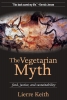
The Vegetarian Myth
Reviewed in Permaculture Activist

By Peter Bane
Permaculture Activist #72, Summer 2009

This book almost literally blew in the door one March day recently and I found myself still engrossed in its captivating story an hour after tearing open the brown padded wrapper. That doesn't very often happen.

Lierre Keith has written a compelling tale of her own near self-destruction from a vegan diet and a broadside against its being perpetrated upon or adopted by any other victims. She has converted 20 years of pain and suffering, and permanent damage to her health into a galvanizing passion to demolish the myth that she believe underpins the worldview of most who adopt vegan diet: "I want to eat without killing." You can't, she says, and if you try you'll die.

The arguments are compelling, and bluntly presented in three large chapters addressing moral, nutritional, and political vegetarians. Every field of grain or soybeans kills ecosystems and a myriad of creatures mostly too small to be seen and thus wept over. But they are just as dead as steers stunned and gutted in a meatpacking plant. At this point the enterprise of agriculture threatens all life on planet Earth.

Humans, unlike ruminants, cannot eat grass and survive. Our digestive systems are tuned for a variety of foods, always including meat. Many vegans, she reports from personal experience, do not know this, and fantasize worlds in which the lamb and the lion shall lie down, if not together, then at least on either side of a big fence from each other—eating the same uncomplaining plants. Can modern people actually be this ignorant? It seems so. Traditional diets have universally recognized the importance of flesh foods, especially animal fats, as the researches of Weston Price and many others have confirmed for over a hundred years. But modern people devoid of dietary or any other cultural traditions have picked up deadly memes, and many, especially younger people, have killed themselves trying to atone for civilizational violence.

Keith is no less an activist for interspecies justice and care of the earth now than she was when eschewing flesh in her diet. Are plants insentient? Do they care naught for their offspring? Of course, and the moral impulses that inform veganism are still sound: we should care for all life—animal, plant, and microbe alike—and especially its higher expressions in the organization of ecosystems and species genomes. She has simply recognized the appalling state of willful ignorance that drew her down a deadly road, and is determined to do all she can through personal testimony and powerful persuasion to prevent any others falling victim to the same form of self-destructive madness.

The author demolishes political vegetarianism by exposing its ignorance. On the pretense (and this is the one that caught me 36 years ago) that surplus grain and oil crops from the western developed countries were needed to feed the hungry of India, Africa, and Asia, many political vegetarians have persuaded themselves to turn away from healthy food and embrace arrangements of power that, were they seen clearly, would be understood as imperialist, racist, even genocidal—certainly unjust. No, people in the majority world don't need U.S. food aid. They don't need GMO corn or inedible soybeans. These countries need us to stop overpowering their own native farm sectors with our subsidized exports and our high-powered trade negotiators. She goes on to peel the covers back from the orgy of interlocked corporate boards that makes up the American food system. Scratch beneath the skin of Dean Foods or Odwalla Juice, Hain Food Group, Cascadian Farms or Muir Glen, and you find the likes of Chevron, General Electric, Monsanto, Nike, Starbucks, Texas Instruments, and WalMart as the majority stockholders. "So you're an environmentalist. Why don't you know any of this?," she asks.

Feedlot finishing, chickens in battery houses, and CAFO pork operations are lousy, and we shouldn't be eating that food, but animals living their lives under the sun on agricultural savannas like those nurtured by intensive graziers such as Joel Salatin and thousands of others are tremendously healthy. These carefully managed pastures are sequestering carbon, increasing plant diversity, and growing healthy food for people. Wake up! The author's words virtually scream out from the page. You who disdain eating flesh are fooling no one but yourselves.

Apart from the gripping passion of Keith's personal narrative, why should anyone already eating meat bother reading this book, with its indictments of fast food addiction, its tight analysis of the downward spiral of anorexia and bulimia, and its chilling litany of the deterioration of the body deprived of saturated fats and animal proteins? Because control of food is central to the control of our bodies, our minds, and the political system itself. The author has done a tremendous amount of focused research on the issues of diet and nutrition, ecosystem destruction, agriculture, and the manipulation of the food system, and the chain of money and control that weave an insidious trap for us all. You will learn many things you need to know here. Things on which your very life depends.

This book is a political exposé, a diet book, a treatise on anthropology, and a roaring condemnation of grain agriculture. Keith looks at agriculture's destruction of the land, amped up by fossil fuels to a massive holocaust in the past five decades, and finds no redemption anywhere. She admits that the Land Institute's project to breed seed-heavy perennial grasses could prevent much of the destruction of plow agriculture, but asks "why would we want to?" When Kansas and the rest of the Great Plains virtually overflowed with bison, antelope, and a host of other ruminants, flesh of which is superb food for humans, why would we try to replace it with something that may not ever work, and certainly stands little chance of feeding anyone for decades?

Grain isn't good for us. We love it because its seeds contain small amounts of opioids that give our brains a rush, but it causes all our tissues to swell when we eat it: our joints, our livers, our nerves, our blood vessels. Most of the degenerative diseases of modern life are linked to the inflammatory influence of a diet rich in refined carbohydrates and vegetable oils. We eat them also because they are the cheapest and most profitable calories that industrial farming and food processing can put on the shelf, and Money wants us to eat them.

Meat, Keith reminds us, especially organ meats with their superb assembly of minerals and saturated fats, literally made humans into our modern form. These readily absorbed, nutrient-dense foods allowed our brains to grow and our digestive tracts to shrink. We are still dependent on this complex of foods for wholesome nutrition, but most of us don't know it. Or should I say that the cultures that reminded us of its importance are eroding and disappearing from the modern world. And that the manipulation of memes by corporate advertising is killing us, one cheese puff at a time.

In the nature of a book that attempts to integrate personal passion and scholarship to a high degree, it might be too much to expect a program of reform to be well articulated. In her fourth chapter, Keith expounds on a simple formula for saving the world: Refrain from having children; stop driving your car; and grow your own food. Many will take issue with at least the first, though by any account we need to reduce the human population humanely and as fast as possible, but there can be little quarrel with the science of the latter two points. You won't find a lot here about how to make the changes happen—and let me tell you they are tough in the aggregate—though the author gives a good account of the logic of permaculture and the importance of perennial polycultures, rotational grazing, and no-till gardening. In recommending how "To Save the World," Keith takes a good lick at patriarchy and monotheism along with industrial farming and soy pseudofoods. By this point in the argument, you don't have to care if her polemic is over-the-top. The point has been driven home. Our food system is killing us—resist!

Published with the blessing and under the imprint of Derrick Jensen's Flashpoint Press, The Vegetarian Myth is an attractive and information-rich book that lives up to its subtitle. Aside from a few graphs used to illustrate the manipulation of cholesterol studies, the books consists of text only. The cover theme of Lascaux cave art is carried through on most pages with tiny glyphs of bison marking transition points in the text. No matter the lack of illustration, the writing is powerful and persuasive. Keith has every reason to be bitter and angry, but she has transmuted her anger and seasoned it well with a self-reflective humor that sweeps us along this road to recovery from a scorched earth. As I read her description of her first meat meal in 20 years (a can of tuna eaten reluctantly with a plastic fork), I found myself in tears. Ten years recovering from a quarter century of vegetarian folly myself, I never went through the agony that Keith lives with yet, but I knew the shattering epiphany she experienced with that first bite—coming home to the truth of her body, and of life itself.

Whether you are a vegan (run, if you can, to the bookstore), vegetarian, recovering from either diet, or never gave up meat at all, you will benefit from this author's painful mistakes and her laser-like focus on the path to a sane diet and all that it entails. Mark this one for the top shelf on cultural recovery.

Tuesday, January 6, 2009

Call for submissions to Permaculture Activist #72

"Permaculture Abroad" will be the theme of issue #72. May 2009. What's going on, permaculturally speaking, in the rest of the world will be the topic, with significant focus on permaculture in Africa, the continental host of the International Permaculture Convergence #9 in 2009, The deadline for submissions is March 1, 2009.
Please read the Writer Guidelines before submitting articles.

Wednesday, March 5, 2008

"PERMACULTURE - FARMING AND LIVING WITH NATURE"

LISTEN TO ARCHIVED VERSION - download/open | stream

"Permaculture" or "permanent agriculture" was originally conceived almost 30 years ago by Australian ecologists Bill Mollison and David Holmgren. Observing aboriginal culture and forest ecosystems, he conlcuded that we could deliberately design agriculturally productive ecosystems, echoing diversity, stability, and resillience of natural ecosystems.

Permaculture designs provide food, energy, and shelter for people and animal inhabitants while linking the needs and outputs of each element.

Permaculture is a holistic approach to land use, which works with nature's rhythm and patterns, weaving together the elements of microclimate, annual and perennial plants, animal, water and soil management, and human needs into intricately connected and productive communities.

Guests

Gregoire Lamoureux - Kootenay Permaculture Institute/Spiral Farm - The Kootenay Permaculture Institute is located just outside of Winlaw in the Slocan Valley of British Columbia. Gregoire is a permaculture designer, consultant, and teacher. He has worked with permaculture systems for over 15 years and taught courses in many parts of Canada. He taught the permaculture design course as a Summer Session at the University of Manitoba in 2005. Gregoire is on the Board of Directors of the Slocan River Streamkeepers and has served on the Board of Seeds of Diversity Canada for seven years. He is a founding member of the Kootenay Organic Growers Society. He has written for Natural Life Magazine. He has been a guest lecturer at the BC Organic Agriculture Conference, and the Guelph Organic Agriculture Conference.

Peter Bane - Publisher, The Permaculture Activist - North America's leading (and the world's oldest) permaculture periodical. Based in Bloomington, Indiana, since 1985 the publication has informed on permaculture design, edible landscaping, bioregionalism, cooperative action, aquaculture, natural building, earthworks, renewable energy and more.