Showing posts with label Relocalization. Show all posts

Wednesday, December 7, 2011

Uncle Sam Wants You to Raise Chickens!

Our city council tonight is considering removing the 5 chicken limit and eliminating the requirement for getting permission from adjacent neighbors. There would still be a small annual registration fee and inspection. We hope to expand the limits to include other animals, too, overtime.

The impulse of rapid change and shocks to the economy may cause it all to happen much faster as people stop waiting for permission and simply take command of their own local destinies. Do all you can where you are...and take a stand. I guarantee, it WILL be challenged. Find your allies and hold strong.

Meanwhile, where the hell are the leaders who will stand up and say that all citizens must begin to throw off the chains of their dependency on the industrial producers, of food-like substances, that are destroying our soils, air, water and health? Don't wait for them to tell you. BE THE LEADERS! BE the ones we've been waiting for!

This article from Mother Earth News reminds us that once upon a time our government EXPECTED us to raise our own food to demonstrate our patriotism in a time of war (which we've been in for some time now, if you hadn't noticed). Now they want us to be dependent on huge, impersonal, uncaring, greed-motivated industries who produce nutritionally empty, over-processed, over-packaged, over-transported crap that keep us sick and dependent on a bloated industrial drug / insurance monopoly. We, the people, can do better.


Uncle Sam Wants You to Raise Chickens


… Or he did, back in 1918, as this poster illustrates.


Funny how things change, isn’t it? These days, people have to fight and petition and beg and plead in many municipalities to get their government to let them keep a few backyard hens. And even when city leaders permit it, they lay out complicated rules about how many, where and how the birds must be housed. And please! No roosters!
 As the poster so rightly points out, two hens per person will keep a family in eggs. The flock will take minimal effort, cost little and provide plenty of enjoyment, because chickens are fun to watch.


Read more: http://www.motherearthnews.com/the-happy-homesteader/uncle-sam-wants-you-to-raise-chickens.aspx#ixzz1ftIcm7Kq

Saturday, September 18, 2010

The Vision of City Repair - Placemaking - Relocalizing - Reskilling - Re-Villaging

City Repair is an organized group action that educates and inspires communities and individuals to creatively transform the places where they live. City Repair facilitates artistic and ecologically-oriented placemaking through projects that honor the interconnection of human communities and the natural world. The many projects of City Repair have been accomplished by a mostly volunteer staff and thousands of volunteer citizen activists.

City Repair began in Portland, Oregon with the idea that localization - of culture, of economy, of decision-making - is a necessary foundation of sustainability. By reclaiming urban spaces to create community-oriented places, we plant the seeds for greater neighborhood communication, empower our communities and nurture our local culture.


Intro to Placemaking


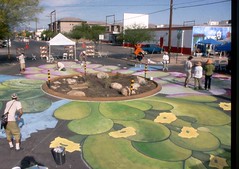
Placemaking is a multi-layered process within which citizens foster active, engaged relationships to the spaces which they inhabit, the landscapes of their lives, and shape those spaces in a way which creates a sense of communal stewardship and lived connection.  This is most often accomplished through a creative reclamation of public space: projects which take the form of benches on street corners where neighbors can sit, rest and talk with each other, kiosks on sidewalks where neighbors can post information about local events, needs and resources and street paintings in the public right-of-way that demonstrate to all who pass through that this is a Place: inhabited, known and loved by its residents.  In all instances, these projects are undertaken by local communities who come together to discuss what it is they want in their neighborhood – what elements are lacking in the public sphere and how the community can work together with the resources they have to create their own place.
Placemaking touches upon deeper societal issues and contributes to participatory democracy. As the process of developing a community place proceeds; people develop deeper relationships and more energy to create together because they live together. Creating a common ground that transcends the differences among people powerfully addresses this isolation and creates an environment where people feel like they can do anything they set their collect minds to.

Major Elements of Placemaking:

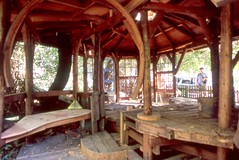
Natural Building: The essence of natural building lies in its inherent emphasis on environmental preservation and social sustainability.  Natural building is a method of construction based in using minimally processed, natural materials that are available locally.  The techniques for most natural building methods reflect the materials themselves in that they are simple, low-tech and ecologically sustainable.  Natural building employs a sense of the human-scale and isn’t dependent on expensive, energy intensive, high-tech equipment.  Natural building materials have low toxicity, are low-tech and local, making them great tools for teaching communities the synthesis of building principles in sustainability and social empowerment.
Permaculture: Permaculture is the conscious design of sustainable human settlements.  It is also about being local: shepherding the resources that enter a place; keeping them cycling within the “system,” be it backyard, neighborhood, or bioregion; and creating beneficial connections between each part.  Community and a sense of place can only be created by the people who dwell together and who have real stake in creating a home.
Public Art: Artwork in our neighborhoods can also create a strong sense of place, whether it is a mural, a sculpture, temporary art such as chalk drawings or functional art pieces like benches or lampposts.  Public art presents an opportunity for a neighborhood to tell its history, express local culture and have a fun project for anyone to get involved.

Sunday, January 18, 2009

Transition Partnership with Relocalization!

To all members of the Transition US community:

It is with great pleasure that I write to tell you that we have secured seed funding to support the growth of the Transition movement in the US. This funding, which comes as a combination of cash and in-kind services, is being provided by Post Carbon Institute, with whom we expect to develop a strong strategic alliance. The agreement not only provides us with funding sufficient to support an Executive Director but also gives us immediate non-profit status.

Post Carbon Institute will no longer be providing active support to the Relocalization Network (RN). Instead we will be working with members of the RN to inspire them to join Transition US, where they will be able to share their experiences and know-how with other Transition Initiatives. Please help in the process of welcoming RN members into Transition US and supporting them in whatever ways you can.

We are in the process of forming a Board of Directors for the non-profit Transition US. For purposes of moving forward quickly, the initial members of the Board are to be Pamela Gray and Jennifer Gray, founders of Transition US, together with Asher Miller, Executive Director of Post Carbon Institute and Richard Heinberg, Senior Fellow of the Post Carbon Institute. Peter Lipman, Chair of the Transition Network Board of Trustees has been asked and has agreed to join the Transition US Board. Together with Pamela's participation as a Transition Network Trustee, this will enable us to stay in close touch with decisions taken in the UK.

The negotiations for this agreement took place very quickly in the last few weeks of 2008. It was a surprise to all involved that we could find a way to work together to the benefit of both organizations without coming across barriers that would cause delays. Please accept my apologies for not involving more of you in the decision-making but it was not possible to do so in the time allowed. In the future we will be posting news of developments on the Transition US web site. Our web site will be redesigned and developed over the next few months as a result of the investment.

Following the tremendous success of the trainings that took place in the latter part of 2008, and the steady stream of new Transition Initiatives that are appearing in the US, 2009 will be a year of rapid growth for the US Transition Movement. We must act collectively to prepare our communities to build resilience in the face of change. By continuing to work together, sharing ideas, resources and experiences wherever possible, we will be able to show communities the way to a future that holds the promise of being happy, healthy and strong.

Best wishes and Happy New Year,

Pamela
Transition US
==================================================
Transition Network - tackling peak oil and climate change together
==================================================
Pamela A Gray, PhD
Trustee, Transition Network
77 Del Casa Drive
Mill Valley, CA 94941

Monday, October 20, 2008

Conference On Michigan's Future - Local Futures

Local Future
Local Future Sustainability Banner
Michigan's Future Conf.
Sustainability Conference
Video Presentations
Middleville (Pilot)
Grand Rapids
Michigan
Organizer
Join

Local Future: Paths to Sustainability
Conference on Michigan's Future
-
Nov. 14-16, 2008
Crystal Mountain Resort, Thompsonville, MI

"The Conference of Michigan's Future: Energy, Economy & Environment"
looks at the challenges of the monetary crisis and the oil crisis and proposes realistic, job creating solutions for Michigan.

Over two-dozen speakers are confirmed
including Richard Heinberg, Albert Bates, Ellen Brown, Paul Murray, Tony Earley, and Jerry Norica.

If you care about Michigan's future, take a moment to visit the Michigan Conference web site and consider participating to help create a brand new vision for Future Michigan.

Conference on
Peak Oil & Climate Change - Online

Local Future hosts the
International Conference on Peak Oil and Climate Change: Paths to
Sustainability
.

The inaugural conference features 50 presenters including Richard Heinberg, Julian Darley, Dr. David Goodstein, Megan Quinn Bachman, Stephanie Mills, and Pat Murphy.

NEW! - Watch conference presentations & download podcasts for free.

Introduction to Local Future

Unemployment, inflation, war, peak oil, climate change, biodiversity loss, overpopulation -- global problems that need local solutions.

Local Future helps communities develop compassionate, sustainable, local, systems to provide jobs, food, energy, transportation, and essential services.

Local Future Network members develop these systems by helping their
community to transition from dependent units of the failed global economy; to independent cultures of compassionate, sustainable, local economy.

Global Problems

The global economic system creates problems which threaten humanity and the planet:

  • peak oil
  • climate change
  • over population
  • resource depletion
  • widespread pollution
  • misallocation of power
  • institutional cruelty
  • economic instability
  • environmental destruction
  • geopolitical conflict & war

This unsustainable global economic system fails to protect humans, the environment, and the natural systems on which all life depends. It does not meet the long term goals of civilization.

When a system fails to such a catastrophic degree, it is time for change.

Local Solutions

New local systems must be developed that are grounded in a value system of truth, compassion, understanding, sustainability, renewal and community. Developing new systems takes dedicated individuals who share the common value system,
walk a common path, and move towards a common vision of the future.
Local systems are needed to provide:

  • jobs - that are challenging, safe and community oriented
  • money - community currency that creates jobs, motivates
    progress and reinforces values
  • food - that is nutritious, compassionate, sustainable, organic
    and available year-round
  • energy - heat, electricity and fuels from renewable sun, wind, water and biomass sources
  • transportation - utilizing ride sharing, mass transit, community vehicles and human power
  • homes - safe, comfortable and welcoming, zero energy new homes and retrofits
  • water - fresh, clean, free water that is owned and managed locally
  • waste management - emphasizing reduce, reuse and recycling
  • health care - high quality, low cost, community based services and prevention
  • education - local teachers dedicated to providing continuing service
  • security - utilizing open communication, problem solving, education and dialogue
  • entertainment - opportunities for all to participate and enjoy
  • culture - celebrating diversity and history
  • spirituality - inviting all people to explore the deeper questions of life

Members of Local Future Network communicate and meet to learn, support, plan, and act. They take the initiative to increase independence for themselves and their communities. Their shared value system of truth, compassion, understanding, sustainability, renewal and community guides their actions toward a vision of a prosperous local future.

Join Local Future

You are invited to make the future a better place.

Join the Local Future Network.

The Conference on Michigan's Future
Energy, Economy & Environment

Crystal Mountain Resort,
Thompsonville, MI
Friday, Nov. 14 - Sunday, Nov. 16, 2008

Local Future Videos
Lights, Camera, Action for Sustainability

Local Future published the following
videos for educational use. These videos, when combined with recommended
resources, provide an excellent start on learning how and why we will be living
a local future.


Peak Oil: The Energy Crisis of Oil Supply Depletion
Aaron Wissner, 10 min

Supply, Demand and Price: The Economics 101 of Peak Oil
Aaron Wissner,
1 min

Conference Welcome and the Greening of Grand Rapids Michigan
George Heartwell, 10 min

Peak Oil and Energy Explained by Dr. Vernon Ehlers, U.S. Representative

Vernon Ehlers, 14 min

Peak Oil (and Gas Prices) in Five Slides
Aaron Wissner, 3 min

What Does it Take to be Sustainable? Some Examples

Aaron Wissner, 9 min

Beyond Sustainability: Surviving Peak Oil and Climate Change
Pat Murphy, 38 min

Surviving Peak Oil, Thriving in Community
Megan Quinn Bachman, 33 min

Peak Oil: How do we know? Is recession coming? What about
insurance?

Aaron Wissner, 3 min

Crude Awakening: Peak Oil and the End of Cheap Energy: Part 1
Tim Hudson, 1 hour

Crude Awakening: Peak Oil and the End of Cheap Energy: Part 2
John Richter, 1 hour

Re-Energizing America: Rescuing America from its Costly Fossil Fuel Addiction
Dan Chiras, 1 hour

Curtailment & Community: Survival Strategies for Peak Oil & Climate Change
Megan Quinn Bachman, 20 min

Interview with Megan Quinn Bachman on Peak Oil and Community Solutions
Megan Quinn Bachman, 15 min

Saturday, March 8, 2008

Peak Moment Television

Peak Moment: Community Responses For a Changing Energy Future are weekly 28-minute programs featuring host Janaia Donaldson's conversations and on-site tours with guests. It highlights practical solutions and responses towards a lower-energy, more connected, sustainable life. How can we thrive, build stronger communities, and help one another in this time of transition?


PM95_120.jpg

Peak Moment: Economic Localization - A Community Rediscovering Itself

In this freewheeling conversation, Jason Bradford and Brian Weller, co-founders of Willits Economic LocaLization (WELL), discuss local food security, creating a farm at a nearby grade school, being rooted in community, urban / rural friction in wealth and land use, regional trading partners, reinventing local public transportation, and more. Episode 95.

PM91_120.jpg

Peak Moment: A Sustainability Renaissance Man

Earth needs humans to figure out our shared destiny, says Alan Seid, whose interest is both the outer and inner dimensions of sustainability. Outside there's ecology, social systems and economics (e.g., in Permaculture). Inside is the psychological dimension of personal and group values and intentions. How do we meet people where they are, engender respect, promote crucial information-sharing, and motivate change? Episode 91.

PM83_120.jpg

Peak Moment: Practical Tools to Grow an Intentional Community

Communities Magazine ex-editor Diana Leafe Christian concisely spells out what the successful 10% of intentional communities do: common vision and purpose, fair participatory decision-making, clear agreements in writing, good balance of right and left-brain knowledge, methods of staying accountable to agreements, criteria for new members, good communication and processing skills. She also discusses peak oil effects on the wider community. Episode 83.

PM79_120.jpg

Peak Moment: Alcohol Can Be a Gas, Part I

The first automobile fuel was alcohol, which could be produced by most farms. Permaculturist David Blume discusses the history, production and properties of alcohol. He notes that plants are more efficient in producing sugars (used for alcohol) than oils (biodiesel). If corn were first fermented, its starch could be used for alcohol and the remainder fed to cattle -- far more efficient for food, fuel and land use. Episode 78.

Peak Moment: Alcohol Can Be a Gas, Part II

Permaculturist David Blume discusses alcohol's low emissions, and producing alcohol as a biological complex in which wastes become raw materials for other processes. He claims that with one year of the U.S. Defense budget, the entire world could be set up to produce alcohol and permanently replace oil for transportation. He discusses vehicle conversion, and how citizens can undertake alcohol fuel distribution. Episode 79.

PM76_120.jpg

Peak Moment: City Repair - Permaculture for Urban Spaces

What happens when citizens apply permaculture principles to a city grid? They create friendly places within the grid that invite people to come together. Mark Lakeman, co-founder of Portland, Oregon's City Repair Project describes these "creative intervention" projects as placemaking at its best. People learn to work together, build trust and have fun. The results, from painted intersections to cob benches and other organic structures, invite people "to inhabit the planet on our own terms" rather than the grid-locked culture imposed by the city. Episode 76.

pm73_120.jpg

Peak Moment: Post Carbon Cities - Planning for Energy and Climate Uncertainty

Smart municipalities are planning and preparing for energy vulnerability and climate change. Daniel Lerch, manager of the Post Carbon Cities project, has prepared a guidebook including case studies of cities large and small planning how to maintain essential services in the face of energy and climate uncertainty. Episode 73.

pm68_120.jpg

Peak Moment: Bullock Brothers Homestead - A 25-Year Permaculture Project

Take a tour with Joe, Doug and Sam Bullock on their Orcas Island property, site of a yearly Permaculture design course. Using nature as their model, they create edges and wildlife habitat, move water through the landscape, promote diversity, and raise an astonishing variety of plants from sub-arctic to tropical -- a wise investment in these climate-changing times. Episode 68.

PM63_120.jpg

Peak Moment: Peak Oil, Peak Coal and Beyond

Hot topics from Richard Heinberg: record-high U.S. fuel prices; the ethanol big-business boondoggle; coal projected to peak about a hundred years early (around 2020); what the climate change discussion is missing; and enjoying ourselves as we "go local." Episode 63.

PM48

Peak Moment: A Defining Moment in Human History

The planet is rapidly confronting us with limits to the exploitative, dominator system of the past 5000 years. David Korten, author of When Corporations Rule the World, and more recently The Great Turning: From Empire to Earth Community, implores us to replace the old dominator-control stories with new stories -- affirming life values of cooperation, community and interdependence. Episode 48.
PM27

Peak Moment: Learning from Cuba's Response to Peak Oil

Megan Quinn of Community Solution discusses her visit to Cuba, and the movie "The Power of Community." This young woman sees Peak Oil as an opportunity to create the communities we want, but notes that we must reduce our consumption despite environmentalists' assurances that biofuels will save us. Episode 27.