Thursday, September 10, 2009

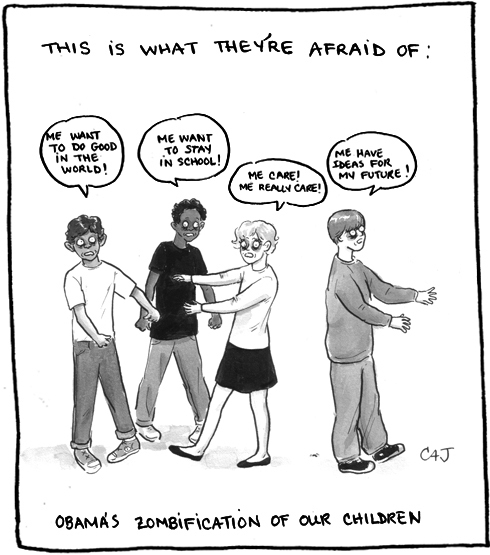
Zombies!

Carolita Johnson Carolita Johnson cartoonista, etc.
Posted: September 8, 2009 08:26 AM at Huffington Post

Shift Happens....

JUNEAU, Alaska — Global warming conjures images of rising seas that threaten coastal areas. But in Juneau, as almost nowhere else in the world, climate change is having the opposite effect: As the glaciers here melt, the land is rising [3 Inches per Year] , causing the sea to retreat.

A few decades ago, large boats could sail regularly along Gastineau Channel between Downtown Juneau and Douglas Island, to Auke Bay, a port about 10 miles to the northwest. Today, much of the channel is exposed mudflat at low tide. “There is so much sediment coming in from the Mendenhall Glacier and the rivers — it has basically silted in,” said Bruce Molnia, a geologist at the
United States Geological Survey who studies Alaskan glaciers.

Read the rest at the New York Times...

Glacial Meltdown

Time-Lapse Videos Of Extreme Ice Loss Show Vivid Evidence Of Climate Change

Doh!

Bill Maher recently annoyed a lot of people by calling Americans stupid. In case there's any doubt as to the validity of his claim I recommend a visit to (The Customer Is) Not Always Right. If its any consolation at all, its not just Americans.

"If you’ve ever had the pleasure of working in retail, service or other public-facing jobs, you’ve inevitably come across that occasional customer that either makes your blood boil, tickles your funny bone or leaves you totally confused. We all need a place to vent, so Not Always Right is a collection of quotes from these particularly memorable customers.

We believe that while customers deserve to be treated right, so do the employees and the other folks that serve them. Not Always Right is about leveling the playing field for those of us who toil and sweat every day trying to juggle demanding customers and often unreasonable corporate expectations. At the end of the day, it’s about remembering that whether we’re a customer or an employee, we’re all human, foibles and all."

Here's a sample...

Kookie Cookie Karma

Restaurant | New York, USA

Me: “Can I help you, ma’am?”

Customer: “Yes. What are these?”

Me: “That is a fortune cookie, ma’am.”

Customer: “It doesn’t look like a cookie. Where are the chocolate chips?”

Me: “Ma’am, these are a different kind of cookie. You open them up and they tell your fortune on a piece of paper.”

Customer: “What kind of cookies have paper in them!?”

Me: “Fortune cookies, ma’am.”

Customer: “This is an outrage! Cookies are meant to be eaten, and paper isn’t EATABLE!”

Me: “Please, ma’am, the paper is–”

Customer: “Shut up! I’m leaving.”

(The customer begins to storm out but in her anger misses the door and walks right into the wall. When she finally stumbles out, I open up the fortune cookie and read its message: “Do not worry. You will get what is coming to you in life.”)

Introducing The iKa-Chunk

Mobile Phone Kiosk | New Zealand

(A very elderly customer approaches me at my mobile phone kiosk.)

Customer: “Oh, these looks nice. What are you selling?”

Me: “Mobile phones, ma’am. They’ll allow you to keep in touch with people, wherever you are.”

Customer: “Oh, this one looks lovely, nice, and slim! *unfolds it and holds it to her ear* “What’s this one called?”

Me: “That one is called a stapler, ma’am.”
Friday, September 4, 2009

Top 10 Reasons To Grow Your Own Organic Food


1. GET THE NUTRITION YOU NEED & ENJOY TASTIER FOOD!

Many studies have shown that organically grown food has more minerals and nutrients that we need than food grown with synthetic pesticides. There’s a good reason why many chefs use organic foods in their recipes—they taste better. Organic farming starts with the nourishment of the soil, which eventually leads to the nourishment of the plant and, ultimately our bodies.

2. SAVE MONEY
Growing your own food can help cut the cost of the grocery bill. Instead of spending hundreds of dollars and month at the grocery store on foods that don’t really nourish you, spend time in the garden, outside, exercising, learning to grow your own food.

3. PROTECT FUTURE GENERATIONS
The average child receives four times more exposure than an adult to at least eight widely used cancer-causing pesticides in food. Food choices you make now will impact your child’s future health.

“We have not inherited the Earth from our fathers,
we are borrowing it from our children.”

– Lester Brown


4. PREVENT SOIL EROSION
The Soil Conservation Service estimates more than 3 billion tons of topsoil are eroded from the United States’ croplands each year. That means soil erodes seven times faster than it’s built up naturally. Soil is the foundation of the food chain in organic farming. However, in conventional farming, the soil is used more as a medium for holding plants in a vertical position so they can be chemically fertilized. As a result, American farms are suffering from the worst soil erosion in history.

5. PROTECT WATER QUALITY
Water makes up two-thirds of our body mass and covers three-fourths of the planet. The Environmental Protection Agency (EPA) estimates pesticides - some cancer causing - contaminate the groundwater in 38 states, polluting the primary source of drinking water for more than half the country’s population.

6. SAVE ENERGY
American farms have changed drastically in the last three generations, from family-based small businesses dependent on human energy to large-scale factory farms. Modern farming uses more petroleum than any other single industry, consuming 12 percent of the country’s totally energy supply. More energy is now used to produce synthetic fertilizers than to till, cultivate and harvest all the crops in the United States. If you are growing your own food in the city, you are cutting down on transportation and pollution costs.

7. KEEP CHEMICALS OFF YOUR PLATE
Many pesticides approved for use by the EPA were registered long before extensive research linking these chemicals to cancer and other diseases had been established. Now the EPA considers 60 percent of all herbicides, 90 percent of all fungicides and 30 percent of all insecticides carcinogenic. A 1987 National Academy of Sciences report estimated that pesticides might cause an extra 4 million cancer cases among Americans. If you are growing your own food, you have control over what does, or doesn’t, go into it. The bottom line is that pesticides are poisons designed to kill living organisms and can also harm humans. In addition to cancer, pesticides are implicated in birth defects, nerve damage and genetic mutations.

8. PROTECT FARM WORKERS & HELP SMALL FARMERS
A National Cancer Institute study found that farmers exposed to herbicides had six times more risk than non-farmers of contracting cancer. In California, reported pesticide poisonings among farm workers have risen an average of 14 percent a year since 1973 and doubled between 1975 and 1985. Field workers suffer the highest rates of occupational illness in the state. Farm worker health is also a serious problem in developing nations, where pesticide use can be poorly regulated. An estimated 1 million people are poisoned annually by pesticides.

Although more and more large-scale farms are making the conversion to organic practices, most organic farms are small, independently owned family farms of fewer than 100 acres. It’s estimated the United States has lost more than 650,000 family farms in the past decade. And the U.S. Department of Agriculture predicted that half of this country’s farm production will come from 1 percent of farms by the year 2000, organic farming could be one of the few survival tactics left for family farms.

9. PROMOTE BIODIVERSITY
Mono-cropping is the practice of planting large plots of land with the same crop year after year. While this approach tripled farm production between 1950 and 1970, the lack of natural diversity of plant life has left the soil lacking in natural minerals and nutrients. To replace the nutrients, chemical fertilizers are used, often in increasing amounts. Single crops are also much more susceptible to pests, making farmers more reliant on pesticides. Despite a tenfold increase in the use of pesticides between 1947 and 1974, crop losses due to insects have doubled—partly because some insects have become genetically resistant to certain pesticides.

10. HELP BEAUTIFY YOUR COMMUNITY
Besides being used to grow food, community gardens are also a great way to beautify a community, and to bring pride in ownership.

Source PDF (Printable Version): http://longbeachorganic.org/

Cow Farts and Other Myths

Debunking the meat/climate change myth
(snip)
If those people concerned about rising levels of greenhouse gasses, instead of condemning meat eating, were condemning the enormous output of greenhouse gasses due to fossil fuel and fertilizer use by a greedy and biologically irresponsible agriculture, I would cheer that as a truthful statement even if they weren’t perceptive enough to continue on and mention that the only “new” carbon, the carbon that is responsible for rising CO2 levels in the atmosphere, is not biogenic from livestock but rather anthropogenic from our releasing the carbon in long term storage (coal, oil, natural gas.) Targeting livestock as a smoke screen in the climate change controversy is a very mistaken path to take since it results in hiding our inability to deal with the real causes. When people are fooled into ignorantly condemning the straw man of meat eating, who I suspect has been set up for them by the fossil fuel industry, I am appalled by how easily human beings allow themselves to be deluded by their corporate masters.


An Inconvenient Cow
(snip)
In his fascinating recent book, 1491: New Revelations of the Americas Before Columbus, Charles Mann paints a picture of wild ruminant populations before the arrival of Europeans: “North America at the time of Columbus was home to sixty million bison, thirty to forty million pronghorns, ten million elk, ten million mule deer, and as many as two million mountain sheep.” That’s just North America. We have not even considered the enormous herds pounding the African plains, nearly all of which are methaneproducing ruminants including wildebeest, Cape buffalo, giraffes, gazelles, antelope, kudu—you get the point. Even today, these animals number in the hundreds of millions; their numbers were many fold greater in the past. How can it be that we have been able to overlook this perfectly natural scenario and move forward with casting the blame on the world’s 1.5 billion domesticated cattle?

Nature’s herds are by no means light on the land. Reports from the travels of Lewis and Clark attest to the fact that the herds of bison left not one scrap of fodder for their horses to eat, and the land was coated with a sheet of manure so thick, it turned vast expanses of prairie black. This manure, with the help of sage grouse, prairie chickens and dung beetles was then quickly recycled into some of the richest soil on the planet; this is the same manure that the U.N. blames for poisoning our atmosphere with nitrous-oxide.


Splendor From the Grass
(Snip)
...the way cows are fed today causes them to suffer from a range of health problems. Dairy cows are fed grains and soybeans, which have high caloric and nitrogen values. Sometimes rations even include bakery waste, such as out-of-date donuts, candy and pastries. These foodstuffs upset the delicately balanced ecosystem in the cow’s rumen. As rumen microbes digest the foods eaten by the cow, they produce waste products which inhibit the growth of other microbes. One of these metabolic wastes, acetic acid (vinegar), is used as an energy source by cattle. But the waste from microbial digestion of starches—like corn and bakery waste—is lactic acid, which has no value to ruminant. It also lowers the pH in the rumen, causing acidosis. The colostrum (first milk) of such acidic cows has very few antibodies because they are immunosuppressed.

Another serious consequence of grain feeding is that cows on grain absorb lower amounts of fat-soluble vitamins A, D and E, even when these vitamins are added to feed; and, consequently, less of these vital nutrients show up in the milk...

Of all the cull cows taken to slaughter today, only about 5 percent have livers that can be salvaged. Damage to the liver is attributed to high levels of protein in soy-based feed.

Contrasts


From:

Thursday, September 3, 2009

Outstanding & Useful References

Tom Clothier's Garden Walk and Talk

Drawing of hand with green thumb. Introduction to the Archive

Drawing of hand with green thumb. Perennial Germination Database
Drawing of hand with green thumb.
Annual/biennial Germination Database
Drawing of hand with green thumb.
Penstemon Germination Database
Drawing of hand with green thumb.
Tree/Shrub Germination Database

Articles about seeds and seed starting:

Drawing of hand with green thumb. Seed Germination versus soil Temperature
Drawing of hand with green thumb. Soilless mixes - Sowing techniques
Drawing of hand with green thumb. Damping-Off -- Frequently asked questions
Drawing of hand with green thumb. Genetics for Seed Savers
Drawing of hand with green thumb. A Taxonomic Index of the works of Norman C. Deno
Drawing of hand with green thumb. A note on Seed Viability

Tom Clothier's Garden Perspectives

Drawing of hand with green thumb. Aphids
Drawing of hand with green thumb.
My Army of Groundskeepers (Insect pest control)
Drawing of hand with green thumb.
Asparagus Beetles
Drawing of hand with green thumb.
Garden Design (Weedy herbiage)
Drawing of hand with green thumb.
Growing & processing Black Walnuts
Drawing of hand with green thumb.
Growing & processing Horseradish
Drawing of hand with green thumb. Lettuce all year 'round
Drawing of hand with green thumb. Making your own soil
Drawing of hand with green thumb. Non-Insect pests
Drawing of hand with green thumb. Potentillas in my garden
Drawing of hand with green thumb. Pumpkins versus Squash
Drawing of hand with green thumb. Seeds
Drawing of hand with green thumb. Slugs & snails
Drawing of hand with green thumb. Squash vine borers
Drawing of hand with green thumb. The praying mantis
Drawing of hand with green thumb. Walking Stick Kale: Growing the hook for your cane.
Drawing of hand with green thumb. Weeds
Drawing of hand with green thumb. Three unusual fruits & vegetables (Weedy herbiage)
Drawing of hand with green thumb. Why aren't my tomatoes turning red?
Drawing of hand with green thumb.
Plant photos from my garden.

General Gardening Resources and Opinion

Drawing of hand with green thumb. Botanical binomials -- What do the names mean?
Drawing of hand with green thumb. Dictionary of specific epithets
Drawing of hand with green thumb. Nestbox construction for Bumblebees
Drawing of hand with green thumb. How mole hills become mountains
Drawing of hand with green thumb. A List of Hummingbird favorite plants
Drawing of hand with green thumb. Native Pollinator References
Drawing of hand with green thumb. A list of Bumblebee favorite plants
Drawing of hand with green thumb. Plant friends of black walnut trees
Drawing of hand with green thumb. Plants for attracting beneficial insects
Drawing of hand with green thumb. Seed envelopes
Drawing of hand with green thumb. Synonyms
Drawing of hand with green thumb. The interpretation of Garden Observations (Weedy herbiage)
Drawing of hand with green thumb. Developing your own seed start scheduling database
Drawing of hand with green thumb. Determining "weeks before last frost" in your area.