
Saturday, December 27, 2008


Friday, December 26, 2008
...Let There Be Pie...and there Was Pie
 We’re Gonna Need More Pie
 ...this is one of my all-time favorite posts. I thought about editing the parts that reflect badly on me, but those are the funniest bits, as usual, so I just left them in. I had so much fun writing this - and Edson, my son, helpfully points out that Obama, whatever his limitations, is clearly on the pie platform too - he’s a big fan. So that can only be good ;-).
The other day I got embroiled on a newsgroup in one of those endless discussions/debates/headbangings about what the best approach to greening the planet is. Of course, all of you know that my defining characteristics are my reasonableness, aversion to confrontation and sensitivity, so my role here was to calm the hot tempers and settle the differences of others, which I do from my sheer love of humanity. I provided a calm and rational perspective that I know helped settle everything right down, because that’s just the kind of healing, caring person I am.
Ok, just on the off chance that anyone involved in that group says otherwise, I want to ask you upfront, who will you believe - them or me? After all, the people saying I was fanning the flames of this stupid umm…integral argument are nothing more than two or three hundred ordinary voices, where as I am a professional idio…author. I daily produce hundreds of words that are pulled randomly out of my a…er…finely crafted and honed for maximum effect. Sometimes the words even make sentences. Once in a while even grammatical sentences. These words are read by as many as eight or nine people around the world every single day. So you can certainly imagine that my ravings…um wisdom should outrank the sworn testimony of several hundred people.
So you’ll be proud to know that I, of course, natural leader that I am, did come up with a healing solution, something that we could come together on, a real commitment to change, a possible solution to the profound difficulties wrought upon us by the Great Change that comes sweeping over the (ok, stupid metaphor deleted)… But I did have an idea.
 The idea was pie. And my position is that I’m for it. I know this is just the kind of hard-edged, radical position taking that you can expect on this blog, the reason you know you can turn here first to hear opinions that are beholden to no one…except the guy up the road with the cherry trees, who I can’t afford to piss off if I want pie. But this kind of risky political statement in favor of pie is just the sort of thing I know you’ll wish to support by donating a large portion of your salary to keep me going. Just click on the button below that says “big heaping wads of cash.”
I’m in favor of pie. I mean, what could be better than pie? It is commonly associated with good, noble things like motherhood, America, light bondage and domination, clowns and the federal reserve, so how could we not be for pie? In fact, who isn’t for pie? Well…
I have to tell you the ugly truth. There are powerful anti-pie interests in our government, and people working night and day to restrict your pie access. But we here at Casaubons book (Who is “we” you ask in puzzlement? Well, Sharon has obviously gone off the deep end writing her book, as you can tell from this post, so mostly the voices in her head. But they sometimes wear cool hats, and one of them is named “Leo.”) are committed to bringing you the truth about pie access and other equally crucial issues, like socks and beer.
 It occurred to me, as I was healing the rift in this newsgroup brought on by unnamed troublemakers not named Sharon, that pie can do a great deal to heal our environmental crisis. For example, today’s climate change and peak oil news was particularly awful. There’s the coal, the war, the monks in Burma. There’s the fact that even if we halved our emissions, global warming will keep going for 600 years http://www.planetark.org/dailynewsstory.cfm/newsid/44719/story.htm . There’s the mass extinctions. The fact that one of the few bits of environmental good news, the reforestation of the east is threatened by us: http://www.nytimes.com/2007/10/07/nyregion/nyregionspecial2/07rCOVER.html?_r=1&ref=nyregionspecial2&pagewanted=all&oref=slogin And then there’s the financial news…
All in all, I think the only possible reaction (other than hysterical weeping) to all this bad news on a cold, snowy afternoon is to put on fuzzy pajamas, bunny slippers and eat half a pie. Or to drink a lot of local beer, I guess. Heck, you could drink beer and eat pie together.
 Yes, I know that’s pathological of me, but sometimes a retreat into pathology is rather comforting. I doubt I’m the only person who has ever responded to the bad news about our environment by thinking “apple or pumpkin?” The reality is whether we believe in stockpiling ammo or creating sustainable ecovillages, the need to derive comfort where we can is our common ground.
Pie can bring us together. And that unifying power isn’t limited to the peak oil movement – pie can cross religious, cultural and national boundaries. While there may be deep cultural divisions between those who believe that you should make your sweetened orange vegetable pies with sweet potatoes and those who vote for pumpkin, I believe these barriers can be crossed, if only we’ll just take a piece of each with a lot of whipped cream.
 Pie can be a powerful political motivator as well. Right now, money tends to be the most powerful tool in politics, but let us not underestimate the influence of pie. Pies in the face are a powerful tool of political resistance in Europe. I’ve heard rumors that Bill Clinton sent the Haitians back because the republicans offered him all the blueberry pies he wanted. Dick Cheney regularly sits around nude, plotting his attacks on Middle Eastern countries while eating entire mince pies.
This kind of inside information isn’t easy to come by – the author had to send several pies to congressional aides. Fortunately, they are sleep deprived, wired on coffee and often morally bankrupt so bribing them with pie is very easy.
But pie is also essentially, deeply democratic. Pie is an essential ingredient in town-meeting style democracy in many New England states, along with baked beans. And pie is about democracy – fundamentally, pie (and pasties, empanadas, dumplings, wontons and all the other pie relatives) are about stretching high value foods to share with everyone. If you have six apples and ten guests, someone gets screwed, unless you put them between two crusts with some spices and call it pie – everyone gets a piece of sweet apple, everyone gets some crust. Pies are a way of getting maximum enjoyment from high-value foods. Meat, fruit, spices – these things are special. But they can be enjoyed regularly if carefully combined with filling starches. They are about democracy, frugality, comfort and family.
 And pies are things that you have to produce either for yourself or in your locality. The truth is that frozen pie crust tastes awful, and that Sara Lee pies taste like corn syrup, which is what they are mostly made from. Real pie - good pie comes either out of your kitchen or a local bakery or diner where they make it fresh every single day from real ingredients. Pies are part of a whole lifestyle – if you want to eat pie, you have to cook, or you have to have a little Mom and Pop bakery. And those things are democratic too – as opposed to corporatist.
Sure, you say, but if I eat too much pie, I’ll get fat. And lord knows, that’s a real possibility. But here’s the thing. How many of you have ever met a really fat Amishman? I haven’t. And they eat pie more or less constantly, or so my Amish neighbors tell me.
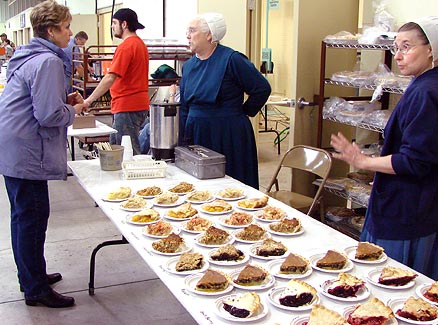 Pie can power a human-powered lifestyle in the way that junky processed crap can’t. Certainly the Amish cookbooks I’ve seen are filled with pies. And back when dessert (or breakfast in New England) was routinely pie, people were a lot thinner. One might argue that pie isn’t what makes you fat – it is not living the pie lifestyle. Because the pie lifestyle means picking berries or walking to the bakery. It means eating pie as a treat, and as the place where you put your special festival foods that you don’t have all the time, while most of you meals are simple.
Instead, for most Americans, breakfasts is false pie - poptarts, which despite a plastic resemblance are not pies at all – because they aren’t actually food. The poptart lifestyle makes you fat, the pie lifestyle makes you thin, or thinner.
 Pie makes you thin. It brings about democracy. It brings about agrarian or relocalized societies and economies. It provides comfort, crossing political lines. People talk about oil as the “master resource” but perhaps we need to start reconsidering the power of pie to create a sustainable, human powered economy. Pie-centered societies, ones that provide a chicken in every pot pie, are what we’re striving for. We can all consume less, and still have an evenly distributed piece of the pie.
Which is why I must say to you with a heavy heart – we are facing peak pie. Corporate interventions, and the “better than homemade” slogan has resulted in a US population that mostly doesn’t know how to cook anymore. Millions of people think that pumpkin comes from a can. Farmers are still going out of business at an appalling rate. The majority of our pie ingredients are contaminated by pesticides. Our ability to provide for our pie needs is deeply threatened. We are facing the final destruction of the pie lifestyle – and the end of the last remnents of our democracy.
 So what can we do about it? How can we fight back for the pie lifestyle, for Mom, Teddy Bears and Apple (or Peach) pie? The only way to deal with this depletion crisis is to start living the pie lifestyle. Bake a pie today from locally grown ingredients. Eat a pie today, and use it to fuel human powered activity – dump your leaf blower and get out a rake, get rid of the power mower and bring out the push mower, lose the chainsaw and get the bucksaw down.
Make a pie and give it to a neighbor. Give out the recipe. Get together and make pies for elderly shut ins or the school bake 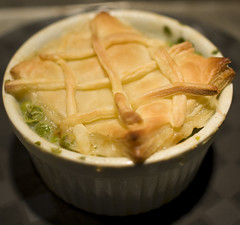 sale or to buy solar lighting for the neighborhood watch. Throw a pie at a warmonger – we’ll have a bake sale to raise your bail. Point to the coal plant builders and the energy wasters and tell people - they are against pie! Start “Pie Eating Veterans for the Truth” and tar polluters and heavy emitters with the scorned label “pie haters.” Don’t forget to mention that they don’t like mothers, babies or kittens either. Have a town meeting and hand out pie. Give out pie at the voting booths, to hungry people in the park, to the shelter and soup kitchen. Try pies from other places, other lands – and send the money you would have spent on poptarts to good causes. When the world seems to suck, eat pie, and use that energy to get back on your feet and fight again.
 Fight now, for motherhood, justice and apple pie!
Shalom,
Sharon
Saturday, December 20, 2008
Vilsack and Obama: Farmer in Chief my Ass! by Sharon Astyk
Once again Sharon Astyk speaks my mind in words that go straight to the heart of the matter. I fervently urge you to spend some time at her blogs (caution - can be habit-forming - also, sometimes very funny, which is to say you maybe should take a pee first so you don't wet yourself - e.g. We're Gonna Need More Pie)
Casaubon's Book - Sharon Astyk
Riot 4 Austerity
Depletion & Abundance
Casaubon's Book - Sharon Astyk
Riot 4 Austerity
Depletion & Abundance
Vilsack and Obama: Farmer in Chief my Ass!
Sharon December 17th, 2008
So Tom Vilsack is going to be Secretary of Agriculture, hmmm… Let’s see, rabid ethanol proponent…check! Enthusiastic supporter of GMOs and biotechnologies…check! Totally indebted to and under the thumb of agribusiness…check! Yup, it seems clear that Obama really took Michael Pollan’s “Farmer in Chief” piece to heart ;-P. Short of actually appointing, say, Monsanto’s chairman, it is hard to imagine a choice less likely to make real shifts in our food system.
But of course, as Rod Dreher points out (quite correctly) and as Carolyn Baker points out (equally correctly), so far there’s very little from the Obama administration that should make us feel secure that what’s coming is going to shift the status quo. Ultimately, Hillary, Geithner and the rest of the crew mostly can be described as people who did things not as badly as George W. Bush and his primary appointees - but that’s hardly saying anything of note.
I was in college when Bill Clinton was elected president, and I was almost alone in my social circle in refusing to volunteer for him - I’d supported a more leftist candidate in the primaries, and despite my acute desire to believe that Clinton would offer some kind of radical change, I couldn’t quite shake the reality of his positions out of my thinking. The same is true of Obama, who, for example, wrote of dealing with the mortgage crisis in terms of the moral hazard of bailing out homeowners - but appears to have few qualms about bailing out banks.
I had precisely the same feeling during this campaign - I preferred Obama quite dramatically to Hillary Clinton, and there were genuinely moments of hopefulness in his campaign. But I kept thinking, riffing on the late, great Molly Ivins, that "you have to dance with them that brung you". That is, Obama couldn’t possibly come to power without indebting himself to people who are more invested in the status quo than in improving lives.
In order to be the president many of us hoped Obama would be, he would have to be willing to betray many of the people who brought him, and their hopes and investments in his future. This is no easy feat for anyone, and is probably less so for someone who came so far, so fast, with the hand of so many. It isn’t impossible - other presidents have done it. The man isn’t even president yet.
But presidents are known by the company they keep - the reality is that no man can supervise all the elements of the nation alone - they depend enormously on those people that Obama is appointing right now. He will not be out in the fields, or at the soup kitchens - he will rely on reports and summaries from those he appoints. And those summaries will be given by men whose viewpoints are already formed. Vilsack cannot but describe our food system through the lens of his prior investments, and this will be disastrous.
In 2002, the Atlantic ran a story by Mark Bowden called “Tales of the Tyrant” - it described what it was like to be a dictator, and imagined how Saddam Hussein’s situation must lead inevitably to his downfall. The deepest reason, Bowden argued, was that everyone lied to the dictator all the time - they couldn’t do anything else.
I’ve thought of that story a number of times in relationship to various presidencies. It is true that our presidents don’t routinely throw advisors who tell unpleasant truths into jail - but even the best of them are surrounded, not so much by people who lie all the time, but by people who tell their truth as though it were “the” truth. To some degree, of course, this is inevitable - everyone’s worldview is shaped by their experiences. But it is possible to bring in a diversity of viewpoints, to find, in multiple versions of the truth, something closer to reality. Obama has overwhelmingly chosen one, very narrow set of viewpoints - the viewpoints of people who have power now, and to whom he is already indebted for his power.
I don’t claim that there is no hope for Obama, but before he chose these people to surround him, there was hope that an ordinary man of integrity, hearing a range of viewpoints, might choose something different. Now, we have to imagine that Obama is an extraordinary man, one with the power to find unconventional paths to knowledge, and the willingness to override the viewpoints he has invested himself in. It gets harder to hope for change.
Sharon
Friday, December 19, 2008
Carbon Sink: CO2 becomes Soil!
Cows have lately been getting a bad reputation as contributing to the destruction of the atmosphere. Feedlot cows do, in fact. Grass-fed cows, on the other hand, can contribute to the removal of CO2 from the atmosphere...and you can help. Read on...
Here are some alternate sources, since CFA is now defunct.
http://carbonfarmingcourse.com/
http://carbonfarminghandbook.blogspot.com/
http://www.carbonfarming.org.nz/
The article is still practically appropriate.
Here are some alternate sources, since CFA is now defunct.
http://carbonfarmingcourse.com/
http://carbonfarminghandbook.blogspot.com/
http://www.carbonfarming.org.nz/
The article is still practically appropriate.
Carbon Farmers of America is a company built around a vision of ecological restoration and hope.
Together, grassfarmers and conscious citizens can effectively grow new topsoil and reverse global warming.
Topsoil has the capacity as a carbon sink to capture the excess carbon in our atmosphere. And our soils desperately need that carbon.
Today, we have the knowledge we need to rapidly create new topsoil over much of the Earth’s surface. Given this knowledge, Carbon Farmers of America offers every American the most responsible choice available: create that topsoil starting today.
The front lines of this historic undertaking are family farmers holistically managing grassland farms and carefully planning the grazing of livestock.
The excess carbon dioxide in our atmosphere causing global warming can be transformed, through photosynthesis by grassland plants and then decay by soil life, into stable soil organic matter.
| Soil organic matter is the key to soil fertility, true economic prosperity, climatic stability, clean and abundant water and vibrant human health. Once created, and under continuing good management, a significant portion of soil organic matter stays in soils for up to a thousand years. If the American people were to restore the soil fertility of the Great Plains that we have destroyed in the last 150 years, atmospheric levels of carbon dioxide would be reduced to near pre-industrial levels. |
Seen globally, the same results would be achieved if we humans were to increase the organic matter levels of the world agricultural and grazing lands by 1.6%.
(See Allan Yeomans, Priority One: Together We Can Beat Global Warming)
As we capture carbon dioxide and create true wealth through soilbuilding we must also radically reduce our emissions of greenhouse gases.
We the people have the power to stop global warming and restore the topsoil that is our truest wealth!
What We Do
Carbon Farmers of America trains, equips, scientifically monitors and provides ongoing support to member farmers across America to rapidly create new, high organic-matter topsoil. We pay our farmer members for every ton of carbon dioxide they capture in new topsoil.
Together, within the next ten years, we aim to create the new topsoil that will feed our descendants, insure clean and abundant waters and stabilize our climate.
Wednesday, December 17, 2008
Sharon Astyk's Prognostications for 2009
 Given that she nailed most of her 2008 predictions, Sharon Astyk's 2009 prognostications are worth paying attention to:
"In previous years, I was fairly lighthearted about my predictions - this year, I don’t find it possible to be. I really hope I’m wrong about this. And I hope you will make decisions based on your own judgement, not mine. These are predictions, the results of my analysis and my intuitions, and sometimes I’m good at that. But I do not claim that every word that comes out of my mouth or off my keyboard is the truth, and you should not take it as such. You are getting this free on the internet - consider what you paid for it, and value it accordingly.
1. Some measure of normalcy will hold out until late spring or early summer, mostly based on hopes for the Obama Presidency. But by late summer 2009, the aggregate loss of jobs, credit and wealth will cause an economic crisis that makes our current situation look pretty mild. With predictions of up to a million jobs lost each month, there will simply come a point at which the economy as we understand it now cannot function - we will see the modern equivalents of breadlines and stockbrokers selling apples on the streets.
2. Many plans for infrastructure investments currently being proposed will never be completed, and many may never be started, because the US may be unable to borrow the money to fund them. The price of globalization will be high in terms of reduced availability of funds and resources - despite all the people who think that we’ll keep building things during a collapse, we won’t. We will have some variation on a Green New Deal in the US and some nations will continue to work on renewable infrastructure, but a lot of us are going to be getting along with the fraying infrastructure, designed for a people able to afford a lot of cheap energy, that we have now. The most successful projects will be small, localized programs that distribute resources as widely as possible.
I pray that we will have the brains to ignore most other things and set up some kind of health care system, one that softens the blows here. If not, we’re really fucked - the one thing most of us can’t afford is medical care as it works now in a non-functioning economy. Unfortunately, my bet is that we don’t do something about this, but I hope to God I’m wrong.
3. 2009 will be the year that most of the most passionate climate activists (and I don’t exclude myself) have to admit that there is simply not a snowball’s chance in hell (and hell is getting toastier quickly) that we are going to prevent a 2C+ warming of the planet. We are simply too little, too late. That does not mean we will give up on everything - the difference between unchecked emissions and checked ones is still the difference between life and death for millions - but hideously, regretfully and painfully, the combination of our growing understanding of where the climate is and the economic situation will force us to begin working from the reality that the world we leave our children is simply going to be more damaged, and our legacy smaller and less worthy of us than we’d ever hoped.
4. 2008 will probably be the world’s global oil peak, but we won’t know this for a while. When we do realize it, it will be anticlimactic, because we’ll be mired in the consequences of our economic, energy and climate crisis. Lack of investment in the coming years will mean that in the end, more oil stays in the ground, which is good for the climate, but tough for our ambitions for a renewable energy economy. Over the long term, however, peak oil is very much going to come back and bite us all in the collective ass.
5. Decreased access to goods, services and food will be a reality this year. Some of this will be due to stores going out of business - we may all have to travel further to meet needs. Some will be due to suppliers going under, following the wave of merchant bankruptcies. Some may be due to disruptions in shipping and transport of supplies. Some will be due to increased demand for some items that have, up until now, been niche items, produced in small numbers for the small number of sustainability freaks, but that now seem to have widespread application. And some may be due to deflation - farmers may not be able to harvest crops because they can’t get enough for them to pay for the harvest, and the connections between those who have goods and those who need goods may be thoroughly disrupted. Meanwhile, millions more Americans will be choosing between new shoes and seeing the doctor.
6. Most Americans will see radical cut backs in local services and safety nets. Funding will simply dry up for many state and local programs. Unemployment will be overwhelmed, and the federal government will have to withdraw some of its commitments simply to keep people from starving in the streets. Meanwhile, expect to see the plows stop plowing, the garbage cease to be collected, and classrooms to have 40+ kindergarteners to a class - and potentially a three or four day school week.
7. Nations will overwhelmingly fail to pony up promised commitments to the world’s poor, and worldwide, the people who did the least harm to the environment will die increasingly rapidly of starvation. This will not be inevitable, but people in the rich world will claim it is.
8. We will finally attempt to deal with foreclosures, but the falling value of housing will make it a losing proposition. Every time we bring the housing values down to meet the reality, the reality will shift under our feet. Many of those who are helped will end up foreclosed upon anyway (as is already the case) and others will simply see no point in paying their mortgage when, by defaulting, they could qualify for lowered payments (as is already the case). Ultimately, the issue will probably self resolve in either some kind of redistribution plan that puts people in foreclosed houses with minimal mortgaging, with foreclosures dragging down enough banks that people find it feasible to simply stop paying mortgages that are now unenforceable, or with civil unrest that leads people simply to take back housing for the populace. I don’t have a bet on which one, and I don’t think it will be resolved in 2009.
9. By the end of the year, whether or not we will collapse or have collapsed will continue to be hotly debated by everyone who can still afford their internet service. No one will agree on what the definition of collapse actually is, plenty of people will simply be living their old lives, only with a bit less, while others will be having truly apocalyptic and deeply tragic losses. Some will see the victims as lazy, stupid, alien and worthless, no matter how many there are. Others will look around them and ask “how did I not see that this was inevitable?” Many people will be forced to see that the poor are not a monolith of laziness and selfishness when they become poor. We will know that we are in our situation only in retrospect, only in hindsight - our children will have a better name for the experience than we will, caught up in our varied personal senses of what is happening Meanwhile, each time things get harder most of us will believe they are at the bottom, that things are now “normal” and adapt, until it becomes hard to remember what our old expectations were.
10. Despite how awful this is, the reality is that not everything will fall apart. In the US, we will find life hard and stressful, but we will also go forward. People will suck a lot up and retrench. It will turn out that ordinary people were always better than commentators at figuring out what to do - that’s why they stopped shopping even while people were begging them to keep buying. So they’ll move in with their siblings and grow gardens and walk away from their overpriced houses, or fight to keep them. Some of them will suffer badly for it, but a surprising number of people will simply be ok in situations that until now, they would have imagined were impossible to survive. We will endure, sometimes even find ways of loving our new lives. There will be acts of remarkable courage and heroism, and acts of the most profound evil and selfishness. There will be enormous losses - but we will also discover that most of us are more than we think we are - can tolerate more and have more courage and compassion than we believe of ourselves.
An early Happy New Year, everyone. May you know better than you deserve and see others at their best in these hard times."
Consume this Movie....While Supplies Last!
Are Americans too materialistic? Are we willfully trashing the planetary ecology in order to serve the desires and drives of the ego? And what, or who could be driving this powerful force of seduction? Consume This Movie takes a critical look at social injustice, peak oil, resource depletion and our deep need to feel connected to each other through what we choose to consume. This 80 minute documentary also examines the frenzied pace of fast-lane materialism that is beggining to burn us out. We Americans are just now beginning to yearn for a simpler life, but is it too late? Have we set in motion a runaway train that threatens to undermine the ecological, social and spiritual cornerstones that make the pursuit of happiness possible in the first place? Walk, don't drive to see this powerful documentary film, while supplies last!
Woven into this exploration are interviews with Dr. Peter Whybrow, American Mania, Juliet B. Schor, The Overspent American, simplicity guru’s Cecile Andrews and Duane Elgin, photographic artist Chris Jordan, advertising expert James. B. Twitchell and Post Carbon Institutes Julian Darley among others.
Woven into this exploration are interviews with Dr. Peter Whybrow, American Mania, Juliet B. Schor, The Overspent American, simplicity guru’s Cecile Andrews and Duane Elgin, photographic artist Chris Jordan, advertising expert James. B. Twitchell and Post Carbon Institutes Julian Darley among others.
Subscribe to:
Posts (Atom)